Dimensional Weight
Dimensional weight (also called volumetric weight or DIM weight) is a pricing concept that reflects the amount of space a shipment occupies relative to its actual physical weight. Airlines and express carriers have limited cargo hold volume and limited payload capacity — both are finite resources. A shipment of styrofoam packing peanuts, for example, might weigh very little but consume enormous space that could otherwise carry denser, heavier cargo.
To ensure fair compensation for space consumed, carriers apply dimensional weight calculations. The shipment is charged based on whichever is greater: the actual gross weight or the dimensional weight. This mechanism is fundamental to air freight pricing and directly impacts shipping costs for any business moving cargo by air.
What is Dimensional Weight
Dimensional weight converts a package's physical volume into an equivalent weight figure. The concept recognizes that an aircraft's cargo capacity is constrained by two factors simultaneously:
- Weight capacity — The maximum payload an aircraft can carry, limited by structural design, fuel load, and runway length
- Volume capacity — The total cubic space available in the cargo hold(s)
If carriers charged only by actual weight, a shipper sending lightweight but bulky goods would pay very little while consuming a disproportionate share of available space. Dimensional weight corrects this imbalance.
Dimensional weight is the theoretical weight of a package calculated from its dimensions, using a standard conversion factor. When dimensional weight exceeds actual weight, the shipment is said to be "volumetric" or "cubing out" — the shipper pays for space rather than mass.
The opposite scenario — where actual weight exceeds dimensional weight — is called "weighing out." Dense cargo like metal parts, liquids, or machinery typically weighs out, meaning the shipper pays based on actual gross weight.
How to Calculate Dimensional Weight
The standard formula used across the air freight industry is:
Metric Formula (cm / kg)
Dimensional Weight (kg) = (Length × Width × Height in cm) ÷ 6,000
Imperial Formula (in / lb)
Dimensional Weight (lb) = (Length × Width × Height in inches) ÷ 166
The 6,000 cm³/kg divisor (or equivalently 166 in³/lb or 366 in³/kg) is the IATA standard dimensional factor for air freight. It represents the volume-to-weight ratio at which cargo is considered to be of "average" density.
Worked Examples
Example 1: Lightweight electronics shipment
A carton measures 60 cm × 40 cm × 50 cm and weighs 15 kg.
| Step | Calculation | Result |
|---|---|---|
| Volume | 60 × 40 × 50 | 120,000 cm³ |
| Dimensional weight | 120,000 ÷ 6,000 | 20.0 kg |
| Actual weight | — | 15.0 kg |
| Chargeable weight | Greater of 20.0 vs 15.0 | 20.0 kg |
The shipment cubes out — the shipper pays for 20 kg even though the carton only weighs 15 kg.
Example 2: Dense auto parts shipment
A carton measures 40 cm × 30 cm × 25 cm and weighs 28 kg.
| Step | Calculation | Result |
|---|---|---|
| Volume | 40 × 30 × 25 | 30,000 cm³ |
| Dimensional weight | 30,000 ÷ 6,000 | 5.0 kg |
| Actual weight | — | 28.0 kg |
| Chargeable weight | Greater of 5.0 vs 28.0 | 28.0 kg |
The shipment weighs out — the shipper pays for the actual 28 kg because the cargo is dense relative to its size.
Example 3: Multi-piece shipment (5 identical cartons)
Each carton: 50 cm × 40 cm × 35 cm, weighing 8 kg.
| Step | Calculation | Result |
|---|---|---|
| Volume per piece | 50 × 40 × 35 | 70,000 cm³ |
| Total volume (5 pcs) | 70,000 × 5 | 350,000 cm³ |
| Total dimensional weight | 350,000 ÷ 6,000 | 58.3 kg |
| Total actual weight | 8 × 5 | 40.0 kg |
| Chargeable weight | Greater of 58.3 vs 40.0 | 58.3 kg |
For air freight, dimensional weight is typically calculated on the total shipment (sum of all piece volumes), not per individual piece. However, some express carriers calculate per piece and sum the results. Always confirm the method with your carrier.
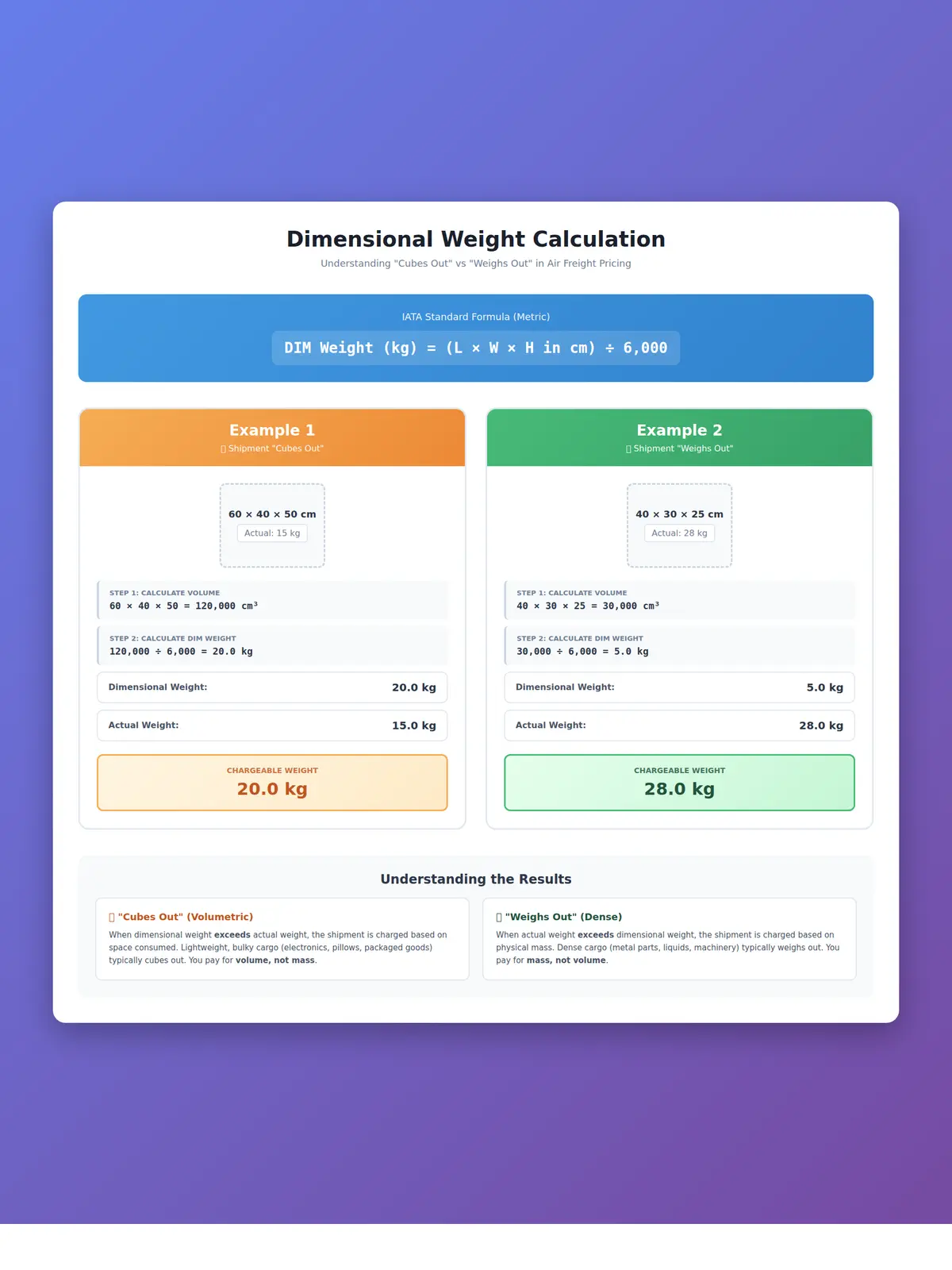 Side-by-side comparison of "cubes out" vs "weighs out" scenarios. The shipment on the left (lightweight, bulky) is charged based on dimensional weight, while the shipment on the right (dense, compact) is charged based on actual weight.
Chargeable Weight
Chargeable weight is the weight figure used to calculate the freight charge. It is always the greater of actual gross weight or dimensional weight.
Pivot Ratio
The pivot ratio (also called the volume-weight ratio) is the threshold at which a shipment transitions from weighing out to cubing out. For the standard 6,000 divisor:
- Pivot ratio: 1 kg per 6,000 cm³ (or approximately 167 kg per cubic meter)
- Cargo denser than 167 kg/m³ → weighs out (pays on actual weight)
- Cargo lighter than 167 kg/m³ → cubes out (pays on dimensional weight)
| Cargo Type | Typical Density | Likely Result |
|---|---|---|
| Steel parts, machinery | 500–2,000 kg/m³ | Weighs out |
| Canned food, beverages | 300–600 kg/m³ | Weighs out |
| Clothing, textiles | 80–150 kg/m³ | Cubes out |
| Electronics (boxed) | 100–200 kg/m³ | Borderline |
| Pharmaceuticals | 50–200 kg/m³ | Often cubes out |
| Styrofoam, cushions | 10–30 kg/m³ | Severely cubes out |
Optimizing for Dimensional Weight
Since volumetric shipments cost more per actual kilogram, reducing dimensional weight directly reduces freight costs. Several practical strategies apply:
1. Right-Size Packaging
The most impactful optimization is eliminating excess space inside cartons. Every centimeter of void fill adds to dimensional weight without protecting the product further.
- Use carton sizes matched to product dimensions (avoid one-size-fits-all boxes)
- Reduce internal cushioning to the minimum required for protection
- Consider vacuum-packing or compression for soft goods
2. Stack and Nest Products
Products that can be nested (e.g., bowls stacked inside each other) or disassembled (e.g., furniture with legs removed) ship at dramatically lower dimensional weights.
3. Consolidate Shipments
Working with a freight forwarder to consolidate multiple small shipments into a single ULD can improve the overall weight-to-volume ratio. Dense cargo can be combined with voluminous cargo in the same unit.
4. Negotiate DIM Factors
For high-volume shippers with consistent volumetric profiles, some carriers will negotiate a higher divisor (e.g., 7,000 or 8,000 instead of 6,000), which reduces the calculated dimensional weight. This is common in express parcel contracts.
5. Consider Mode Switching
For extremely volumetric cargo where air freight costs become prohibitive, consider whether ocean freight or trucking might be viable alternatives. Ocean freight uses a more favorable 1:1,000 kg/m³ ratio (1 CBM = 1 metric ton for pricing).
Dimensional Weight Across Carriers and Modes
The DIM factor is not universal — it varies by carrier, service level, and transport mode:
| Carrier / Mode | DIM Factor (cm³/kg) | DIM Factor (in³/lb) | Notes |
|---|---|---|---|
| IATA Standard (Air Freight) | 6,000 | 166 | Industry default for general air cargo |
| Express carriers (FedEx, UPS, DHL) | 5,000 | 139 | More aggressive — charges more for volume |
| Express (negotiated) | 6,000–8,000 | 166–222 | Available for high-volume contract customers |
| Ocean Freight (FCL) | N/A | N/A | Charged by container, not weight/volume |
| Ocean Freight (LCL) | 1,000,000 (1 CBM = 1 MT) | — | 1 revenue ton = 1 m³ or 1,000 kg |
| Trucking (LTL) | Varies by freight class | — | Uses density-based NMFC classification |
Express carriers (FedEx, UPS, DHL) typically use a 5,000 cm³/kg divisor — more aggressive than the IATA standard 6,000. This means the same package will have a higher dimensional weight (and potentially a higher charge) with an express carrier than with a general air freight carrier. Always calculate both when comparing quotes.
Impact on Rate Comparisons
When comparing air freight quotes from different providers, ensure you understand which DIM factor each carrier applies. A carrier quoting a lower per-kilogram rate but using a 5,000 divisor may end up more expensive than a higher per-kg rate with a 6,000 divisor for volumetric cargo.
| Scenario | Carrier A (Rate: $3/kg, DIM: 5,000) | Carrier B (Rate: $3.50/kg, DIM: 6,000) |
|---|---|---|
| Package: 60×40×50 cm, 15 kg actual | DIM: 24 kg → $72 | DIM: 20 kg → $70 |
| Package: 40×30×25 cm, 28 kg actual | Actual: 28 kg → $84 | Actual: 28 kg → $98 |
In the first case (volumetric cargo), Carrier B is cheaper despite the higher rate. In the second case (dense cargo), Carrier A is cheaper. The right choice depends on the cargo profile.
Resources
| Resource | Description | Link |
|---|---|---|
| IATA TACT Rules (The Air Cargo Tariff) | Official IATA tariff rules including chargeable weight calculations | iata.org/tact |
| Maersk Air Cargo Weight Guide | Clear explanation of chargeable weight with worked examples | maersk.com |
| FedEx Dimensional Weight Calculator | Online tool to calculate FedEx dimensional weight for express shipments | fedex.com/dimweight |
| UPS Dimensional Weight Information | UPS-specific DIM factors and calculation guide | ups.com |
| DHL Volumetric Weight Guide | DHL Express volumetric weight calculation and optimization tips | dhl.com |
Related Topics
- Air Waybill — Chargeable weight appears on the AWB and determines the freight charge
- ULD Types — How cargo dimensions affect ULD selection and utilization
- Ocean Freight Rates — How ocean freight uses different volume-weight calculations
- Freight Classes — How trucking uses density-based classification instead of DIM factors
- Consolidation — How combining shipments can optimize the weight-volume ratio
- Rate Shopping — How DIM weight affects parcel carrier comparisons