Dangerous Goods in Air Freight
Dangerous goods (also called hazardous materials or "hazmat") are substances and articles that pose a risk to health, safety, property, or the environment during air transport. The IATA Dangerous Goods Regulations (DGR) — currently in its 67th Edition (effective January 1, 2026) — is the globally recognized standard for classifying, packaging, marking, labeling, and documenting these shipments. Every airline requires compliance with the DGR as a condition of carriage.
The IATA DGR is based on the ICAO Technical Instructions for the Safe Transport of Dangerous Goods by Air, which in turn derives from the UN Recommendations on the Transport of Dangerous Goods (Model Regulations). This layered framework ensures consistency across all transport modes while imposing additional restrictions specific to the unique risks of air transport — cabin pressurization, temperature extremes, vibration, and the impossibility of stopping mid-flight.
Shipping undeclared or improperly packaged dangerous goods by air is a criminal offense in most jurisdictions. Fines can exceed $500,000, and incidents endanger aircraft, crew, and passengers. Always verify compliance before tendering hazmat shipments.
The Nine Hazard Classes
The UN classification system divides dangerous goods into nine hazard classes, several with subdivisions. Each class corresponds to a specific type of hazard and carries its own packaging, labeling, and handling requirements.
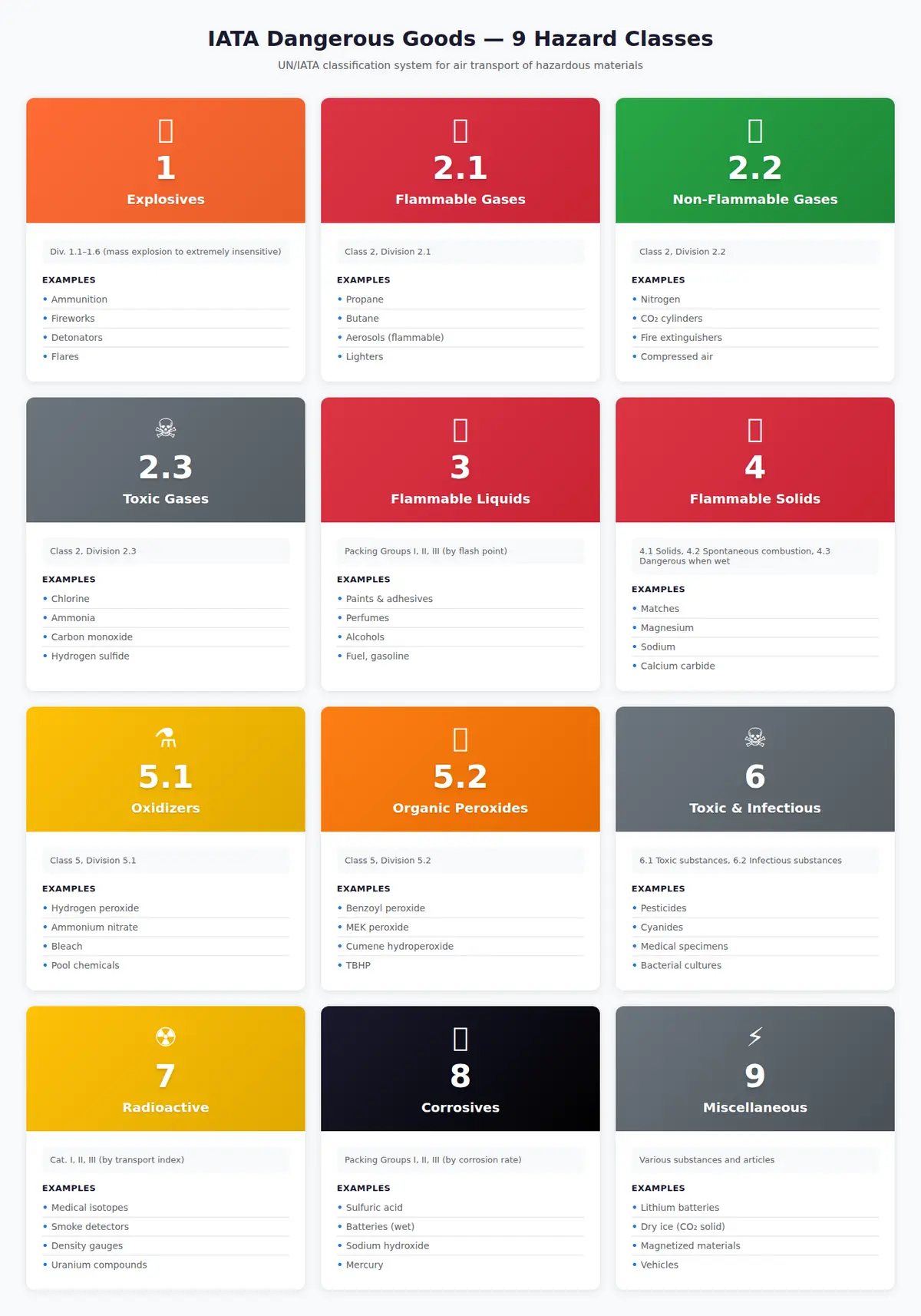
| Class | Name | Divisions | Examples |
|---|---|---|---|
| 1 | Explosives | 1.1–1.6 | Ammunition, fireworks, detonators, flares |
| 2 | Gases | 2.1 Flammable, 2.2 Non-flammable/non-toxic, 2.3 Toxic | Propane, CO₂, nitrogen, aerosols, fire extinguishers |
| 3 | Flammable Liquids | — | Paints, adhesives, perfumes, fuel, alcohols |
| 4 | Flammable Solids | 4.1 Flammable solids, 4.2 Spontaneously combustible, 4.3 Dangerous when wet | Matches, magnesium, sodium, calcium carbide |
| 5 | Oxidizers & Organic Peroxides | 5.1 Oxidizers, 5.2 Organic peroxides | Hydrogen peroxide, ammonium nitrate, bleach |
| 6 | Toxic & Infectious Substances | 6.1 Toxic, 6.2 Infectious | Pesticides, cyanides, medical specimens, cultures |
| 7 | Radioactive Materials | I, II, III (transport index) | Medical isotopes, smoke detectors, density gauges |
| 8 | Corrosives | — | Batteries (acid), sulfuric acid, sodium hydroxide, mercury |
| 9 | Miscellaneous | — | Lithium batteries, dry ice, magnetized materials, vehicles |
Classes 3–6 and 8 are further classified into Packing Groups that indicate the degree of danger:
- Packing Group I — Great danger
- Packing Group II — Medium danger
- Packing Group III — Minor danger
The packing group determines the performance level required for UN-specification packaging.
Subsidiary Risks
Many substances present more than one hazard. A subsidiary risk (or secondary hazard) requires additional labeling. For example, a flammable liquid that is also toxic must carry both a Class 3 label and a Class 6.1 subsidiary risk label.
Packaging and Labeling Requirements
Proper packaging is the primary defense against dangerous goods incidents in air transport. The DGR mandates UN-specification packaging (also called Performance Oriented Packaging or POP) for most dangerous goods.
UN Packaging Standards
UN-specification packaging is tested to withstand the conditions of air transport:
| Test | Purpose | Applies To |
|---|---|---|
| Drop test | Simulates handling impacts (1.2m for PG I, 1.0m for PG II, 0.8m for PG III) | All UN packaging |
| Stacking test | Simulates weight of stacked cargo | Drums, boxes, jerricans |
| Leakproofness test | Verifies liquid containers don't leak under pressure | Liquid packaging |
| Hydrostatic pressure test | Tests internal pressure resistance | Metal/plastic drums for liquids |
| Vibration test | Simulates transport vibration | Combination packaging |
Each approved package bears a UN marking that encodes its specifications:
UN 4G/Y30/S/25/USA/+AA0001
│   │  │  │  │   │     └── Manufacturer code
│   │  │  │  │   └── Country of authorization
│   │  │  │  └── Year of manufacture
│   │  │  └── Solid (S) or Liquid (L)
│   │  └── Max gross weight (kg)
│   └── Packing group (X=I, Y=II, Z=III)
└── Packaging type (4G = fibreboard box)
Labeling Requirements
Every dangerous goods package must display:
- Hazard class label(s) — diamond-shaped labels (minimum 100mm × 100mm) indicating primary and subsidiary hazards
- UN number — preceded by "UN" (e.g., UN1203 for gasoline)
- Proper Shipping Name — the standardized name from the DGR (e.g., "Flammable liquid, n.o.s.")
- Handling labels — orientation arrows for liquids, "Cargo Aircraft Only" where applicable
- Shipper and consignee information — name and address on the same surface as the hazard label
Overpack Marking
When multiple packages are placed inside an outer container (an overpack), the overpack must be marked with the word "OVERPACK" and display all labels and markings visible from the outside, unless the inner packages' markings are already visible.
The Shipper's Declaration for Dangerous Goods
The Shipper's Declaration for Dangerous Goods (DGD) is a mandatory document for most dangerous goods shipments by air. It certifies that the shipper has properly classified, packaged, marked, and labeled the shipment in accordance with the DGR.
Key Information on the DGD
The declaration must include:
- Shipper and consignee details
- Air waybill number
- Aircraft type restriction (Passenger & Cargo Aircraft, or Cargo Aircraft Only)
- UN number, Proper Shipping Name, hazard class, and packing group
- Quantity and type of packaging
- Packing instruction reference
- Authorization details (if special permission was granted)
- Signed certification by the shipper that the shipment complies with IATA DGR
Many freight forwarders employ certified DG specialists who hold IATA DG Category 1 (shippers) or Category 6 (freight forwarders) certification. These professionals prepare and verify dangerous goods documentation, reducing the risk of rejection at acceptance.
Shipper and Carrier Responsibilities
Shipper Obligations
The shipper bears primary responsibility for dangerous goods compliance:
- Classify the substance correctly using DGR criteria
- Package in UN-specification packaging appropriate to the hazard
- Mark and label all packages with required information
- Complete documentation — Shipper's Declaration and AWB handling information
- Train personnel — anyone involved in preparing DG shipments must hold current IATA DG training
- Provide emergency information — 24-hour emergency contact for the shipment
Carrier Obligations
Airlines and their ground handling agents must:
- Perform acceptance checks — verify documentation completeness, inspect packages for damage and correct labeling, confirm quantities against the declaration
- Apply loading restrictions — segregation rules prevent incompatible classes from being loaded together; some items require specific aircraft positions
- Notify the pilot-in-command — the NOTOC (Notification to Captain) must list all dangerous goods aboard, their location, and emergency procedures
- Report incidents — any dangerous goods accident or incident must be reported to the relevant civil aviation authority
Restricted and Forbidden Articles
The DGR distinguishes three categories of restriction:
| Category | Description | Examples |
|---|---|---|
| Forbidden on all aircraft | Cannot be transported by air under any circumstances | Explosives (Div. 1.1, 1.2, 1.3 except small quantities), toxic gases, infectious substances not in compliance |
| Forbidden on passenger aircraft | Allowed on cargo-only aircraft | Many Class 1 items, large lithium batteries, certain toxics and corrosives |
| Permitted with conditions | Allowed on both aircraft types with specific packaging/quantity limits | Small lithium batteries, dry ice (≤200 kg), aerosols, limited/excepted quantities |
Special Provisions and Exemptions
- Limited Quantities — small amounts of certain dangerous goods in consumer-type packaging may ship with reduced requirements
- Excepted Quantities — very small amounts (milliliters/grams) may be exempt from most DGR requirements when properly packaged
- Operator Variations — individual airlines may impose stricter limits or refuse certain goods entirely (published as "Operator Variations" in the DGR)
- State Variations — countries may impose additional restrictions beyond ICAO standards
Lithium Batteries — A Special Focus
Lithium batteries (Class 9, UN3480/UN3481 for lithium-ion; UN3090/UN3091 for lithium metal) are the most frequently shipped dangerous good by air and the most common cause of DG-related incidents.
Key Regulations (2026 DGR, 67th Edition)
| Configuration | Packing Instruction | Aircraft Restriction | State of Charge |
|---|---|---|---|
| Li-ion batteries alone (Section I) | PI 965 | Cargo Aircraft Only | ≤ 30% SOC |
| Li-ion batteries alone (Section II) | PI 965 | Passenger & Cargo | ≤ 30% SOC |
| Li-ion packed with equipment | PI 966 | Passenger & Cargo | No restriction |
| Li-ion contained in equipment | PI 967 | Passenger & Cargo | No restriction |
| Li-metal batteries alone | PI 968 | Cargo Aircraft Only | N/A |
| Li-metal packed with equipment | PI 969 | Passenger & Cargo | N/A |
| Li-metal contained in equipment | PI 970 | Passenger & Cargo | N/A |
Starting January 1, 2026, standalone lithium-ion batteries shipped under Section I (PI 965) and Section II must be offered at a state of charge not exceeding 30% of rated capacity, or an indicated battery capacity not exceeding 25%. This applies to all standalone battery shipments.
The BATTERY mark (introduced in the DGR 67th Edition) is now required on packages containing lithium batteries prepared under Section II of the applicable packing instruction, replacing the previous lithium battery handling label.
Training Requirements
The IATA DGR mandates that all personnel involved in the air transport of dangerous goods must receive initial and recurrent training (every 24 months). Training categories include:
| Category | Personnel | Scope |
|---|---|---|
| 1 | Shippers/packers | Classification, packaging, marking, labeling, documentation |
| 3 | Operators handling DG | Acceptance, storage, loading procedures |
| 6 | Freight forwarders | Acceptance, storage, DGD verification |
| 10 | Security staff | Recognition of undeclared DG |
| 12 | Flight crew | Emergency procedures, NOTOC interpretation |
Training must be specific to the individual's function and include both general awareness and function-specific components, with assessment to confirm competency.
Resources
| Resource | Description | Link |
|---|---|---|
| IATA Dangerous Goods Regulations | The definitive manual for shipping hazardous materials by air (67th Edition, 2026) | iata.org/dgr |
| IATA Lithium Battery Guidance | Official guidance document for shipping lithium and sodium-ion batteries | iata.org/lithium-batteries |
| FAA Hazmat — How to Ship | U.S. FAA guide to packaging and shipping dangerous goods by air | faa.gov/hazmat |
| UN Transport of Dangerous Goods | The underlying UN Model Regulations that form the basis for IATA DGR | unece.org/transportdangerous-goods |
| TSA Cargo Screening Program | U.S. TSA requirements for screening air cargo, including dangerous goods | tsa.gov/cargo-screening |
Related Topics
- Air Waybill — the AWB must include dangerous goods handling information and reference the Shipper's Declaration
- ULD Types — certain dangerous goods have specific ULD loading restrictions and segregation requirements
- Airport Operations — dangerous goods acceptance is a critical step in cargo terminal operations
- Import/Export Documentation — dangerous goods require additional customs and regulatory documentation