Consolidation (LCL/Groupage)
Consolidation is the practice of combining shipments from multiple shippers into a single container or unit load for transport. This approach allows smaller shipments to share transportation costs, making international shipping more accessible and cost-effective for businesses that do not have enough cargo to fill an entire container or aircraft unit.
Consolidation services are typically provided by freight forwarders or NVOCCs (Non-Vessel Operating Common Carriers), who aggregate cargo at origin, book space with carriers, issue individual shipment documents, and deconsolidate cargo at destination for final delivery.
Freight consolidation is the process of combining multiple smaller shipments (from different shippers) into a single larger unit (container, truck, or air pallet) to achieve economies of scale and reduce per-unit shipping costs.
What is Consolidation
Consolidation transforms multiple small shipments into one large shipment, distributing the cost of transportation across all participants.
How Consolidation Works
The consolidator's role:
- Collect cargo from multiple shippers at origin (or receive it at a consolidation warehouse)
- Pack cargo efficiently into a container (ocean) or onto pallets/ULDs (air)
- Issue individual transport documents — each shipper receives a House Bill of Lading (HBL) or House Air Waybill (HAWB)
- Book space with the carrier under a single Master Bill of Lading (MBL) or Master Air Waybill (MAWB)
- Deconsolidate at destination, separating shipments for individual consignees
- Arrange final delivery to each consignee
Consolidation vs. Direct Shipment
| Characteristic | Consolidated Shipment (LCL/Groupage) | Direct Shipment (FCL/Dedicated) |
|---|---|---|
| Cargo Volume | Small volumes (typically < 10-15 CBM ocean, < 1,000 kg air) | Full container (20ft/40ft) or exclusive aircraft space |
| Cost Structure | Pay only for space used (per CBM or kg) | Pay for entire container/dedicated space, regardless of utilization |
| Transit Time | Longer (due to consolidation/deconsolidation time) | Faster (direct routing) |
| Handling | More handling points (CFS at origin/destination) | Fewer handling points (often door-to-door) |
| Flexibility | Ship smaller quantities more frequently | Requires enough cargo to justify full load |
| Ideal For | Low-volume importers, sample shipments, SMBs, trial orders | High-volume shippers, regular production runs |
Use LCL/groupage when your cargo occupies less than 50-60% of a container (ocean) or pallet (air). Beyond this threshold, the cost of a full container or dedicated air shipment often becomes competitive with or cheaper than the consolidated rate.
LCL (Less Than Container Load)
LCL (Less Than Container Load) is the ocean freight consolidation method, where multiple shippers' cargo shares space in a single container.
LCL Workflow
LCL Pricing Structure
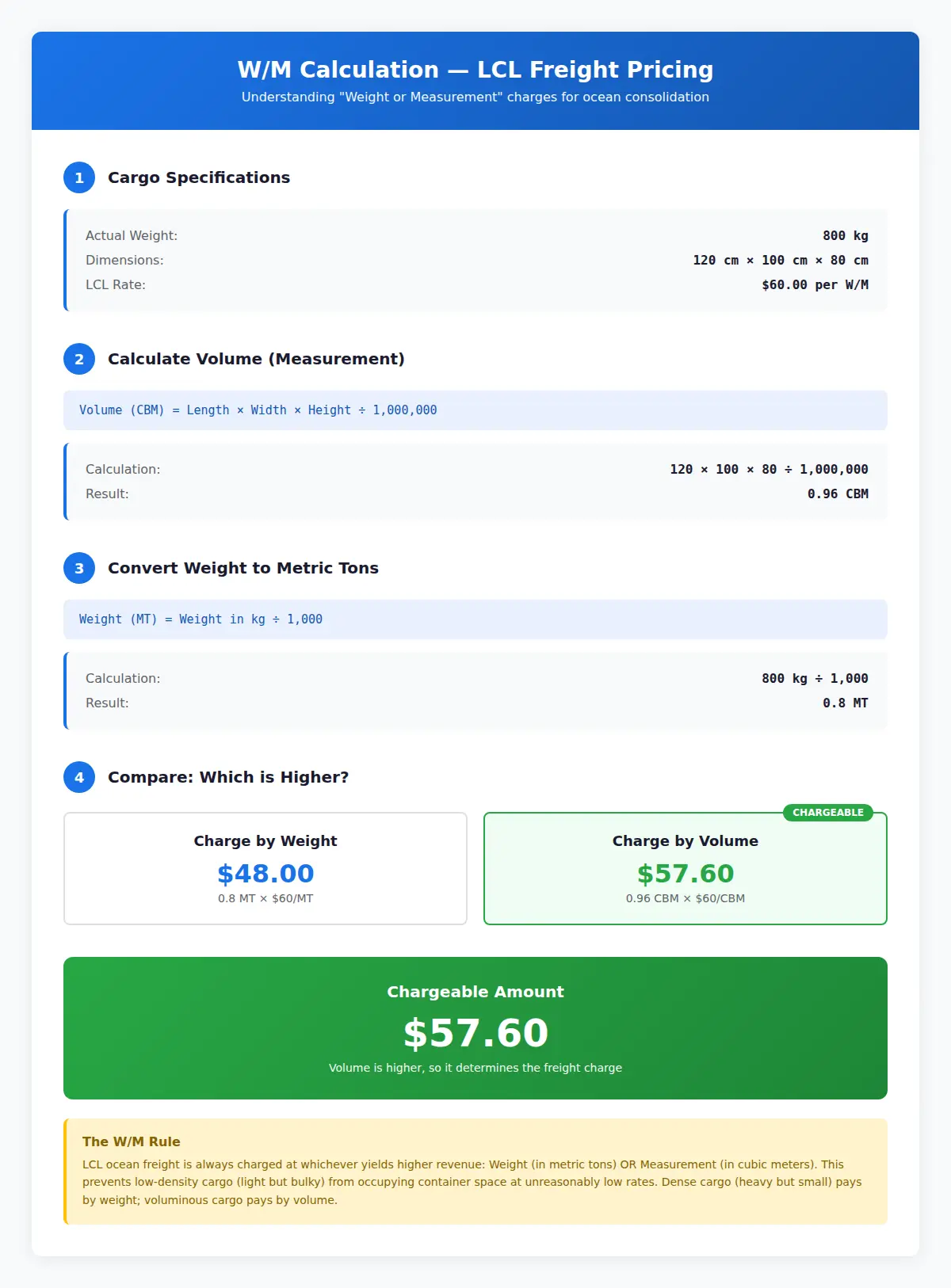
LCL freight is charged based on W/M (Weight or Measurement), whichever yields a higher revenue for the carrier:
- Weight (W) — charged per metric ton (1,000 kg)
- Measurement (M) — charged per cubic meter (CBM)
Calculation example:
Cargo: 800 kg, dimensions 120cm × 100cm × 80cm
- Volume: (1.2m × 1.0m × 0.8m) = 0.96 CBM
- Weight in tons: 800 kg = 0.8 metric tons
If LCL rate is $60 per W/M:
- Charge by weight: 0.8 MT × $60 = $48
- Charge by volume: 0.96 CBM × $60 = $57.60
Chargeable amount: $57.60 (volume is higher)
LCL Rate Components
| Charge Type | Description | Typical Range |
|---|---|---|
| Ocean Freight (per CBM or W/M) | Base transport cost from origin port to destination port | $30-$120 per CBM (varies by lane, season) |
| Origin CFS Charges | Receiving, handling, consolidation at origin | $25-$50 per CBM |
| Destination CFS Charges | Deconsolidation, handling, storage at destination | $30-$60 per CBM |
| Documentation Fee | B/L issuance, customs filing | $25-$75 per shipment |
| Minimum Charge | Applied to very small shipments | Often 1 CBM minimum |
| Overweight Surcharge | High-density cargo (e.g., > 1,000 kg/CBM) | Additional $10-$30 per MT |
Total LCL cost = Ocean freight + Origin CFS + Destination CFS + Documentation + any surcharges
Destination CFS free time is typically 5-7 days from cargo availability. After that, daily storage fees apply ($5-$15 per CBM/day). Plan pickup or delivery promptly to avoid demurrage.
LCL Service Schedules
NVOCCs and large forwarders operate fixed weekly consolidations on popular lanes:
- Major trade routes (China → US West Coast, Europe → US East Coast, Asia → Europe): Weekly or twice-weekly departures
- Secondary lanes (Southeast Asia → Australia, Latin America → Europe): Weekly to bi-weekly
- Less common lanes: May be 2-4 weeks between consolidations
Transit time for LCL is typically 3-7 days longer than FCL on the same route due to:
- Cargo aggregation time at origin CFS (2-5 days)
- Deconsolidation time at destination CFS (1-3 days)
LCL Cargo Packing Best Practices
Since LCL cargo shares container space with others:
- Palletize whenever possible — reduces damage risk, simplifies handling
- Use shrink wrap or strapping — prevents cartons from shifting
- Label clearly — all sides of packages with shipper/consignee info and handling marks
- Avoid loose cartons — always on pallets or secured as a unit
- Fragile goods — use crating or additional protective packaging
Groupage in Air Freight
Groupage (also called "consolidation" or "groupage service") is the air freight equivalent of LCL, where smaller air shipments from multiple shippers are combined under a single Master Air Waybill (MAWB).
Air Freight Consolidation Process
Air freight consolidators (often freight forwarders with IATA accreditation) aggregate cargo and issue:
- House Air Waybill (HAWB) — individual AWB for each shipper's cargo (e.g., HAWB 001-12345678-001)
- Master Air Waybill (MAWB) — consolidator's AWB covering the entire pallet/ULD sent to the airline (e.g., MAWB 074-12345678)
Process:
Groupage Pricing
Air cargo consolidation rates are typically 15-30% cheaper than direct airline rates for small shipments, because:
- Consolidators buy space in bulk from airlines at discounted rates
- They aggregate volume across many customers, negotiating better contracts
Typical groupage rate structure:
- Per kilogram charge with minimum charge (e.g., $4.50/kg, minimum 45 kg)
- Break points for volume discounts (100+ kg, 300+ kg, 500+ kg, 1000+ kg rates)
- Dimensional weight rules still apply (1 CBM = 167 kg)
Comparison example:
| Shipment Weight | Direct Airline Rate | Groupage Rate | Savings |
|---|---|---|---|
| 50 kg | $6.00/kg = $300 | $4.50/kg = $225 | $75 (25%) |
| 150 kg | $5.50/kg = $825 | $4.00/kg = $600 | $225 (27%) |
| 500 kg | $4.80/kg = $2,400 | $3.50/kg = $1,750 | $650 (27%) |
Groupage adds 1-3 days to direct air transit due to consolidation and deconsolidation time. For urgent shipments, consider direct airline booking (deferred or express services).
When Groupage Makes Sense
Choose groupage for:
- Small shipments (< 500 kg) where direct airline rates are prohibitive
- Non-urgent cargo where 1-2 extra days are acceptable
- Regular low-volume lanes where you ship the same route frequently in small batches
Choose direct airline booking for:
- Time-sensitive shipments requiring fastest possible delivery
- Very large shipments (> 1,000 kg) where bulk rates apply and consolidation savings diminish
- High-value cargo where minimizing handling touchpoints reduces risk
Consolidation Warehouses and CFS
Consolidation depends on physical facilities where cargo is aggregated, packed, and later deconsolidated.
Container Freight Station (CFS)
A CFS (Container Freight Station) is a warehouse facility, typically located near a port or airport, where LCL/groupage cargo is:
- Received from shippers or feeder trucking
- Inspected and measured to verify weight/dimensions (for W/M calculation)
- Stored temporarily until a consolidation is ready
- Packed into containers (ocean) or onto pallets/ULDs (air)
- Dispatched to the carrier's terminal
- Deconsolidated upon arrival at destination (unpacking containers/pallets)
- Stored until consignee pickup or final delivery is arranged
CFS Operations Workflow
| Stage | Activity | Purpose |
|---|---|---|
| Inbound | Cargo arrives via truck or drop-off; receipt issued | Acknowledge custody transfer |
| Inspection | Visual check for damage, count packages, verify dimensions and weight | Verify against booking details; calculate W/M charges |
| Labeling | Apply CFS labels or consolidation identifiers | Track cargo within facility |
| Staging | Store in designated area until consolidation departure | Organize by sailing/flight and destination |
| Stuffing/Build-up | Pack container (ocean) or build pallet (air) with multiple shipments | Maximize space utilization, secure cargo |
| Documentation | Prepare container load plan, seal container, issue MBL/MAWB | Provide manifest to carrier, issue HBLs/HAWBs to shippers |
| Dispatch | Truck container to port/airport terminal | Transfer to carrier |
| Deconsolidation (Destination) | Unpack container/pallet, sort by consignee | Separate individual shipments |
| Delivery | Consignees pick up or CFS arranges delivery | Complete shipment journey |
CFS Charges and Free Time
Typical destination CFS charges:
| Charge | Description | Typical Cost |
|---|---|---|
| Destuffing Fee | Unpacking the container | $100-$200 per container (split among shippers based on volume) |
| Handling Fee | Per-shipment charge for receiving and storing | $30-$60 per CBM |
| Free Time | Days before storage charges begin | 5-7 days from cargo available date |
| Storage Fee | After free time expires | $5-$15 per CBM per day |
| Delivery Order Fee | Issuing paperwork for cargo release | $15-$40 per shipment |
Coordinate customs clearance and final delivery before cargo arrives at destination CFS. Storage fees accumulate quickly and can negate the cost savings of LCL.
Benefits and Trade-offs
Consolidation offers significant advantages for smaller shippers, but it's not without drawbacks.
Benefits
| Benefit | Explanation |
|---|---|
| Cost Savings | Pay only for space used, not an entire container/pallet; typically 40-60% cheaper than FCL/dedicated air for small volumes |
| Market Access | Enables small businesses and startups to ship internationally without needing full container quantities |
| Cash Flow | Ship smaller batches more frequently, reducing inventory carrying costs and working capital requirements |
| Risk Reduction | Test new markets with smaller trial orders before committing to large volumes |
| Flexibility | Adjust shipment sizes based on demand without worrying about filling a container |
Trade-offs and Limitations
| Trade-off | Explanation | Mitigation Strategy |
|---|---|---|
| Longer Transit Time | Consolidation/deconsolidation adds 3-7 days | Plan ahead; use for non-urgent shipments |
| More Handling | Cargo is touched more times (origin CFS, destination CFS), increasing damage risk | Use sturdy packaging, palletize, insure high-value goods |
| Less Control | You share space with others; delays in one shipment can affect the entire consolidation | Choose reliable consolidators with regular schedules |
| Complexity | Multiple charges (ocean freight, CFS fees, documentation) can be confusing | Request all-in quotes from forwarders |
| Restricted Commodities | Some dangerous goods, oversized items, or very heavy cargo may not fit consolidation constraints | Check with forwarder before booking; may need FCL |
Break-even Analysis: LCL vs. FCL
When does FCL become cheaper than LCL?
As cargo volume increases, the per-CBM cost of FCL decreases. The break-even point is typically:
- Ocean freight: Around 10-15 CBM (varies by lane)
- Rationale: If FCL rate is $3,000 for a 20ft container (28 CBM usable), the per-CBM cost is ~$107. If LCL all-in cost (freight + CFS) is $120/CBM, you save money with FCL at 25 CBM (full container). But you reach break-even earlier because you avoid CFS fees and faster transit.
Example calculation:
| Option | 8 CBM Shipment | 15 CBM Shipment | 25 CBM Shipment (20ft full) |
|---|---|---|---|
| LCL | 8 × $120 = $960 | 15 × $120 = $1,800 | 25 × $120 = $3,000 |
| FCL (20ft) | $3,000 (waste 17 CBM) | $3,000 (waste 10 CBM) | $3,000 (fully utilized) |
| Best Choice | ✅ LCL | ✅ LCL (borderline) | ✅ FCL |
- 0-10 CBM: LCL almost always cheaper
- 10-15 CBM: Compare quotes; FCL may be competitive if you can fill to 15+ CBM or value faster transit
- 15+ CBM: FCL usually better value and faster
Resources
| Resource | Description | Link |
|---|---|---|
| Maersk LCL Services | Global LCL consolidation services and schedules from a major carrier | maersk.com/lcl |
| CMA CGM LCL Solutions | LCL consolidation services and rate information | cma-cgm.com/products-services/lcl |
| DHL Ocean Freight LCL | Freight forwarding LCL services with global reach | dhl.com/ocean-freight/lcl |
| Flexport LCL Guide | Educational resource on LCL shipping process and costs | flexport.com/learn/lcl |
| FIATA Model Rules | Standard trading conditions for freight forwarders, including consolidation services | fiata.org |
Related Topics
- Role of a Freight Forwarder — forwarders typically operate consolidation services
- Booking Process — how LCL bookings differ from FCL bookings
- FTL vs. LTL — similar consolidation concept in trucking
- Ocean Freight Rates — understanding FCL vs. LCL pricing
- Container Types — equipment used in LCL consolidations