Freight Classes (NMFC)
The National Motor Freight Classification (NMFC) system is the standardized framework used by Less-Than-Truckload (LTL) carriers across the United States to categorize commodities for pricing purposes. Managed by the National Motor Freight Traffic Association (NMFTA), this classification system assigns every type of freight a class number — from 50 to 500 — based on its transportability characteristics. The assigned class directly determines the base rate a shipper pays for LTL service.
Understanding freight classes is essential for any shipper using LTL services. Incorrect classification is one of the most common causes of billing disputes, reclassification fees, and unexpected shipping costs.
An NMFC code is a standardized numeric identifier assigned to every commodity type in the NMFC tariff. Each NMFC code maps to a specific freight class (50–500) that carriers use as the basis for rate calculation.
How Freight Class Is Determined
Freight class is determined by evaluating four transportation characteristics. While all four factors are considered, density is the dominant factor for most commodities — and has become even more central following the NMFC density-based reform.
The Four Classification Factors
| Factor | Weight | Description |
|---|---|---|
| Density | Primary | Weight per cubic foot (lbs/ft³). Denser freight is cheaper to ship because it uses trailer space efficiently. |
| Handling | Secondary | Ease of loading and unloading. Fragile, oversized, or hazardous freight requires special handling and costs more. |
| Stowability | Secondary | How well the freight fits with other cargo in a trailer. Irregularly shaped or non-stackable items reduce trailer utilization. |
| Liability | Secondary | Risk of damage, theft, or causing damage to adjacent freight. High-value or perishable goods carry higher liability. |
Calculating Density
Density is the most important factor and the one shippers can directly calculate:
Density Formula:
Density (lbs/ft³) = Total Weight (lbs) ÷ Total Volume (ft³)
Step-by-step calculation:
- Measure the length, width, and height of the fully packaged shipment in inches
- Multiply L × W × H to get total cubic inches
- Convert to cubic feet: divide by 1,728 (cubic inches per cubic foot)
- Divide total weight (lbs) by cubic feet to get density
A pallet of automotive parts weighs 500 lbs and measures 48" × 40" × 36":
- Cubic inches: 48 × 40 × 36 = 69,120 in³
- Cubic feet: 69,120 ÷ 1,728 = 40 ft³
- Density: 500 ÷ 40 = 12.5 lbs/ft³
- This corresponds to Class 85 on the density chart
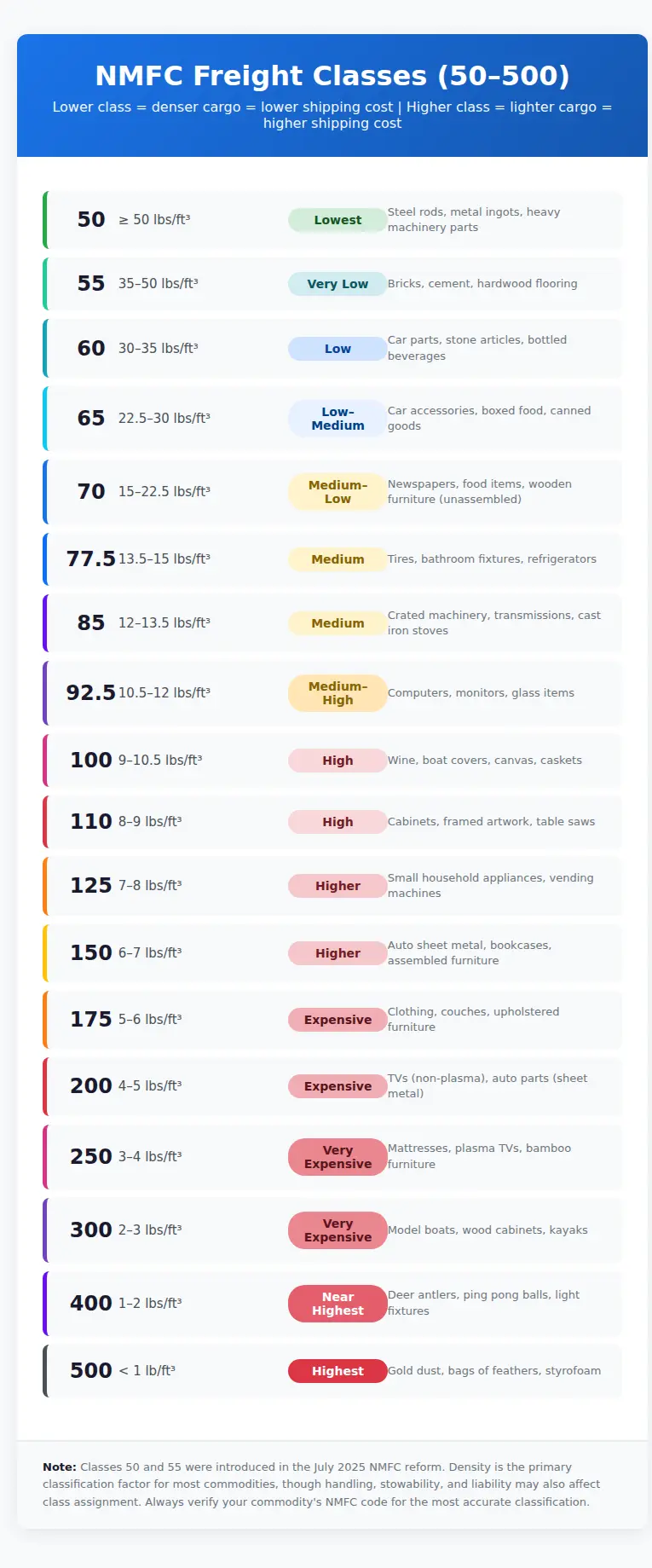
The 18 NMFC Freight Classes
The NMFC system uses 18 freight classes. Lower classes correspond to denser, easier-to-handle freight and result in lower shipping rates. Higher classes apply to lighter, bulkier, or more difficult freight.
| Class | Density Range (lbs/ft³) | Cost Level | Example Commodities |
|---|---|---|---|
| 50 | ≥ 50 | Lowest | Steel rods, metal ingots, heavy machinery parts |
| 55 | 35–50 | Very low | Bricks, cement, hardwood flooring |
| 60 | 30–35 | Low | Car parts, stone articles, bottled beverages |
| 65 | 22.5–30 | Low–Medium | Car accessories, boxed food, canned goods |
| 70 | 15–22.5 | Medium–Low | Newspapers, food items, wooden furniture (unassembled) |
| 77.5 | 13.5–15 | Medium | Tires, bathroom fixtures, refrigerators |
| 85 | 12–13.5 | Medium | Crated machinery, transmissions, cast iron stoves |
| 92.5 | 10.5–12 | Medium–High | Computers, monitors, glass items |
| 100 | 9–10.5 | High | Wine, boat covers, canvas, caskets |
| 110 | 8–9 | High | Cabinets, framed artwork, table saws |
| 125 | 7–8 | Higher | Small household appliances, vending machines |
| 150 | 6–7 | Higher | Auto sheet metal, bookcases, assembled furniture |
| 175 | 5–6 | Expensive | Clothing, couches, upholstered furniture |
| 200 | 4–5 | Expensive | TVs (non-plasma), auto parts (sheet metal) |
| 250 | 3–4 | Very expensive | Mattresses, plasma TVs, bamboo furniture |
| 300 | 2–3 | Very expensive | Model boats, wood cabinets, kayaks |
| 400 | 1–2 | Near highest | Deer antlers, ping pong balls, light fixtures |
| 500 | < 1 | Highest | Gold dust, bags of feathers, styrofoam |
Classes 50 and 55 were introduced in a recent NMFC reform, expanding the previous 16-tier system to 18 tiers. These new classes reward shippers of exceptionally dense freight with lower rates. If you are referencing older freight class charts, they may show only classes 60–500.
The NMFC Density-Based Reform
The NMFTA implemented the most significant overhaul of the NMFC system in decades:
- Density-first classification: Over 2,000 NMFC items were simplified. For most general commodities where handling, stowability, and liability are not significant factors, classification is now determined purely by density.
- New classes 50 and 55: Added to create a 13-tier density-based chart (for density-driven items), rewarding shippers of very dense freight.
- Special identifiers: Commodities with unusual handling, stowability, or liability characteristics are flagged with specific codes that may override the density-based class.
- Carrier dimensioning technology: LTL carriers increasingly use automated dimensioning equipment (vision systems and laser scanners) at terminals to verify shipper-declared dimensions. Inaccurate measurements are caught automatically.
The reform's goal is transparency and simplicity — if you know your shipment's density, you can predict your freight class with high confidence for most commodities.
Impact on LTL Pricing
Freight class is one of the primary inputs into LTL rate calculation. Here is how it flows into your final shipping cost:
Key Pricing Concepts
- CWT (hundredweight) rates: LTL carriers quote rates per 100 pounds (CWT). Higher freight classes have higher CWT rates.
- Discount structures: Most shippers negotiate a percentage discount off the published tariff. Discounts of 70–85% off class rates are common for volume shippers.
- Minimum charge: Every LTL shipment has a minimum charge regardless of weight or class.
- Deficit weight pricing: If a shipment's weight falls just below a rate break threshold, the carrier may charge the higher weight at the lower rate — which can actually cost less.
The Cost Impact of Classification
The difference between adjacent freight classes can mean a 10–25% change in the base rate. For high-volume shippers, even a one-class difference can translate to tens of thousands of dollars annually.
| Scenario | Class | Rate per CWT* | Cost for 1,000 lbs |
|---|---|---|---|
| Machine parts (dense) | 70 | $15.00 | $150.00 |
| Assembled furniture | 150 | $32.00 | $320.00 |
| Mattresses | 250 | $52.00 | $520.00 |
Illustrative rates before discount — actual rates vary by lane, carrier, and contract.
Reclassification and Disputes
Reclassification (or "reclass") occurs when a carrier inspects a shipment and determines that the actual freight class differs from what the shipper declared. This is one of the most common sources of billing disputes in LTL shipping.
Common Causes of Reclassification
- Inaccurate dimensions: Shipper measured the product but not the fully packaged pallet
- Wrong NMFC code: Commodity was assigned to the wrong tariff item
- Density miscalculation: Errors in the weight or cubic-foot calculation
- Packaging changes: A change in packaging altered the shipment's density
How to Avoid Reclassification
- Measure the full shipping unit — include the pallet, packaging, and any overhang
- Use accurate scales — weigh the complete shipment, not estimated product weights
- Look up the correct NMFC code — use the NMFTA's ClassIT tool for the official classification
- Document everything — photograph shipments and retain measurement records
- Request a binding classification ruling — for recurring shipments, the NMFTA can issue an official classification that carriers must honor
Measuring product dimensions instead of the complete shipping unit (pallet + packaging + any overhang or void space) is the #1 cause of reclassification. Carriers measure the entire footprint, including air space within the pallet profile.
Freight Class Lookup
Shippers have several methods to determine the correct freight class:
- NMFTA ClassIT Tool: The official online lookup tool maintained by the NMFTA. Requires a subscription but provides definitive NMFC codes and classes. Available at nmfta.org.
- Carrier classification departments: Most major LTL carriers have classification specialists who can help determine the correct class for unusual items.
- Freight density calculators: Many carriers and third-party logistics providers offer free online density calculators that estimate the freight class based on weight and dimensions.
- Third-party logistics (3PL) partners: 3PLs and freight brokers often handle classification as part of their service, applying their expertise to avoid misclassification.
Resources
| Resource | Description | Link |
|---|---|---|
| NMFTA Official Site | NMFC codes, ClassIT lookup tool, and classification rules | nmfta.org |
| NMFTA ClassIT Tool | Official commodity classification and NMFC code lookup (subscription required) | classit.nmfta.org |
| FMCSA Carrier Search | Verify LTL carrier authority and safety ratings | safer.fmcsa.dot.gov |
| FreightQuote Density Calculator | Free online freight density and class calculator | freightquote.com |
| SMC³ CzarLite | Industry-standard LTL base rate benchmarking tool | smc3.com |
Related Topics
- FTL vs LTL — understanding when LTL (and thus freight classes) applies vs full truckload shipping
- Bill of Lading (BOL) — freight class and NMFC code appear on the BOL and must be accurate
- Dimensional Weight — a similar density-based pricing concept used in air freight and parcel shipping