Demurrage and Detention
Demurrage and detention are container usage charges imposed by shipping lines when containers are not moved or returned within the agreed timeframe. Together often abbreviated as D&D, these charges can accumulate rapidly — sometimes exceeding the freight cost itself — and represent one of the most significant hidden costs in ocean freight logistics.
While the terms are frequently confused or used interchangeably in casual conversation, they refer to distinct charges that apply at different stages of the container's journey. Understanding the difference, and managing both proactively, is essential for controlling logistics costs.
Demurrage vs Detention: The Key Difference
The fundamental distinction is where the container is when the charge applies:
| Charge | Where It Applies | What Triggers It | Paid To |
|---|---|---|---|
| Demurrage | At the port terminal (inside the gate) | Container remains in the terminal yard beyond the allotted free time after vessel discharge | Shipping line |
| Detention | Outside the terminal (at consignee's warehouse, trucking yard, etc.) | Empty container is not returned to the designated depot within the allotted free time after gate-out | Shipping line |
Demurrage = charge for container sitting at the terminal too long after discharge from the vessel.
Detention = charge for container held outside the terminal too long before being returned empty.
A third related charge — port storage or ground rent — is charged by the terminal operator (not the shipping line) for containers occupying terminal yard space. This can apply simultaneously with demurrage.
Combined vs Separate Free Time
Some carriers offer combined (merged) free time, where a single free time allowance covers both the demurrage and detention periods. For example, 14 days combined free time means the consignee has 14 calendar days from vessel discharge to return the empty container — regardless of how that time is split between terminal dwell and off-terminal use.
Other carriers offer separate free time, where demurrage and detention each have their own independent allowance (e.g., 7 days demurrage + 4 days detention).
Combined free time is generally more flexible for the consignee because it allows you to leave the container at the terminal longer (avoiding storage at your own facility) without burning through a separate clock. When negotiating with carriers, always clarify whether free time is combined or separate.
Free Time Allowances
Free time is the grace period during which no D&D charges apply. It begins when the container is discharged from the vessel (for demurrage) or when the container gates out of the terminal (for detention).
Typical free time varies significantly by:
| Factor | Impact on Free Time |
|---|---|
| Trade lane | High-volume competitive trade lanes (Asia–US West Coast) tend to offer more generous free time than niche routes |
| Carrier | Each carrier sets its own tariff. Major carriers publish D&D tariffs on their websites |
| Port / country | Local regulations may set minimum free time (e.g., some countries mandate 7+ days) |
| Equipment type | Reefer containers often have shorter free time than dry containers due to higher equipment cost and demand |
| Customer relationship | Large-volume shippers with service contracts can negotiate extended free time as part of their agreement |
| Import vs export | Import free time is typically 4–7 days; export free time may differ |
Typical Free Time by Region (Import, Dry Containers)
| Region | Demurrage Free Days | Detention Free Days |
|---|---|---|
| U.S. ports | 4–7 days | 4–7 days |
| Northern Europe | 5–7 days | 5–7 days |
| Asia (major ports) | 3–7 days | 3–5 days |
| Latin America | 5–10 days | 5–7 days |
| Middle East / Africa | 5–7 days | 5–7 days |
How Charges Are Calculated
D&D charges are structured in tiered daily rates that escalate the longer the container is held. This is designed to incentivize fast turnaround — the penalty increases the longer you delay.
Example: Typical Demurrage Rate Schedule (40' Dry Container, U.S. Import)
| Period | Days Past Free Time | Daily Rate |
|---|---|---|
| Tier 1 | Days 1–3 | $75/day |
| Tier 2 | Days 4–6 | $150/day |
| Tier 3 | Days 7–10 | $225/day |
| Tier 4 | Days 11+ | $300/day |
Using this example, a container that overstays free time by 8 days would incur:
- Tier 1: 3 days × $75 = $225
- Tier 2: 3 days × $150 = $450
- Tier 3: 2 days × $225 = $450
- Total demurrage: $1,125
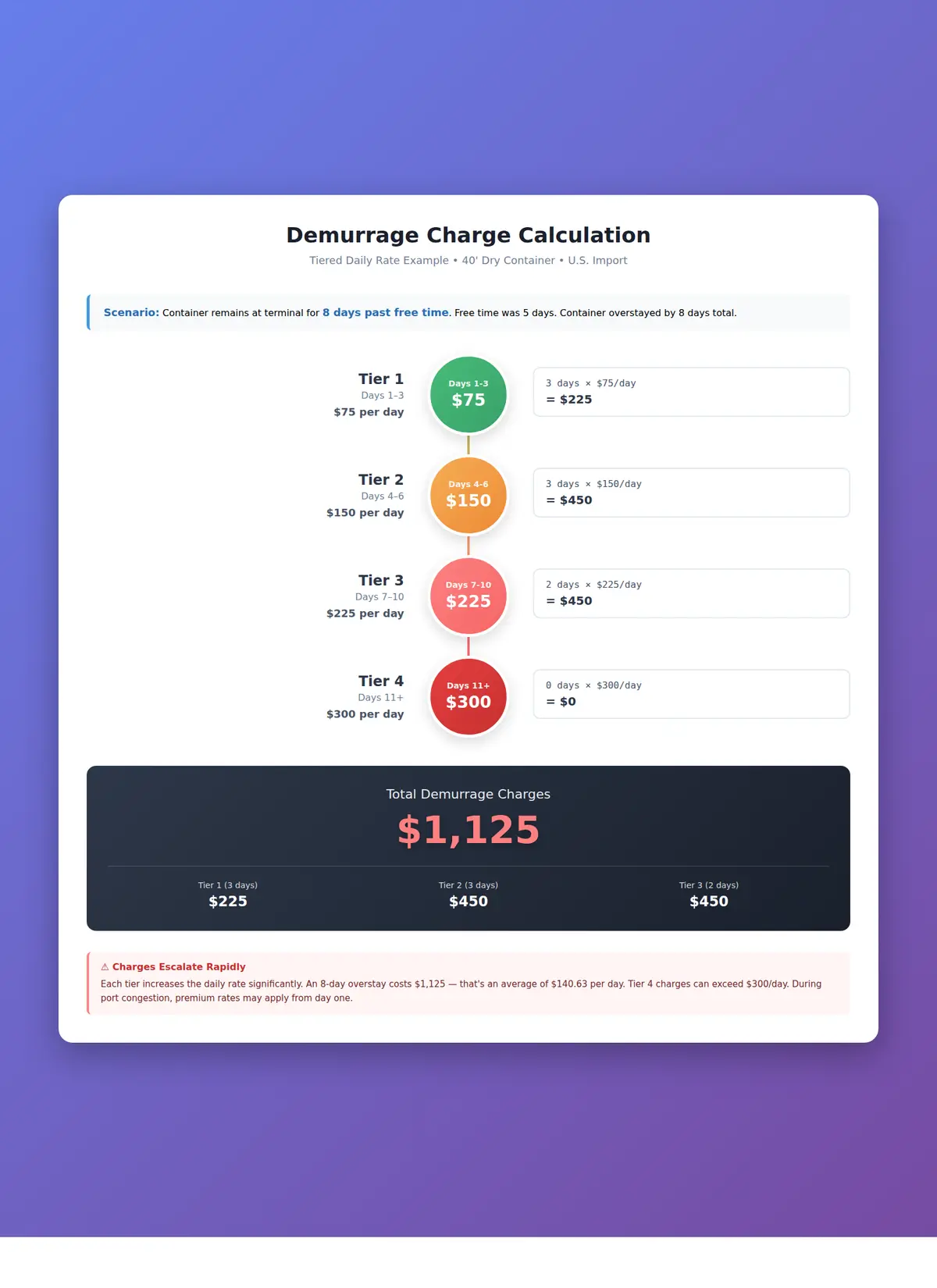 Demurrage charges escalate across four tiers. This example shows how an 8-day overstay accumulates $1,125 in charges through progressively higher daily rates.
Detention charges follow a similar tiered structure, often at comparable or slightly lower rates.
During periods of port congestion or equipment shortages, carriers may impose premium D&D rates that are significantly higher than standard tariffs. In 2021–2022, some carriers charged $300–$400/day from day one in congested U.S. ports. As of 2025, rates of $150–$250/day are common across major trade lanes.
How D&D Appears on Invoices
D&D charges may appear on invoices from different parties:
- Carrier invoice — The shipping line bills demurrage and detention directly, or through their local agent.
- Freight forwarder invoice — If your forwarder manages the shipment, they may pass through carrier D&D charges plus a handling fee.
- Terminal invoice — Port storage (ground rent) is billed separately by the terminal operator.
Common Causes of D&D Charges
Understanding why containers incur D&D is the first step to preventing it:
The most frequent causes:
- Customs clearance delays — Missing permits, incorrect tariff classifications, CBP examinations, or regulatory holds. This is the single largest driver of demurrage.
- Documentation errors — Discrepancies on the Bill of Lading, missing original documents for negotiable B/Ls, or late submission of required filings.
- Consignee unreadiness — The receiving party's warehouse is full, labor isn't scheduled, or internal approvals haven't been completed.
- Port congestion — During peak periods, truckers may be unable to secure terminal appointments, preventing timely pickup even when cargo is cleared.
- Chassis shortages — In the U.S., container pickup requires a chassis (wheeled frame). Chassis shortages at terminal pools prevent timely gate-out.
- Communication gaps — No one in the supply chain is actively tracking container status and free time expiry dates.
Strategies to Minimize D&D Charges
Pre-arrival preparation
- Pre-clear customs — Submit customs entries and all required documentation before the vessel arrives. In the U.S., entries can be filed up to 5 days prior to arrival using Pre-Arrival Processing.
- Ensure documentation accuracy — Verify Bill of Lading details, HS codes, and regulatory requirements well in advance.
- Confirm consignee readiness — Ensure the receiving warehouse has capacity, labor is scheduled, and any inspection or quality-check requirements are arranged.
Free time management
- Negotiate extended free time — Include free time extensions in carrier service contracts. Even 2–3 extra days can prevent most routine D&D charges.
- Request combined free time — Combined D&D free time provides more flexibility than separate allowances.
- Know your free time — Track the exact free time allowance for each carrier and port combination. Don't assume all carriers offer the same terms.
Active monitoring
- Track container milestones — Use carrier tracking portals or API integrations to monitor vessel discharge, container availability, and free time countdowns in real time.
- Set alerts — Configure notifications for key milestones: "vessel arrived," "container available," "free time expiring in 2 days."
- Designate ownership — Assign a specific person or team responsible for monitoring D&D exposure across all active shipments.
When charges are incurred
- Dispute incorrect charges — Carriers sometimes bill D&D for periods when the container was not available for pickup (e.g., under customs hold or terminal congestion). The FMC's Interpretive Rule on Demurrage and Detention (46 CFR § 545.5) establishes that D&D practices must be reasonable and serve their incentive purpose.
- Request fee waivers — For first-time occurrences or charges caused by carrier/terminal issues, contact the carrier's local office to request a waiver or credit.
- Document everything — Maintain records of customs release timestamps, terminal appointment availability, and pickup attempts. This evidence is essential for successful disputes.
In the United States, the Federal Maritime Commission (FMC) regulates demurrage and detention practices under the Shipping Act. The FMC's 2020 Interpretive Rule and subsequent 2023 rulemaking clarified that carriers cannot charge D&D when the container cannot be retrieved due to circumstances beyond the shipper's control (e.g., government holds, terminal closures). Shippers should familiarize themselves with these protections at fmc.gov/detention-and-demurrage.
Resources
| Resource | Description | Link |
|---|---|---|
| FMC Detention & Demurrage | U.S. Federal Maritime Commission's D&D data, regulations, and guidance | fmc.gov/detention-and-demurrage |
| FMC D&D Billing Data (Quarterly) | Aggregated D&D billing and collection data from the nine largest carriers serving the U.S. | fmc.gov |
| Container xChange D&D Calculator | Free tool for estimating demurrage and detention costs by port and carrier | container-xchange.com |
| CMA CGM D&D Tariffs | Published demurrage and detention rates for CMA CGM by country | cma-cgm.com/ebusiness/tariffs/demurrage-detention |
| Hapag-Lloyd D&D Finder | Look up Hapag-Lloyd's demurrage and detention rates by port | hapag-lloyd.com |
Related Topics
- Port Operations — understanding terminal operations and how containers flow through ports
- Bill of Lading — the document that must be surrendered for cargo release
- Ocean Freight Rates — D&D charges are separate from and additional to freight rates
- HS Codes — correct classification prevents customs delays that cause D&D
- Drayage — the trucking leg that determines how quickly containers are picked up and returned