Container Types
Standardized shipping containers are the foundation of modern global trade, enabling goods to move seamlessly between vessels, trucks, and rail cars without repackaging. Since their widespread adoption in the 1960s — pioneered by Malcolm McLean — containers have reduced cargo handling costs by an estimated 90% and dramatically shortened transit times. Choosing the correct container type for a given commodity is a fundamental decision in ocean freight logistics.
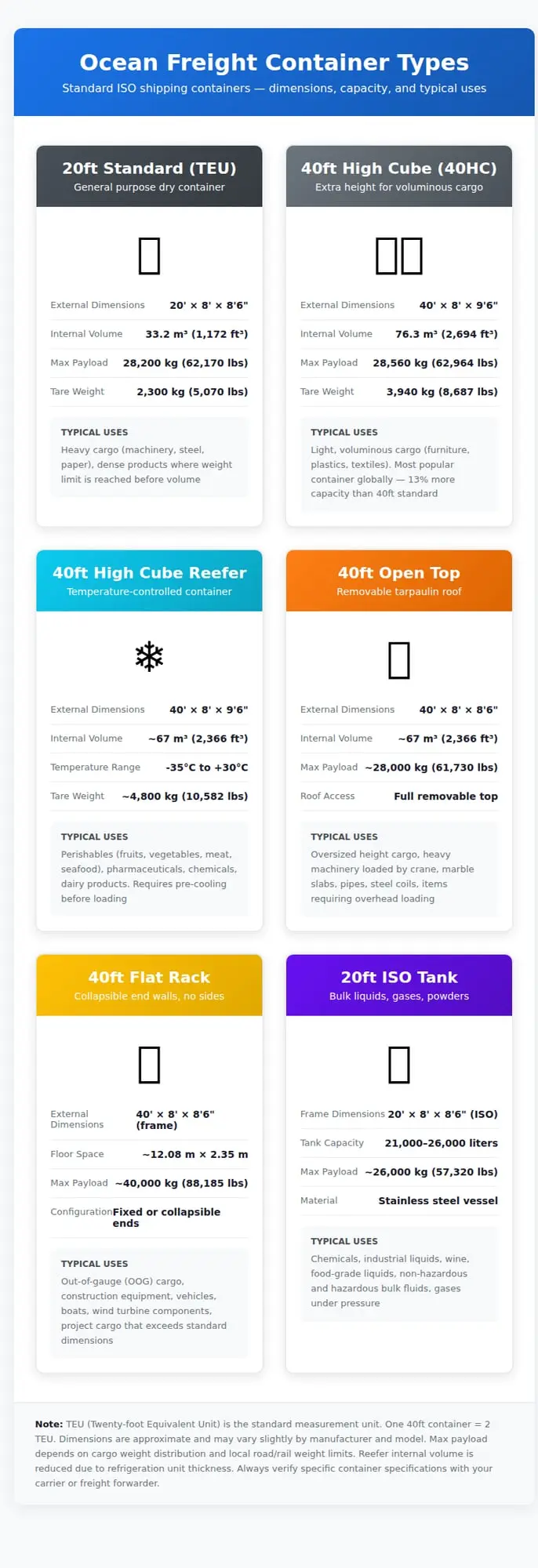
Standard Dry Containers (20ft, 40ft, 40ft HC)
Standard dry containers (also called general purpose containers) are the workhorses of ocean freight, accounting for roughly 90% of all containerized cargo movements worldwide. They are fully enclosed steel boxes with doors at one end, suitable for most dry, non-perishable goods.
The three most common sizes are:
- 20-foot container (TEU) — The basic unit of measurement in container shipping. TEU stands for Twenty-foot Equivalent Unit and is the standard metric for vessel capacity and port throughput.
- 40-foot container (FEU) — Equal to 2 TEU. The most common container size in international trade due to its balance of capacity and transportability.
- 40-foot High Cube (40HC) — Same length and width as a standard 40ft, but one foot taller (9'6" vs 8'6"). Preferred for voluminous, lightweight cargo.
When in doubt, the 40ft High Cube is the most popular container in global trade today. It offers 13% more cubic capacity than a standard 40ft container at minimal additional cost, making it the default choice for most shippers.
Refrigerated Containers (Reefers)
Refrigerated containers, commonly known as reefers, are temperature-controlled units equipped with an integral refrigeration system. They maintain precise temperatures ranging from -35°C to +30°C (-31°F to 86°F), making them essential for transporting perishable goods.
Common commodities shipped in reefers:
- Fresh fruits and vegetables
- Frozen meat, poultry, and seafood
- Dairy products
- Pharmaceuticals and vaccines
- Chemicals requiring temperature stability
- Chocolate and confectionery
How Reefers Work
Each reefer has a built-in refrigeration unit powered by an external electrical supply. On vessels, they plug into the ship's power grid; on chassis during land transport, they use a genset (generator set) or clip-on unit. Temperature is controlled by a microprocessor that monitors and adjusts cooling/heating continuously.
Reefers do not cool cargo down — they maintain the temperature of pre-cooled cargo. Goods must be loaded at the correct temperature. Loading warm product into a reefer can cause condensation, uneven temperatures, and spoilage.
Pre-Trip Inspection (PTI) is mandatory before every reefer shipment. Technicians verify that the refrigeration unit, thermostat, ventilation, drainage, and door seals are functioning correctly.
| Feature | 20ft Reefer | 40ft High Cube Reefer |
|---|---|---|
| External length | 20' (6.06 m) | 40' (12.19 m) |
| Internal length | 17'8" (5.44 m) | 37'11" (11.56 m) |
| Internal width | 7'6" (2.29 m) | 7'6" (2.29 m) |
| Internal height | 7'5" (2.27 m) | 8'2" (2.50 m) |
| Capacity | ~27 m³ | ~67 m³ |
| Temperature range | -35°C to +30°C | -35°C to +30°C |
| Tare weight | ~3,080 kg | ~4,800 kg |
Open-Top and Flat Rack Containers
Open-Top Containers
Open-top containers have the same dimensions as standard dry containers but feature a removable tarpaulin roof or hard-top panels instead of a fixed steel roof. They allow cargo to be loaded from the top using cranes.
Typical uses:
- Tall machinery that exceeds standard container height
- Heavy coils, pipes, and steel products
- Marble slabs and other items requiring overhead loading
- Out-of-gauge (OOG) cargo that protrudes above the container walls
Flat Rack Containers
Flat rack containers consist of a strong steel floor with collapsible or fixed end walls and no side walls or roof. They come in 20ft and 40ft sizes and are designed for heavy, oversized, or oddly shaped cargo.
Common flat rack cargo:
- Construction equipment and heavy machinery
- Vehicles and boats
- Large pipes and structural steel
- Wind turbine components
- Project cargo
Flat rack and open-top shipments typically incur higher freight rates than standard containers because they cannot be stacked normally and may occupy additional deck or hold space on the vessel. Carriers charge based on the slot equivalent — the number of standard container slots the OOG cargo displaces.
Tank Containers
Tank containers (also called ISO tanks) are specialized intermodal containers designed for transporting bulk liquids, gases, and powders. They consist of a stainless steel pressure vessel mounted inside a standard ISO frame, allowing them to be handled by the same cranes, chassis, and rail cars as dry containers.
Key specifications:
- Capacity: 14,000 to 26,000 liters (most commonly 21,000–24,000 liters)
- Pressure ratings: Vary from 1.5 bar to 10+ bar depending on the commodity
- Materials: T304 or T316 stainless steel (chemical resistance varies)
- Certifications: Must comply with IMDG Code, ADR/RID (road/rail), and applicable national regulations
Common tank container commodities:
- Food-grade liquids (wine, fruit juice, vegetable oils)
- Hazardous chemicals (acids, solvents, resins)
- Liquefied gases (LPG, compressed gases)
- Pharmaceutical ingredients
Container Dimensions and Weight Limits
The table below summarizes the standard specifications for the most common container types. Note that exact dimensions vary slightly by manufacturer.
| Container Type | External Dimensions (L × W × H) | Internal Dimensions (L × W × H) | Door Opening (W × H) | Tare Weight | Max Gross Weight | Max Payload | Cubic Capacity |
|---|---|---|---|---|---|---|---|
| 20ft Standard | 20' × 8' × 8'6" | 19'4" × 7'8" × 7'10" | 7'8" × 7'5" | ~2,300 kg | 30,480 kg | ~28,180 kg | ~33 m³ |
| 40ft Standard | 40' × 8' × 8'6" | 39'5" × 7'8" × 7'10" | 7'8" × 7'5" | ~3,750 kg | 30,480 kg | ~26,730 kg | ~67 m³ |
| 40ft High Cube | 40' × 8' × 9'6" | 39'5" × 7'8" × 8'10" | 7'8" × 8'5" | ~3,940 kg | 30,480 kg | ~26,540 kg | ~76 m³ |
| 20ft Reefer | 20' × 8' × 8'6" | 17'8" × 7'6" × 7'5" | 7'5" × 7'3" | ~3,080 kg | 30,480 kg | ~27,400 kg | ~27 m³ |
| 40ft HC Reefer | 40' × 8' × 9'6" | 37'11" × 7'6" × 8'2" | 7'5" × 8'0" | ~4,800 kg | 30,480 kg | ~25,680 kg | ~67 m³ |
| 20ft Open Top | 20' × 8' × 8'6" | 19'4" × 7'7" × 7'8" | 7'8" × 7'2" | ~2,350 kg | 30,480 kg | ~28,130 kg | ~32 m³ |
| 20ft Flat Rack | 20' × 8' × 8'6" | 18'5" × 7'3" × 7'4" | N/A | ~2,700 kg | 30,480 kg | ~27,780 kg | N/A |
| 40ft Flat Rack | 40' × 8' × 8'6" | 39'7" × 7'2" × 7'4" | N/A | ~5,000 kg | 45,000 kg | ~40,000 kg | N/A |
The maximum gross weight of 30,480 kg (67,200 lbs) is an ISO standard, but actual allowable weight on roads is typically lower. In the U.S., most states limit gross vehicle weight to 80,000 lbs (36,287 kg) including truck, chassis, and container — meaning the practical payload for a 20ft container is often limited to around 21,000–23,000 kg for road transport. Always check local road weight regulations.
Understanding TEU and FEU
The global shipping industry measures capacity in TEU (Twenty-foot Equivalent Units):
| Measurement | Equivalent |
|---|---|
| 1 TEU | One 20-foot container |
| 1 FEU | One 40-foot container = 2 TEU |
| Vessel capacity | Expressed in TEU (e.g., "24,000 TEU mega-vessel") |
| Port throughput | Annual TEU handled (e.g., "Shanghai: 49 million TEU") |
Related Articles
- Bill of Lading — Container and seal numbers appear on the B/L for every shipment
- Ocean Freight Rates — How container type affects pricing, including equipment surcharges
- Demurrage & Detention — Charges for holding containers beyond the free time allowance
- Port Operations — How containers are handled at marine terminals
- Drayage — Local trucking of containers between port and warehouse
Resources
| Resource | Description |
|---|---|
| World Shipping Council — Containers | Industry overview of container standards and history |
| ISO 668:2020 | International standard for container classification, dimensions, and ratings |
| Maersk Container Specifications | Detailed specs from the world's largest container shipping line |
| U.S. DOT — Size and Weight | Federal Highway Administration truck size and weight regulations |
| Mainfreight Container Specifications | Comprehensive spec sheets for all container types |