Tariff Refund Recovery Strategies: How Smart Shippers Are Clawing Back Millions in Overpaid Duties in 2026

The Supreme Court's landmark February 2026 ruling striking down IEEPA tariffs has triggered a seismic shift in international trade compliance. Importers who paid billions in emergency duties now face a historic recovery opportunity — but only if they act strategically and fast.
The Ruling That Changed Everything
On February 20, 2026, the U.S. Supreme Court ruled that President Trump's tariffs imposed under the International Emergency Economic Powers Act (IEEPA) were unlawful. The decision immediately invalidated the Reciprocal Tariffs and Trafficking and Immigration Tariffs that had been in effect since 2025, leaving importers potentially owed billions in duty refunds.
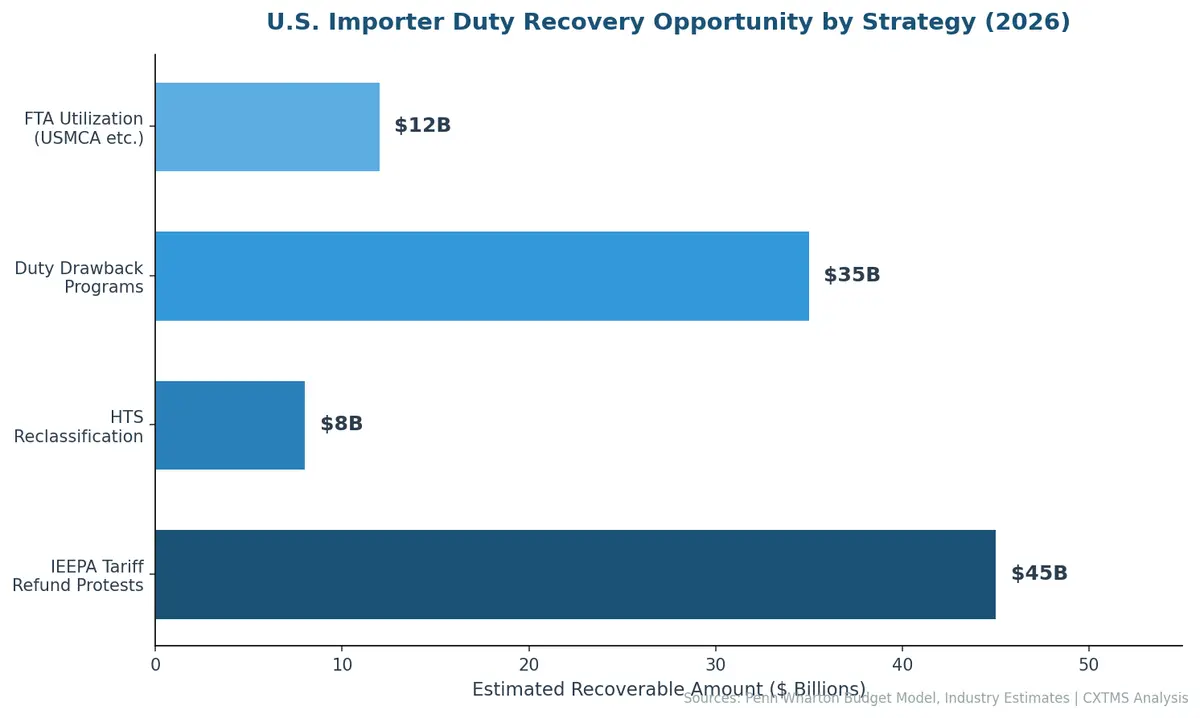
The scale is staggering. According to Penn Wharton's Budget Model, IEEPA tariff collections between January 2025 and January 2026 reached tens of billions of dollars. Within days of the ruling, FedEx sued the U.S. government seeking full refunds of duties paid, and class-action lawsuits began piling up against carriers and brokers over who owes what to whom.
But the IEEPA refund wave is only the most visible piece of a much larger puzzle. Even before this ruling, U.S. companies were leaving enormous amounts of money on the table through unclaimed duty recovery programs.
The $50 Billion Problem: Why Most Refunds Go Unclaimed
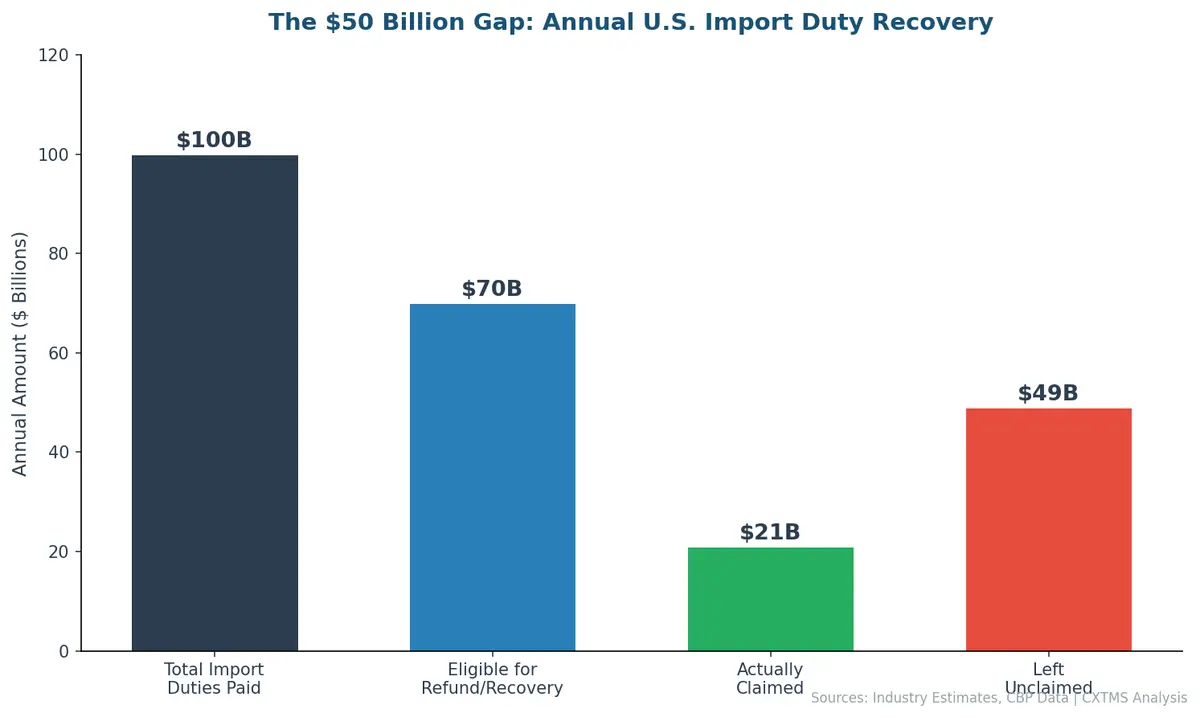
U.S. companies pay over $100 billion in import duties annually, yet industry estimates suggest roughly 70% of eligible duty refunds go unclaimed — an estimated $50 billion left on the table every year. The reasons are painfully consistent: complexity, lack of awareness, and insufficient technology to identify recovery opportunities at scale.
Duty drawback — the federal program allowing importers to recover up to 99% of duties paid on goods that are subsequently exported or destroyed — remains one of the most underutilized trade tools available. Importers have a five-year window from the date of import to file drawback claims, meaning duties paid as far back as 2021 are still recoverable today.
Yet most companies never file. The documentation requirements are extensive, the matching of import entries to export transactions is complex, and many customs brokers lack the technology to identify eligible transactions automatically.
Three Recovery Strategies Every Shipper Should Deploy Now
1. IEEPA Tariff Refund Protests
For any importer who paid duties under the now-invalidated IEEPA tariffs, the immediate priority is filing protests with U.S. Customs and Border Protection. Under 19 C.F.R. § 24.36, refunds are paid to the importer of record, and importers generally have 180 days after goods are "liquidated" to protest and request refunds.
The Court of International Trade's December 2025 ruling clarified that importers are not required to file suit preemptively to preserve their refund rights. However, the refund process is expected to be complex and prolonged, making early action critical.
Key action: Audit all import entries from 2025-2026 for IEEPA-related duties and file protests before liquidation deadlines expire.
2. AI-Powered HTS Reclassification
Harmonized Tariff Schedule (HTS) misclassification is one of the most common — and most costly — errors in international trade. Even a single digit difference in an HTS code can mean the difference between a 0% and a 25% duty rate.
The emergence of AI-driven HTS modeling is transforming this landscape. In February 2026, Cass Information Systems partnered with Caspian to deploy AI-driven tariff audit capabilities, including automated HTS modeling, refund identification, and full support for post-summary corrections and protests. Their platform puts the entire post-entry process on autopilot — identifying misclassifications, filing corrections, and recovering overpaid duties without manual intervention.
Key action: Run an AI-powered audit of historical HTS classifications across all import entries from the past five years. Even a 2-3% reclassification rate can yield significant refunds.
3. Duty Drawback Program Activation
For companies that import goods and subsequently export finished products, duty drawback represents the single largest untapped savings opportunity. The program allows recovery of up to 99% of duties, taxes, and fees paid on imported merchandise that is:
- Manufactured drawback: Imported materials used in the manufacture of exported goods
- Substitution drawback (J2): Commercially interchangeable goods imported and exported within the qualifying window
- Rejected merchandise drawback: Goods returned to the foreign supplier or destroyed
Most customs brokers match drawback claims using simple first-in, first-out sequencing and surface-level compliance checks. This approach files correctly but rarely maximizes refund value. For substitution drawback, refunds are calculated based on the lower of import or export value — meaning strategic matching of high-duty imports to corresponding exports can dramatically increase recovery amounts.
Key action: Identify all import-export pairs eligible for drawback claims going back five years and engage a specialist or technology platform to optimize claim matching.
The USMCA and FTA Savings Gap
Beyond drawback and refund recovery, many shippers are overpaying duties simply by failing to utilize Free Trade Agreements they're already eligible for. The United States-Mexico-Canada Agreement (USMCA) and other bilateral FTAs offer preferential duty rates — sometimes zero — for qualifying goods.
The challenge is proving origin. Rules of origin calculations require detailed supply chain documentation, and many companies default to paying full duty rates rather than investing in the compliance work to claim preferences. With tariff rates elevated across the board in 2026, the ROI on FTA utilization programs has never been higher.
Technology Is the Multiplier
The common thread across all these recovery strategies is technology. Manual tariff audits, spreadsheet-based drawback tracking, and paper-based FTA documentation simply cannot scale to capture the full scope of available refunds.
Modern trade compliance platforms integrate directly with customs entry data, apply AI-powered classification engines, automatically identify drawback-eligible transactions, and generate the documentation needed for filing — reducing what used to take weeks of consultant time to minutes of automated processing.
The companies recovering the most money in 2026 aren't just filing protests after the Supreme Court ruling. They're deploying systematic, technology-driven approaches that continuously identify and capture every dollar of duty savings across their entire import portfolio.
What Smart Shippers Are Doing Right Now
The post-IEEPA landscape has created urgency, but the opportunity extends far beyond one ruling. Companies that build comprehensive tariff recovery programs today will benefit from:
- Immediate IEEPA refund recovery from the Supreme Court ruling
- Ongoing drawback savings of up to 99% on duties for export-oriented operations
- HTS reclassification corrections that reduce future duty exposure
- FTA utilization that eliminates duties on qualifying trade lanes entirely
- Continuous audit capabilities that catch overpayments in real time rather than years after the fact
The window is open. The five-year lookback period means billions in historical overpayments are still recoverable. But deadlines are real, liquidation windows are closing, and the importers who move first will recover the most.
Navigating tariff recovery across complex international supply chains? Contact CXTMS for a demo of how our trade compliance tools automate refund identification, drawback filing, and duty optimization across your entire import portfolio.