AI Packaging Optimization: How Machine Learning Is Eliminating Dimensional Weight Penalties and Cutting Shipping Costs by 20%

Carriers don't just charge by weight anymore — they charge by volume. And in 2026, with both FedEx and UPS rounding up any fractional inch in dimensional weight calculations, shippers who haven't optimized their packaging are hemorrhaging money on every shipment.
The Dimensional Weight Problem Is Getting Worse
Dimensional weight (DIM weight) pricing has been the parcel industry's most effective revenue tool for over a decade. The formula is simple: multiply length × width × height, divide by a DIM factor, and charge whichever is greater — actual weight or dimensional weight.
What's changed in 2026 is how aggressively carriers are tightening the screws. Both FedEx and UPS now round up any fraction of an inch to the next whole inch when calculating dimensional weight. A box measuring 12.1 × 10.2 × 8.3 inches is now billed as 13 × 11 × 9 — a 25% increase in billable cubic volume from rounding alone.
UPS has also introduced a 40-pound minimum billable weight for packages exceeding certain size thresholds, and large package surcharges now trigger a 90-pound minimum regardless of actual weight. For high-volume shippers moving thousands of parcels daily, these incremental changes compound into six- and seven-figure annual cost increases.
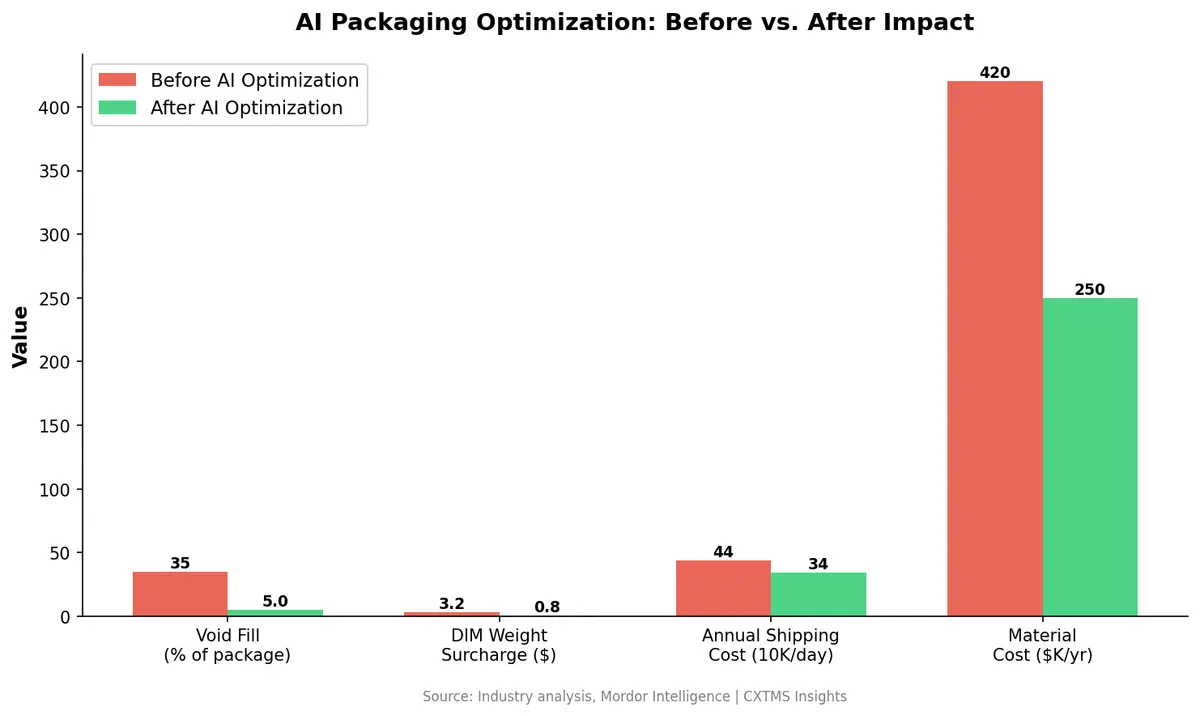
The core issue is straightforward: the average e-commerce package ships with 30-40% void fill. That's air — and carriers are billing for every cubic inch of it.
How AI Packaging Optimization Works
AI-driven packaging optimization attacks the DIM weight problem from multiple angles, using machine learning to analyze product dimensions, order compositions, and shipping patterns in real time.
3D Product Analysis and Box Selection
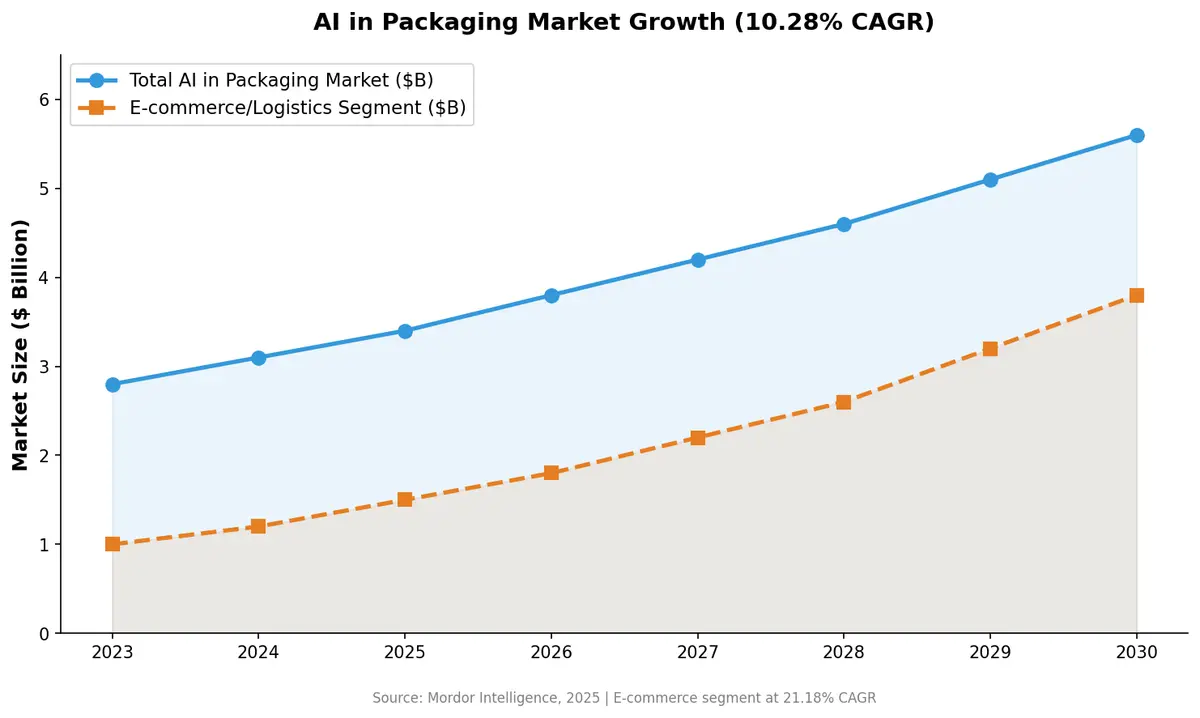
Modern cartonization algorithms ingest precise 3D measurements of every SKU in a warehouse. When an order comes in, the system evaluates all possible configurations — item orientations, stacking patterns, and nesting opportunities — to select the smallest box that safely contains the items. According to Mordor Intelligence's AI in Packaging report, e-commerce and logistics applications of AI in packaging are growing at a 21.18% CAGR, driven specifically by the need to optimize for dimensional weight pricing.
Right-Sizing Automation
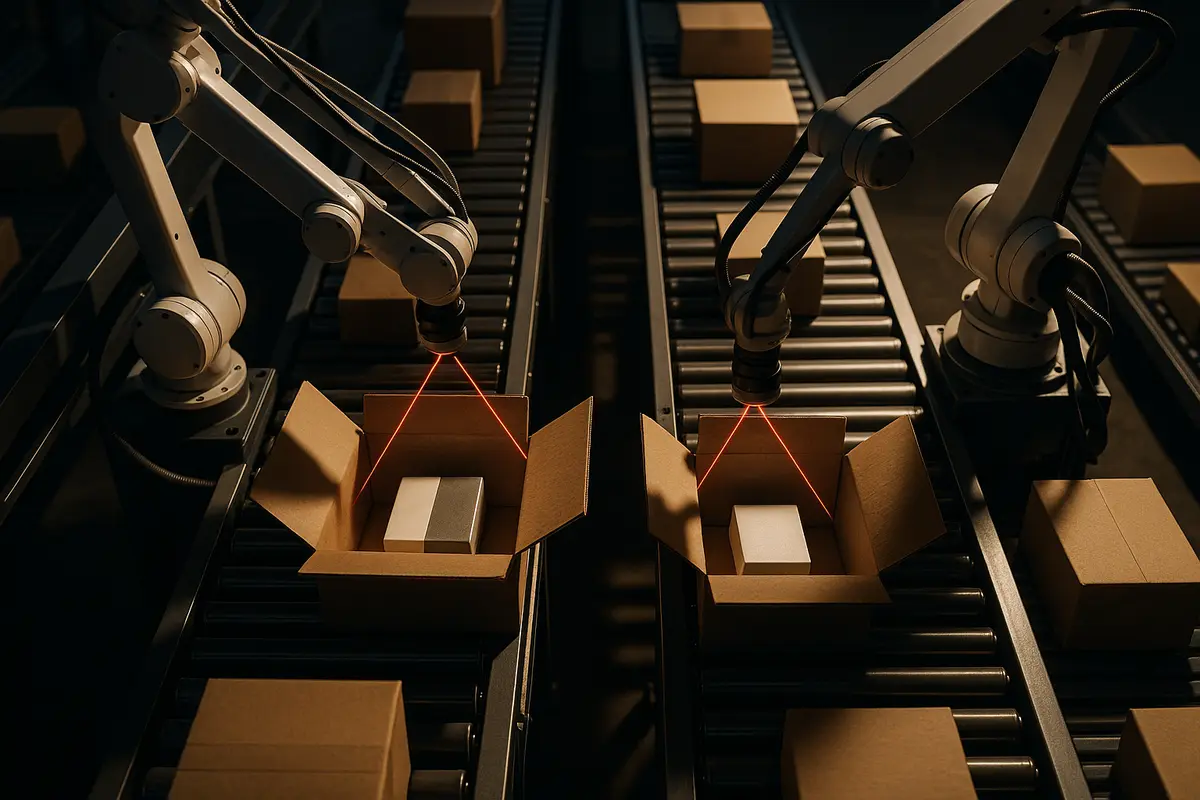
Right-sizing goes beyond selecting from a fixed set of box sizes. Advanced systems use on-demand box-cutting machines guided by AI to create custom-sized packaging for each order. The result: void fill drops from 30-40% to under 5%, and dimensional weight aligns closely with actual weight.
DHL's research into carton set optimization demonstrated that analyzing item dimensions, carrier rates, and destination data to determine the ideal mix of carton sizes can produce significant shipping cost reductions — a strategy that scales dramatically when powered by machine learning rather than manual analysis.
Multi-Item Cartonization
The hardest optimization challenge is multi-item orders. AI cartonization engines solve a variant of the three-dimensional bin packing problem — an NP-hard computational challenge — using heuristic algorithms and reinforcement learning. The system decides not just which box to use, but whether to split an order into multiple shipments when doing so reduces total cost.
The ROI: 15-25% Reduction in Parcel Shipping Costs
The financial case for AI packaging optimization is compelling and well-documented:
- 5-12% cost reduction from optimizing package dimensions alone, according to CEO Today Magazine's analysis of AI shipping trends — and that's for small businesses with limited volume leverage
- 15-25% total savings for high-volume shippers combining right-sizing with carrier rate optimization and zone-skip strategies
- 40%+ reduction in void fill material costs, delivering both financial and sustainability benefits
- Fewer damage claims from snug-fitting packaging that eliminates product movement during transit
For a mid-market shipper moving 10,000 parcels per day at an average shipping cost of $12, even a 15% reduction translates to $6.6 million in annual savings. At 20%, that number climbs to $8.8 million.
2026's Carrier Changes Make Optimization Urgent
The timing couldn't be more critical. FedEx and UPS both implemented dimensional weight rounding changes in early 2026, and the cumulative effect of annual General Rate Increases (GRIs) — 5.9% from UPS alone — means shippers who don't actively optimize are falling further behind every quarter.
The AI in packaging market reflects this urgency, growing at a 10.28% CAGR globally as companies race to deploy intelligent packaging systems. The smart packaging market overall has reached $25.84 billion in 2026, projected to hit $36.94 billion by 2031.
Integration With TMS: The Full-Stack Approach
Packaging optimization delivers the highest ROI when it's integrated into the broader transportation management workflow. Here's what that looks like in practice:
- Order ingestion — TMS receives order details including SKU dimensions and weights
- Cartonization — AI engine recommends optimal packaging configuration
- Rate shopping — TMS evaluates carrier rates based on optimized package dimensions
- Mode selection — System determines whether parcel, LTL, or consolidation is most cost-effective
- Label generation — Shipping labels reflect accurate dimensions, avoiding post-shipment audits and adjustments
When packaging optimization feeds directly into carrier rate shopping, shippers avoid the common trap of optimizing box size in isolation while missing the zone, service level, or carrier that would deliver even greater savings.
Getting Started: The Practical Path
Shippers don't need to overhaul their entire fulfillment operation overnight. The most effective approach starts with data:
- Audit your current DIM weight exposure — Identify which product categories and shipping lanes are most affected by dimensional weight pricing
- Measure void fill ratios — Calculate the percentage of air in your average shipment
- Start with carton set optimization — Even without AI, reducing your box size catalog from 20+ sizes to an optimized set of 8-10 can yield immediate savings
- Layer in AI cartonization — Deploy algorithmic box selection as volume justifies the investment
The shippers who thrive in 2026's carrier pricing environment won't be the ones negotiating harder on rates. They'll be the ones shipping less air.
Ready to integrate packaging optimization into your transportation management workflow? Contact CXTMS for a demo and see how intelligent logistics platforms reduce shipping costs at every stage.