AI-Native Freight Operations: How 15x Productivity Gains Are Rewriting the Economics of Freight Brokerage


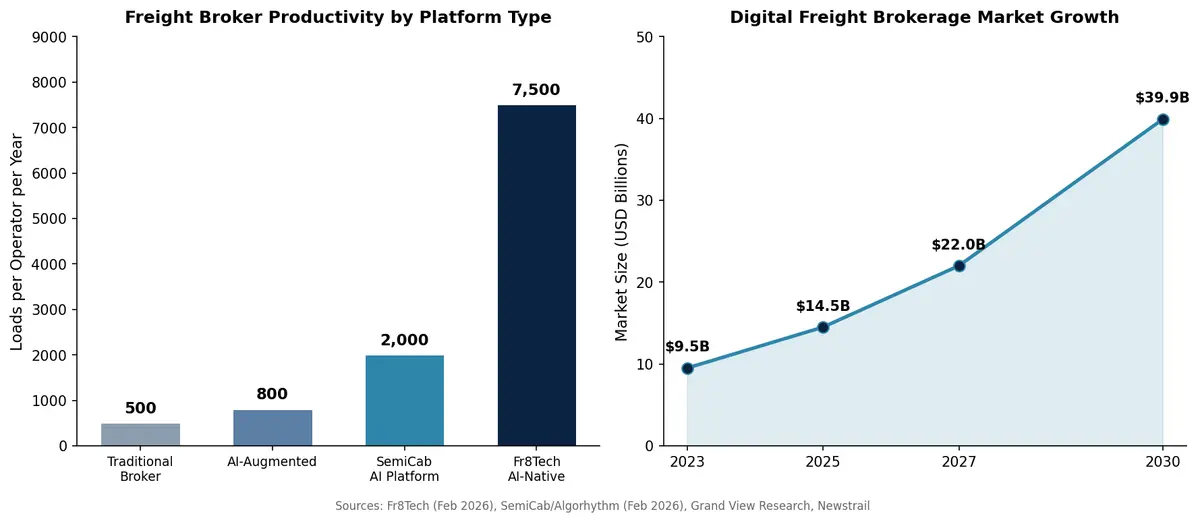
A freight broker managing 500 loads per year used to be the industry benchmark. In February 2026, companies deploying AI-native platforms are reporting individual operators handling over 2,000 loads annually — a 4x improvement — while others are closing domestic bookings 15 times faster than legacy workflows allowed. The freight brokerage industry isn't being incrementally improved. It's being economically restructured.
From AI-Augmented to AI-Native: A Fundamental Shift
The distinction between "AI-augmented" and "AI-native" freight operations matters more than most industry observers realize. AI-augmented systems bolt machine learning onto existing manual workflows — automating a rate lookup here, flagging an exception there. AI-native platforms flip the architecture entirely: intelligence drives execution, and humans provide judgment on exceptions.
Freight Technologies (Fr8Tech) illustrated this shift on February 24, 2026, when the company reported that its AI-native platform was delivering 15x efficiency gains for domestic freight operations and 5x acceleration for cross-border documentation workflows. Operators managing more than 3,500 loads annually are now closing bookings in minutes compared to hours in prior years. The company achieved this while operating with roughly 50% fewer operations staff following headcount reductions in 2025.
Fr8Tech isn't alone. Earlier in February, SemiCab (Algorhythm Holdings) published results showing its AI-driven Collaborative Transportation Platform enabling customers to scale freight volumes by 300% to 400% without adding operational headcount. Individual operators on the platform managed over 2,000 loads annually versus the traditional benchmark of approximately 500 — a 4x improvement in workforce productivity.
The New Brokerage Cost Model
These aren't theoretical projections. They represent a fundamental rework of freight brokerage unit economics.
In the traditional model, scaling a brokerage means scaling headcount nearly linearly. More loads require more dispatchers, more carrier reps, more documentation clerks, and more exception handlers. Labor typically accounts for 60–70% of a brokerage's operating costs, creating a ceiling on margins regardless of volume growth.
AI-native operations break this linear relationship. Here's what the new cost model looks like:
- Carrier discovery and matching: Autonomous AI agents identify available capacity, predict acceptance rates, and tender loads without human intervention
- Rate prediction: Machine learning models price freight in real time based on market conditions, lane history, and carrier behavior patterns
- Documentation and compliance: Cross-border proof-of-delivery validation, customs paperwork, and bill-of-lading generation happen automatically — Fr8Tech reports 5x acceleration in these workflows
- Status updates and tracking: Autonomous voice agents and API integrations handle carrier check calls and shipper notifications around the clock
- Exception management: Only true anomalies escalate to human operators, who focus exclusively on complex problem-solving and customer relationships
The result: a brokerage can handle 3x to 15x more volume with the same or fewer people. Margins expand not by squeezing carriers or raising rates, but by dramatically reducing the cost to execute each transaction.
A Market Primed for Disruption
The U.S. freight brokerage market is valued at $19.68 billion in 2025 and is projected to reach $28.17 billion by 2030, growing at a 7.44% CAGR. Meanwhile, the global digital freight brokerage segment is expanding at a far faster 27.3% CAGR, expected to hit $24.36 billion by 2030 according to Grand View Research.
That divergence tells the story: the overall brokerage market grows steadily, but the digital and AI-native share within it is expanding explosively. Traditional brokerages that don't adopt AI-native architectures face a structural cost disadvantage that will compound year over year.
McKinsey's 2025 State of AI survey found that 88% of organizations now use AI in at least one business function, but only about 6% are capturing meaningful enterprise-wide value. In freight, the companies moving from task-level automation to system-level intelligence — where AI orchestrates the entire freight lifecycle rather than individual steps — are the ones posting the dramatic productivity numbers.
What "AI-Native" Actually Means in Practice
Fr8Tech CEO Javier Selgas described the company's approach: "We've spent years building proprietary AI capabilities with a clear objective — create an operating system where software performs the work and people provide judgment." SemiCab CEO Gary Atkinson echoed the philosophy: "Most systems automate individual tasks. We automate the system itself."
In practical terms, AI-native freight operations share several characteristics:
- Agentic AI architecture: Autonomous software agents handle end-to-end workflows — from load posting through carrier assignment, tracking, documentation, and payment — without human initiation of each step
- Predictive decision-making: The platform anticipates needs (capacity shortages, rate shifts, service failures) and acts proactively rather than reactively
- Continuous learning: Every transaction improves the model. Lane-specific pricing accuracy, carrier reliability predictions, and exception patterns all refine automatically
- Human-on-the-loop, not in-the-loop: People supervise, handle escalations, and manage relationships — they don't process routine transactions
Implications for Traditional Brokers
The consolidation wave that has been discussed in freight circles for years now has a concrete economic driver. When an AI-native brokerage can process a load at one-third to one-fifteenth the labor cost of a traditional competitor, the pressure on margins becomes existential for firms still running manual operations.
For mid-market brokerages handling 10,000 to 50,000 loads per year, the choice is becoming binary: adopt AI-native platforms (whether built internally or licensed as SaaS from companies like Fr8Tech's Fleet Rocket) or face steadily eroding competitiveness.
For shippers, this shift brings tangible benefits. Faster booking times mean better capacity capture. Automated documentation reduces errors and compliance risk. Lower brokerage operating costs create room for more competitive rates without sacrificing service quality.
The Bottom Line
The freight brokerage industry in 2026 is splitting into two distinct operating paradigms. On one side: legacy operations where labor scales linearly with volume and margins remain thin. On the other: AI-native platforms where a lean team leverages autonomous systems to handle volumes that would have required armies of brokers just two years ago.
The 15x productivity gains aren't a ceiling — they're an early benchmark in an industry that's just beginning to understand what's possible when AI isn't an add-on but the foundation.
Managing freight across complex networks? Contact CXTMS to see how intelligent transportation management can streamline your operations and reduce costs.