Customs Clearance Automation in 2026: How AI Document Processing Is Cutting Border Delays From Days to Hours

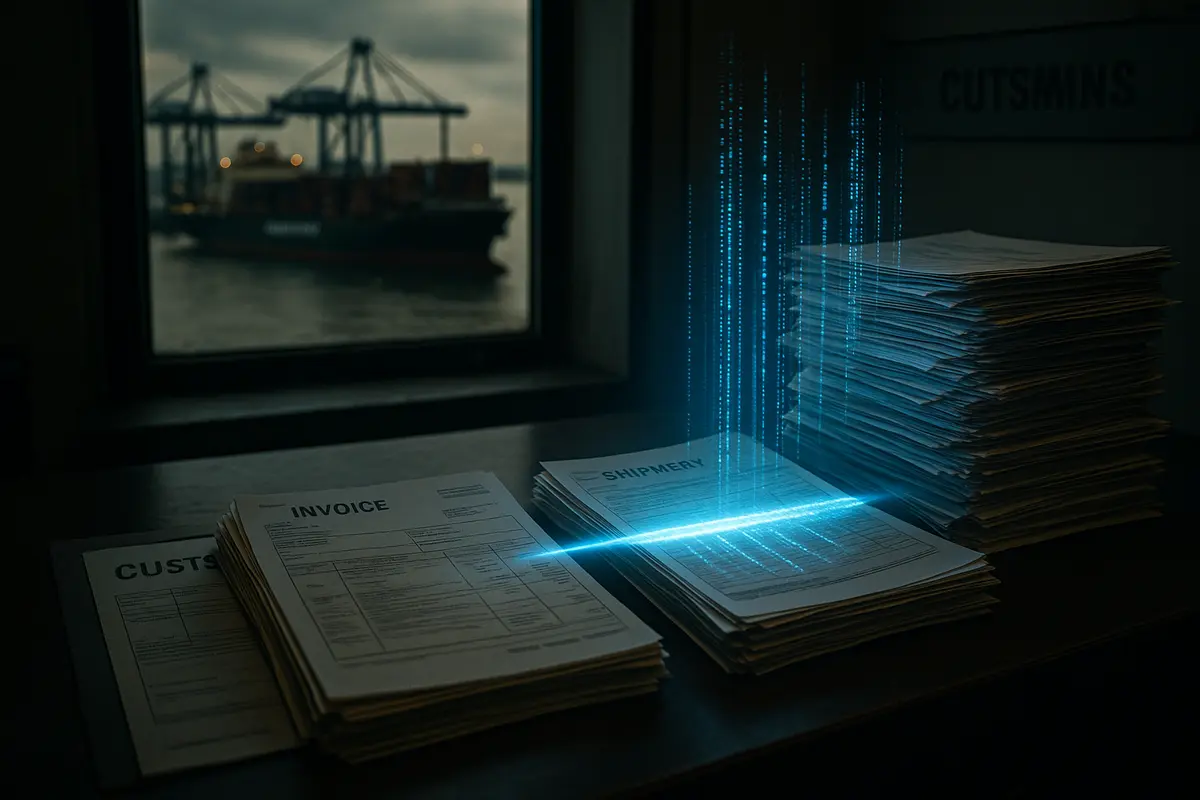
Every international shipment generates a paper trail — commercial invoices, packing lists, certificates of origin, bills of lading, phytosanitary certificates. For decades, customs brokers have manually keyed data from these documents into declaration systems, a process so error-prone and slow that the average customs clearance still takes three to five days. In 2026, AI-powered document processing is finally breaking that bottleneck.
The True Cost of Manual Customs Processing
The U.S. customs brokerage market alone is valued at $5.48 billion in 2026, growing at 2.88% CAGR — and a significant portion of that spend goes toward manual document handling. More than 9 million import entries flow through CBP's Automated Commercial Environment (ACE) each year, processed by over 14,000 licensed customs brokers.
The problem isn't volume — it's the error rate. According to Supply & Demand Chain Executive, businesses lose over $600 billion annually to data entry errors across supply chain operations. In customs specifically, a single misclassified tariff code can trigger duty overpayments of 5–6%, compliance penalties, or cargo holds that cascade into missed delivery windows and contract violations.
For a shipper moving 500 containers per year at an average clearance cost of $300–$500 per entry, even modest delays add up to hundreds of thousands in demurrage, detention, and lost revenue.
How AI Document Processing Works in Customs
Modern customs automation platforms combine three AI technologies to eliminate the manual data entry bottleneck:
Intelligent Document Recognition and OCR
Traditional OCR struggled with the variability of trade documents — different languages, formats, handwritten annotations, and poor scan quality. Today's intelligent document processing (IDP) systems use deep learning models trained on millions of customs documents to extract structured data from commercial invoices, packing lists, and certificates of origin with accuracy rates that match or exceed human operators.
These systems don't just read text — they understand document structure. An AI model can identify that a number appearing after "FOB Value" on a Chinese supplier's invoice represents the declared value, even when the layout differs completely from an invoice generated by a European manufacturer.
Natural Language Processing for Trade Documents
NLP engines analyze product descriptions in trade documents and cross-reference them against regulatory databases. When a commercial invoice describes goods as "polyester blend fabric rolls, 60-inch width, flame retardant," the NLP system maps this description to the correct tariff classification, identifies applicable trade agreements, and flags any restricted-party screening requirements — all in seconds rather than the 15–30 minutes a human broker would spend.
Automated HS Code Classification
Perhaps the most impactful application of AI in customs is automated Harmonized System code classification. With over 5,000 six-digit HS headings and country-specific extensions reaching 10+ digits, manual classification is both time-consuming and error-prone. AI classification engines now achieve 95% accuracy rates at the full tariff line level, continuously learning from CBP rulings, court decisions, and historical filing data.
The World Customs Organization's BACUDA initiative has been pioneering collaborative AI models that use historical trade data to predict HS codes, demonstrating that machine learning can support — and in many cases outperform — human classifiers on routine commodity types.
Pre-Clearance Risk Scoring: Catching Problems Before They Arrive
AI doesn't just speed up document processing — it fundamentally changes the clearance workflow by enabling pre-clearance risk assessment. Modern systems analyze shipment data as soon as documentation is available, days before cargo arrives at port.
Risk scoring algorithms evaluate multiple factors simultaneously:
- Document completeness: Are all required certificates, licenses, and permits attached?
- Valuation consistency: Does the declared value align with historical pricing for similar goods?
- Classification accuracy: Does the HS code match the product description and country of origin?
- Restricted-party screening: Do any parties in the transaction appear on denied-party lists?
- Trade agreement eligibility: Can preferential duty rates be claimed under applicable FTAs?
Shipments that pass all checks can be pre-cleared, moving through customs in hours rather than days. High-risk entries are flagged for broker review before they trigger CBP examinations, giving importers time to resolve discrepancies proactively rather than reactively.
Integration With CBP's ACE System
The U.S. government's shift to the Automated Commercial Environment has created the technical foundation for AI-powered customs automation. ACE provides a single-window platform for filing entries, but the data preparation — gathering, validating, and formatting information from trade documents — has remained largely manual.
AI document processing bridges this gap. Platforms now offer direct ACE integration that automatically populates entry fields from extracted document data, validates submissions against CBP requirements, and files entries electronically with minimal human intervention. What previously required a broker spending 30–45 minutes per entry can now be completed in under five minutes, with the AI handling data extraction, classification, and validation while the broker focuses on exception management.
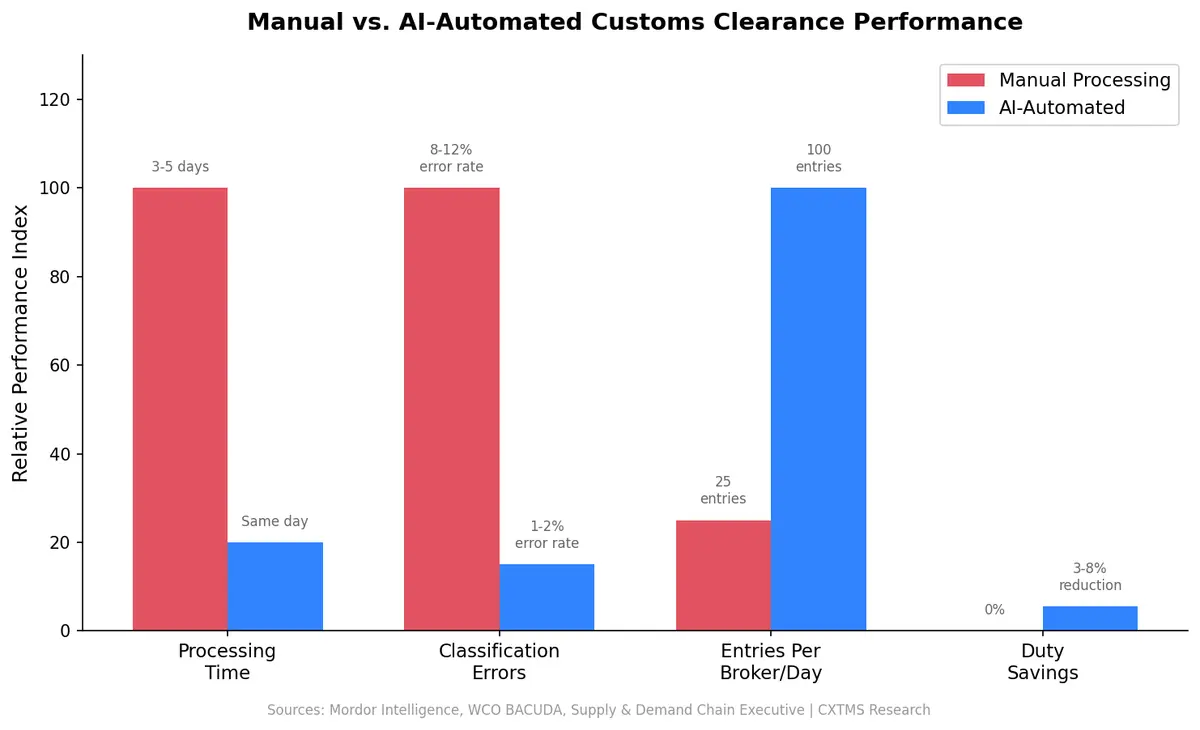
The ROI of Customs Automation
The business case for AI-powered customs clearance is compelling:
- Processing time reduction: 60–80% faster clearance processing, turning multi-day delays into same-day clearance for routine shipments
- Error rate reduction: AI-validated entries show 70–90% fewer classification errors compared to manual processing
- Duty optimization: Automated FTA qualification and accurate classification can reduce duty payments by 3–8% annually
- Labor efficiency: Customs brokers handle 3–4x more entries per day when AI handles document extraction and preliminary classification
- Penalty avoidance: Proactive compliance screening eliminates costly CBP penalties that can reach $10,000+ per violation
For mid-market importers processing 200–1,000 entries per month, the total savings from reduced broker fees, avoided penalties, lower duty rates, and faster cargo velocity typically deliver ROI within the first quarter of implementation.
What This Means for 2026 and Beyond
The customs clearance landscape is shifting from a manual, broker-dependent model to an AI-augmented workflow where technology handles routine processing and human experts focus on complex rulings, trade strategy, and exception management. As Maersk's customs trends outlook notes, 2026 will see greater emphasis on using advance data and public-private co-creation to reduce clearance times across borders.
Shippers who adopt document automation now will gain a structural advantage — faster clearance means lower inventory carrying costs, better customer service levels, and the ability to compete in markets where border efficiency determines whether goods arrive on time.
Struggling with customs clearance delays and compliance complexity? Contact CXTMS to see how our platform automates trade documentation and accelerates border clearance.