20% of U.S. Jobs Face Automation Risk: How Logistics Leads the Workforce Transformation

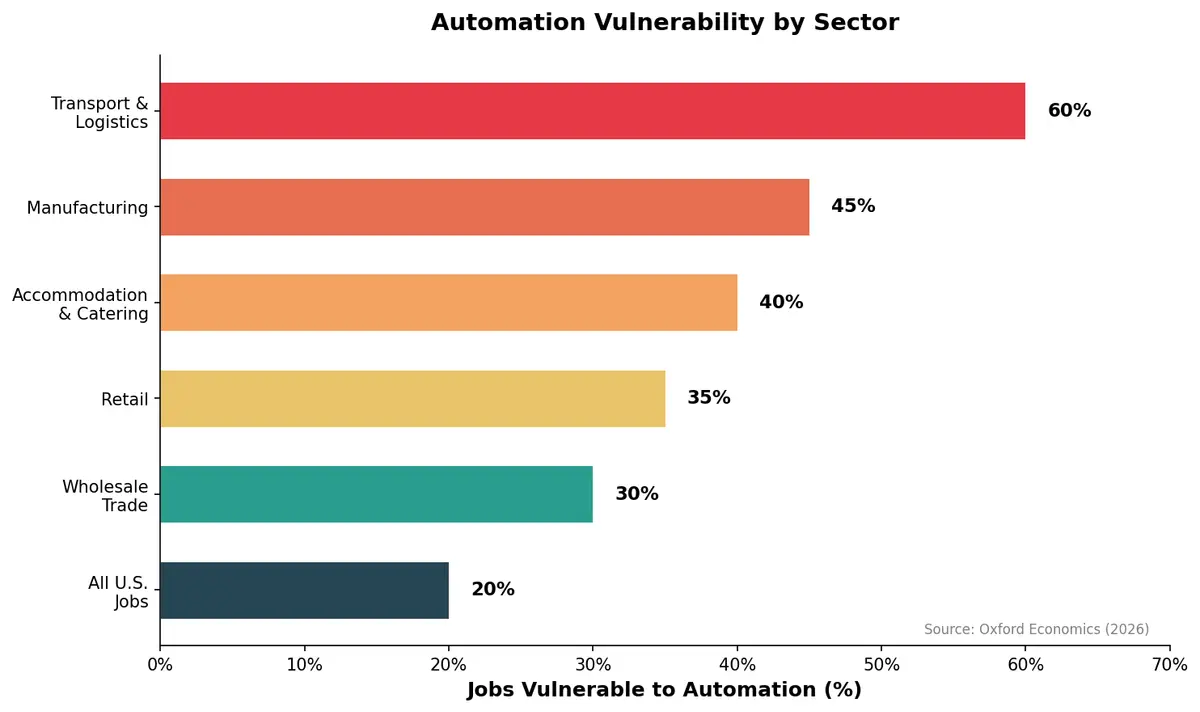
A new report from Oxford Economics is forcing the logistics industry to confront an uncomfortable reality: 20% of all U.S. jobs are highly vulnerable to automation using technology that already exists today — and transport and logistics sits squarely at the top of the risk chart.
The Oxford Economics Report: What the Numbers Say
The Oxford Economics report, which evaluated more than 800 different occupations, found that roughly one-fifth of American jobs could be replaced by commercially available robots and automation systems over the next two decades. But the risk isn't spread evenly.
Transport and logistics is the most vulnerable sector, with approximately 60% of jobs having the potential to be automated. That's a staggering figure for an industry that employs millions of Americans in roles ranging from truck drivers to warehouse workers to freight handlers.
"These jobs are not evenly distributed across the economy; they are, in fact, concentrated in a number of sectors where they make up an extraordinarily high amount of the workforce," Oxford Economics noted in the report. Technologies that once seemed futuristic — self-driving trucks and warehouse automation — have moved from R&D labs to commercial deployment.
Other high-risk sectors include manufacturing, accommodation and catering, retail, and wholesale trade. But logistics leads them all.
Physical AI: The Overlooked Disruption
Senior economist Nico Palesch, the report's author, highlighted a critical blind spot in the public discourse around automation. While headlines have fixated on generative AI's impact on white-collar work — copywriters, coders, analysts — the parallel revolution in physical AI and humanoid robotics poses an equally transformative threat to manual labor.
This is the concept of "physical AI" entering logistics: robots that don't just process data but physically move, sort, pick, pack, and deliver goods. The technology is no longer theoretical.
Amazon's Kent Fulfillment Center: A Preview of the Future
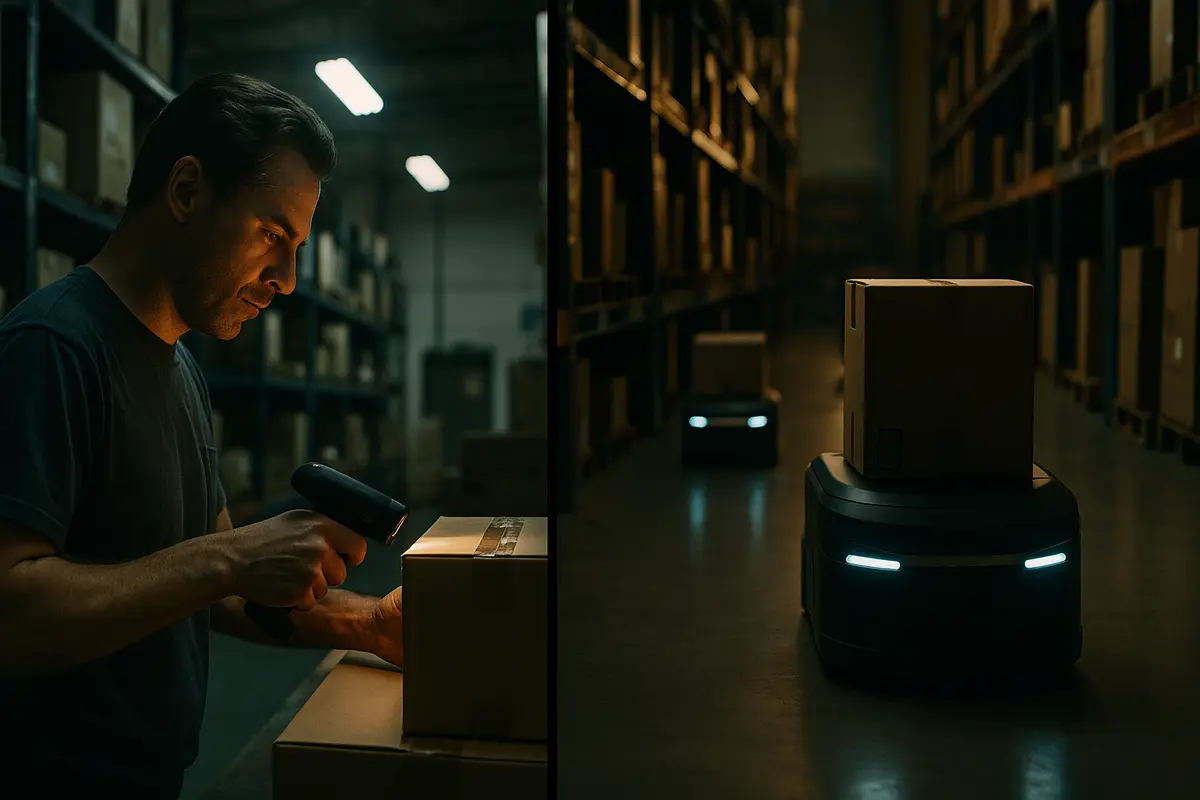
Amazon's BFI4 fulfillment center in Kent, Washington provides a real-world glimpse of what automation at scale looks like. More than 3,000 robots navigate the four-story facility, guided by continuously improving algorithms that make them faster and more efficient with each iteration.
The 850,000-square-foot center operates 24 hours a day, with approximately 3,000 human employees working alongside the robots — roughly a one-to-one ratio. But as robot capabilities increase, that ratio is expected to shift. Amazon isn't replacing workers overnight; it's gradually reducing the number of new hires needed as throughput grows.
Augmentation, Not Annihilation
Despite the headline-grabbing numbers, economists are careful to distinguish between vulnerability and inevitability. As Palesch told CBS News: "Just because there is the potential for automation doesn't mean these jobs are all going to be automated this year, next year or even within five years. Progress is incremental and ongoing."
The more likely scenario? A gradual shift in workforce composition. Restaurants aren't firing all cashiers on day one — they're installing kiosks and slowly reducing cashier hiring while redeploying workers elsewhere. The same pattern is emerging across logistics:
- Warehouse picking is shifting from manual labor to robot-assisted and autonomous systems
- Freight matching is moving from phone-based brokerage to AI-powered platforms
- Route optimization is transitioning from experienced dispatchers to algorithmic planning
- Dock operations are evolving from clipboard-based scheduling to automated yard management
McKinsey's research on supply chain workforce transformation reinforces this view, noting that AI adoption in logistics shifts workers toward "more value-adding tasks and a reduced manual workload" rather than eliminating roles entirely.
What This Means for Logistics Operators
The Oxford Economics findings carry three critical implications for supply chain leaders:
1. Workforce Planning Must Account for Automation Timelines
Companies that assume today's staffing models will hold for the next decade are planning blind. The 60% automation vulnerability figure means logistics operators need rolling workforce strategies that anticipate which roles will be augmented, transformed, or eliminated within five-year windows.
2. Technology Investment Is Now a Talent Strategy
The logistics industry has struggled with chronic labor shortages since the pandemic. Automation isn't just a cost play — it's increasingly the only way to maintain throughput as hiring becomes harder. Companies that invest in automation platforms and TMS systems today are building the infrastructure that will attract tech-savvy workers tomorrow.
3. Reskilling Is Non-Negotiable
The demand for work isn't disappearing — it's changing shape. As Palesch noted, "Together with automation comes the need to maintain robots, design robots, to teach people how to use robots." Logistics companies that pair automation investments with reskilling programs will retain institutional knowledge while building new capabilities.
How CXTMS Helps Teams Evolve
The workforce transformation isn't about choosing between humans and machines — it's about building systems where both operate at their best. CXTMS approaches automation as a force multiplier for logistics teams:
- Automated workflow engines handle repetitive tasks like shipment matching, document generation, and status updates — freeing operations staff to focus on exception management and customer relationships
- Intelligent alerting replaces the need for constant monitoring with proactive notifications that direct human attention where it matters most
- Configurable process automation lets teams gradually automate workflows at their own pace, without requiring a wholesale technology overhaul
The 20% figure from Oxford Economics isn't a prediction of mass unemployment — it's a signal that the logistics workforce of 2030 will look fundamentally different from today's. The companies that start preparing now will lead the transformation rather than be disrupted by it.
Ready to build automation that empowers your team? Contact CXTMS to see how intelligent workflow automation helps logistics operations scale without losing the human expertise that drives them.