The Kenco 2026 Innovation Report: How 150+ Supply Chain Executives Are Actually Deploying AI and Automation

Kenco's 2026 Innovation Report surveyed more than 150 North American supply chain executives and uncovered a striking paradox: the very forces driving companies toward innovation — inflation and labor shortages — are simultaneously making those projects harder to fund. Here's what the data reveals about where the industry is actually investing, what's working, and where the gaps remain.
The Innovation Paradox: Necessity Meets Constraint
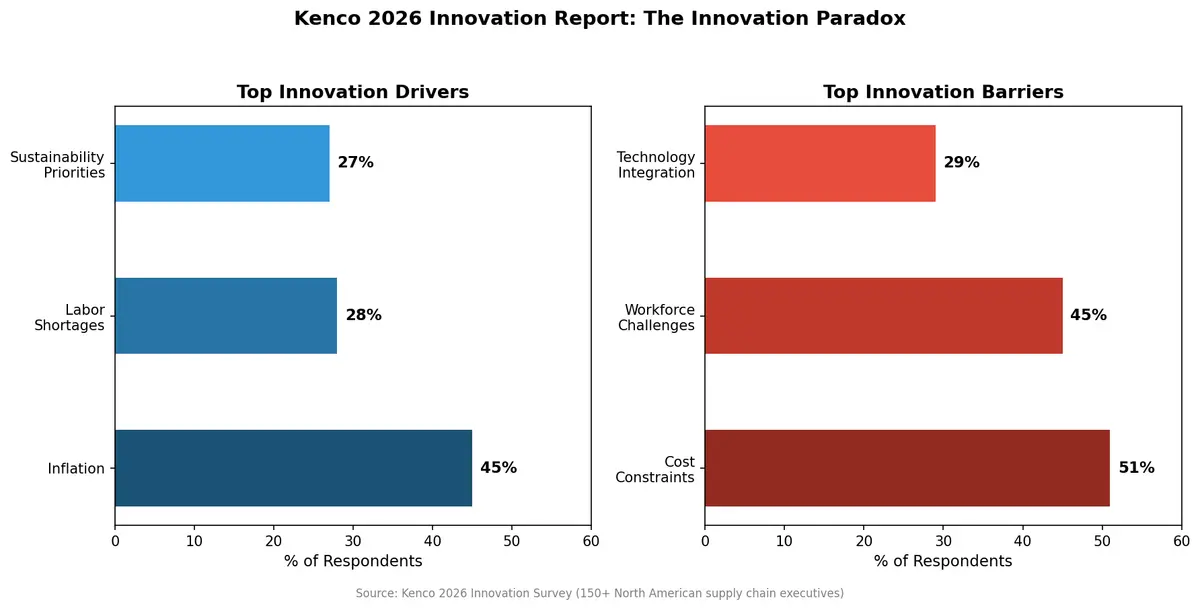
The headline finding from Kenco's survey is what they call the "innovation paradox." Nearly half of respondents (45%) cite inflation as their primary innovation driver, followed by labor shortages at 28% and sustainability priorities at 27%. These aren't theoretical concerns — they're operational emergencies forcing companies to modernize or fall behind.
Yet the barriers to progress mirror those same pressures. Cost constraints top the list at 51%, followed by workforce challenges (45%) and technology integration issues (29%). Companies know they need to innovate but find themselves squeezed between the urgency to act and the difficulty of funding action.
This paradox isn't unique to supply chain. Across the broader C-suite, Accenture's survey of 3,650 executives found that more than three-quarters expect higher levels of disruption in 2026, with 85% planning to increase AI spending — yet employee confidence in job security has dropped 11 percentage points since mid-2025.
Where the Money Is Going
Despite the squeeze, commitment remains strong. 83% of respondents reported having a dedicated 2026 innovation budget, and nearly half (49%) are working with budgets of at least $500,000. While overall budget increases dipped slightly — 35% reported increases, down from 39% the prior year — the investment levels remain substantial.
What's more telling is where that money is going. Supply chain leaders are prioritizing foundational improvements over flashy deployments:
- Quality improvements: 33% of respondents ranked this as their top priority
- Inventory management: 27% are focusing investment here
- Labor efficiency: 23% are targeting workforce productivity gains
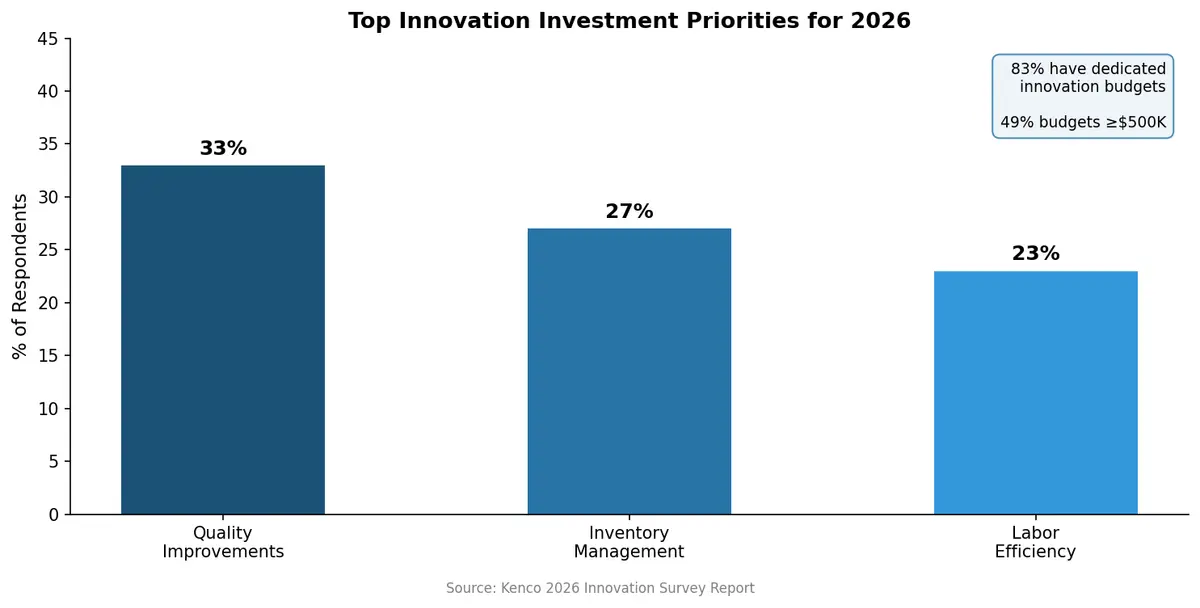
This suggests a maturing industry. Rather than chasing the latest AI demo, executives are investing in the operational foundations that make advanced technology actually useful. You can't deploy machine learning for demand forecasting if your underlying data quality is poor. You can't automate warehouse workflows if your inventory management is unreliable.
Proven Technology Over Novelty
One of the most revealing data points: 42% of executives favor established technologies, and another 43% prefer a blend of existing and emerging solutions. Only a small minority are pursuing bleeding-edge technology for its own sake.
"Supply chain leaders are past the stage of experimenting with innovation just to see what's possible," said Kristi Montgomery, Vice President of Strategic Transformation at Kenco. "They're looking for solutions that positively impact cost, service, and resilience."
This aligns with a broader industry pattern. The Kenco report confirms that organizations are gravitating toward reliability: proven ROI, established vendor ecosystems, and technology that integrates with existing infrastructure. The era of pilot-project tourism — running flashy proof-of-concepts that never scale — appears to be fading.
The Organizational Barrier Nobody Talks About
Perhaps the most underappreciated finding is that organizational challenges — not technology — provide the biggest implementation hurdles. Respondents consistently pointed to misalignment across Operations, IT, HR, Risk, and Legal as common causes of project delays and failures.
This is a critical insight. Most technology vendors sell the promise of their platform's capabilities. But the Kenco data shows that cross-functional coordination is the actual bottleneck. A TMS implementation doesn't fail because the software can't handle the routing logic — it fails because Operations and IT can't agree on data standards, or because Legal's compliance review adds three months to the timeline.
Companies that get innovation right aren't necessarily the ones with the biggest budgets. They're the ones with the strongest internal alignment and the governance structures to move cross-functional projects from pilot to production.
The Rising Role of 3PL Partners
The survey reveals a significant shift in how companies view their third-party logistics partners. 37% of respondents now rely on their 3PL across all four key areas: strategy, implementation, funding, and ongoing operations.
This marks a departure from the traditional transactional 3PL relationship. Companies are no longer just outsourcing warehouse space and truck capacity — they're expecting their logistics partners to bring technology expertise, innovation funding, and strategic guidance. It's a recognition that most mid-market shippers don't have the internal resources to evaluate, implement, and operate advanced supply chain technology on their own.
Bridging the Gap Between Leaders and Laggards
The Kenco data, combined with the Accenture findings showing 70% of supply chain leaders investing in AI and digital tools, paints a picture of an industry bifurcating. On one side, companies with dedicated innovation budgets, strong cross-functional governance, and strategic 3PL partnerships are pulling ahead. On the other, organizations still struggling with basic data quality and departmental silos are falling further behind.
The gap isn't primarily about budget size. Nearly half the companies surveyed have innovation budgets under $500,000, yet many are still making meaningful progress. The differentiator is execution discipline: clear priorities, proven technology choices, and organizational alignment.
What This Means for Your Supply Chain Strategy
The Kenco report offers a practical roadmap for supply chain leaders navigating 2026:
- Fix foundations first. Quality, inventory accuracy, and labor efficiency aren't glamorous, but they're where the ROI lives.
- Favor proven over novel. Blend established and emerging technology rather than betting on unproven solutions.
- Solve the organizational problem. Align Operations, IT, and leadership before selecting technology — not after.
- Leverage your 3PL strategically. If you're still treating your logistics partners as commodity providers, you're leaving value on the table.
- Commit a dedicated budget. Companies with ring-fenced innovation funding move faster than those fighting for dollars from general IT budgets.
The companies that thrive in 2026 won't be the ones with the most advanced AI deployments. They'll be the ones that paired the right technology with the right organizational discipline to actually execute.
Need a TMS platform that delivers proven ROI without the implementation complexity? Contact CXTMS for a demo and see how we help mid-market shippers modernize their logistics operations.