Spatial Computing Enters the Warehouse: How Mixed Reality Headsets Are Transforming Facility Management in 2026

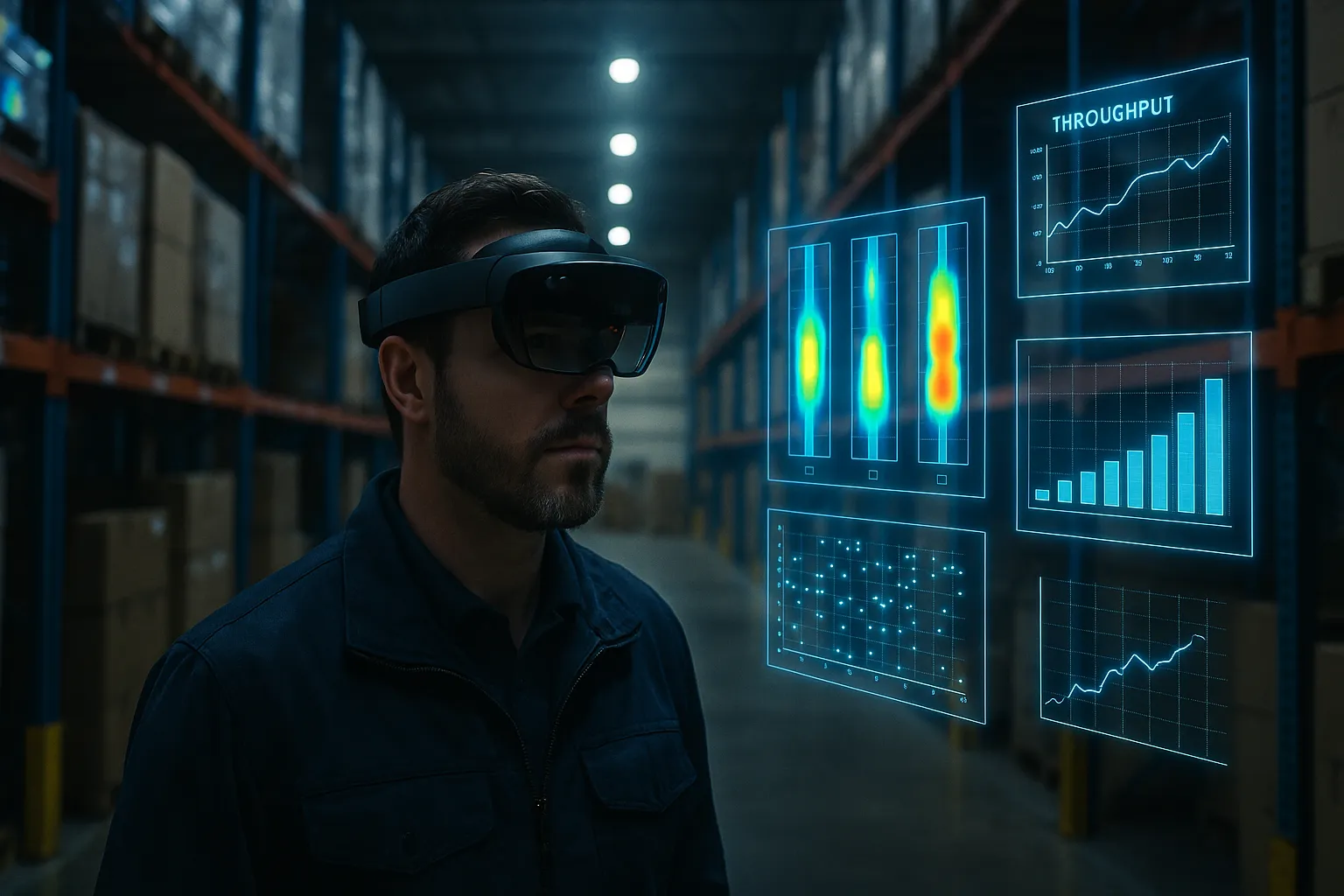
Walk into a progressive distribution center today and you might see something that would have seemed like science fiction five years ago: a facility manager wearing a sleek mixed reality headset, walking through aisles while holographic heat maps of throughput data float above conveyor lines, pick zones glow with real-time productivity scores, and maintenance alerts hover over equipment that's trending toward failure. This isn't a trade show demo anymore—it's the emerging reality of spatial computing in warehouse operations.
A Market Reaching Critical Mass
The numbers tell the story of an industry approaching an inflection point. According to Allied Market Research, the global spatial computing market is projected to reach $1.06 trillion by 2034, growing at a 22.6% CAGR from its current base. Within this broader market, logistics and warehouse operations represent one of the fastest-growing enterprise segments.
The AR and mixed reality market specifically is even more aggressive. Mordor Intelligence estimates the combined augmented reality and mixed reality market at $256.91 billion in 2025, forecasting it to reach $998.14 billion by 2030 at a 31.19% CAGR. Stand-alone head-mounted displays held 48% of revenue share in 2024, while smart glasses are forecast to grow at 33% CAGR through 2030—both form factors finding homes in warehouse environments.
What's driving enterprise adoption? A 2025 Forrester Total Economic Impact study commissioned by Meta found that mixed reality deployments provided significant net present value over three years for enterprise organizations, with measurable gains in training efficiency, remote collaboration, and operational productivity. Mars Petcare, for example, cut coaching travel costs by 35% after deploying RealWear HMT-1 wearables for remote expert assistance.
Walking Through Holographic Warehouse Twins
The most transformative use case for spatial computing in warehousing isn't picking or packing—it's facility management and layout optimization. Imagine being able to walk through your warehouse and see a holographic digital twin overlaid on the physical space, showing:
- Throughput heat maps that reveal which aisles are bottlenecked and which zones are underutilized
- Equipment health indicators floating above each conveyor section, sortation unit, and robotic cell with predictive maintenance timelines
- Worker movement patterns visualized as flow lines, instantly highlighting inefficient travel paths
- Inventory density overlays showing real-time stock levels by zone without checking a screen
This is fundamentally different from looking at the same data on a 2D dashboard. Spatial context changes how managers process information. When you can physically stand at a merge point and see holographic data showing that throughput drops 40% during shift changes, the root cause becomes viscerally obvious in a way that a spreadsheet never communicates.
Several MHI member companies are already building spatial-awareness capabilities into their warehouse management platforms. Fulfilld, for instance, uses patent-pending spatial-awareness digital twin technology combined with AI and ML-powered operational recommendations to optimize product placement and worker productivity—reporting 40% reductions in wasted worker activity and 24% improvements in inventory accuracy.
Use Cases Moving from Pilot to Production
Facility Layout Review and Redesign
Before committing to a warehouse reconfiguration, facility managers can use mixed reality to visualize proposed changes overlaid on the existing space. Walk through the "new" layout while standing in the current one. See where new racking will go, how robot paths will change, and where congestion points might emerge—all before moving a single shelf.
Safety Training and Compliance
Mixed reality training programs allow new employees to experience hazardous scenarios—forklift near-misses, emergency evacuation routes, lockout-tagout procedures—in a safe but viscerally realistic environment. Studies consistently show that immersive training improves retention rates by 75% compared to classroom instruction and reduces on-the-job safety incidents.
Remote Maintenance and Expert Assistance
When a critical piece of equipment goes down, the on-site technician can don a mixed reality headset and share their first-person view with a remote expert who annotates the physical equipment with holographic repair instructions. This eliminates costly expert travel and reduces mean time to repair. Companies deploying this approach report 30–50% reductions in equipment downtime.
Quality Control and Inspection
Spatial computing enables quality inspectors to see holographic overlays of expected product placement, label positioning, and packaging standards while visually inspecting physical goods—catching deviations in real time rather than through after-the-fact auditing.
The Vendor Landscape and Cost Reality
The enterprise mixed reality headset market has matured significantly. The Meta Quest 3 at $499 offers an accessible entry point for warehouse pilots with solid mixed reality passthrough capabilities. Apple Vision Pro occupies the premium tier with superior display fidelity. Microsoft HoloLens 2 remains a staple for industrial applications with its enterprise management features, though its future roadmap remains uncertain. The Samsung–Google–Qualcomm Android XR alliance is racing to deliver new options that could reshape the competitive landscape.
For a mid-size warehouse operation, a pilot deployment of 10–15 headsets with supporting software typically runs $50,000–$150,000 including integration work. That's a fraction of the cost of a single warehouse reconfiguration project gone wrong—which can easily exceed $500,000 when you factor in lost throughput during the transition.
Adoption Barriers Are Real but Shrinking
Let's be honest about what's still holding back widespread adoption. Battery life remains a constraint—most headsets deliver 2–3 hours of continuous mixed reality use, which doesn't cover a full shift. Display quality in bright warehouse lighting can wash out holographic overlays. IT departments face new device management challenges. And there's a simple human factor: not everyone is comfortable wearing a headset for extended periods.
But each of these barriers is actively shrinking. Battery technology is improving rapidly. Display brightness is increasing generation over generation. Mobile device management (MDM) platforms now support XR headsets alongside phones and tablets. And as devices get lighter and more comfortable, user acceptance rises.
The ROI timeline for most warehouse spatial computing deployments is 12–18 months, driven primarily by reduced facility planning errors, faster maintenance resolution, and improved training outcomes.
How CXTMS Logistics Data Feeds Spatial Computing Dashboards
The value of spatial computing in warehouse management is directly proportional to the quality of data feeding those holographic overlays. This is where transportation management becomes a critical input.
CXTMS provides the logistics data layer that makes spatial computing actionable for facility managers. Real-time shipment visibility, carrier performance metrics, dock scheduling data, and freight flow patterns from CXTMS feed directly into spatial computing dashboards, giving facility managers a holographic view that extends beyond the four walls of the warehouse to the entire inbound and outbound logistics network.
When a facility manager walks their dock doors wearing a mixed reality headset, CXTMS data can power overlays showing which carriers are en route, estimated arrival times, load compositions, and historical dwell time patterns for each dock position. That's not just warehouse management—it's end-to-end supply chain visibility rendered in three-dimensional space.
Ready to future-proof your warehouse operations with data-driven logistics intelligence? Request a CXTMS demo and see how our platform powers the next generation of facility management.