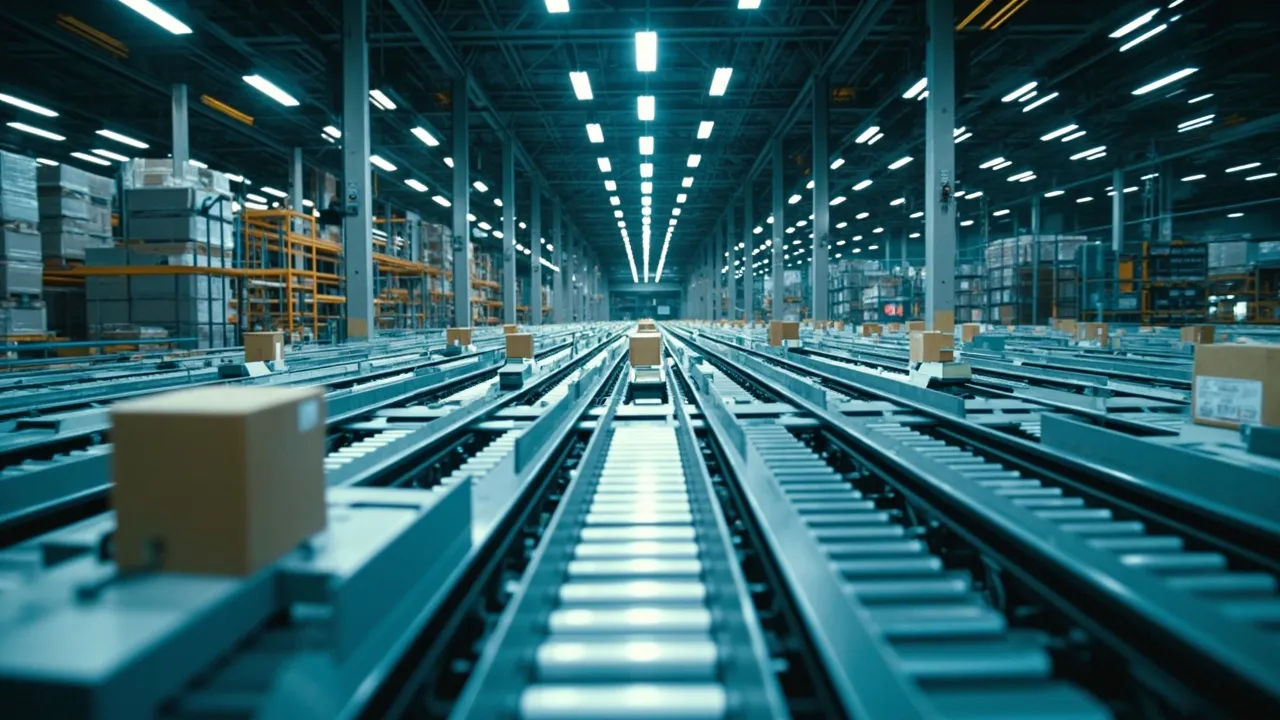
The Warehouse Simulation Market Hits New Heights: Why Pre-Build Digital Modeling Is Becoming Mandatory for New Facilities


The days of designing a warehouse on paper and hoping the layout works are over. As automation complexity skyrockets—with robotic picking systems, autonomous mobile robots (AMRs), and multi-level conveyor networks all competing for floor space—the cost of getting a facility design wrong has never been higher. That's why the warehouse simulation market is exploding, and pre-build digital modeling is quickly shifting from a nice-to-have to a non-negotiable requirement.
A Market Growing at 14.5% CAGR
According to Market.us, the global warehouse simulation market was valued at approximately $617.7 million in 2025 and is expected to reach $2,392.4 million (nearly $2.4 billion) by 2035, growing at a compound annual growth rate of 14.5%. Separate estimates from Analyst View Market Insights peg the 2024 valuation at $590.39 million with a slightly higher CAGR of 15.2% through 2032. Either way, the trajectory is unmistakable: the industry is betting billions on the idea that you should build your warehouse in software before you pour a single slab of concrete.
What's driving this growth? Three converging forces. First, the sheer density of automation in modern facilities means that even small layout miscalculations create cascading throughput failures. Second, the cost of warehouse construction has risen sharply—an average new fulfillment center now runs $150 to $250 per square foot—making rework prohibitively expensive. Third, the rise of multi-channel fulfillment has made facility designs far more complex, with e-commerce pick-pack-ship operations coexisting alongside bulk pallet distribution under the same roof.
Pre-Build Simulation vs. Operational Digital Twins: Understanding the Difference
There's an important distinction that often gets blurred in industry conversations: pre-build simulation and operational digital twins serve fundamentally different purposes.
Pre-build simulation happens before a facility exists. Engineers create a virtual model of the proposed warehouse—including racking layouts, conveyor paths, robot staging areas, dock door configurations, and worker travel paths—then run thousands of scenarios to stress-test the design. The goal is to identify bottlenecks, validate throughput assumptions, and optimize layouts before construction begins.
Operational digital twins, by contrast, mirror a facility that already exists. They ingest real-time sensor data from WMS, WCS, and IoT systems to monitor live operations, predict equipment failures, and optimize ongoing workflows.
The simulation market's explosive growth is being driven primarily by the pre-build use case. As Modern Materials Handling reports, warehouses and fulfillment centers are increasingly automated, asset-intensive operations where multiple types of automation systems and robotics need to work together to hit throughput goals. Simulation is the only reliable way to validate that interplay before committing capital.
Key Vendors Shaping the Market
The vendor landscape for warehouse simulation is maturing rapidly:
-
Autodesk FlexSim (formerly FlexSim Software Products, acquired by Autodesk) has emerged as one of the leading platforms for 3D warehouse simulation, offering drag-and-drop model building with statistical reporting and scenario optimization. The platform enables teams to test facility designs, resource allocation, and system configurations in a risk-free virtual environment.
-
Siemens has expanded aggressively into supply chain simulation through its Tecnomatix portfolio and, more recently, its Digital Twin Composer platform built on NVIDIA Omniverse.
-
Rockwell Automation offers Arena Simulation software, widely used in manufacturing and distribution environments for process modeling and capacity analysis.
-
Manhattan Associates, Dematic, and KNAPP have all integrated simulation capabilities into their warehouse design services, allowing customers to model material flow before committing to automation investments.
The PepsiCo-Siemens-NVIDIA Deployment: A Case Study in Scale
Perhaps the most compelling validation of pre-build simulation's value comes from PepsiCo's partnership with Siemens and NVIDIA, announced in early 2026. PepsiCo is digitally transforming select U.S. manufacturing and warehouse facilities using Siemens' Digital Twin Composer, powered by the NVIDIA Omniverse platform.
The results speak volumes: the simulation-first approach is identifying up to 90% of potential issues before physical build. That statistic alone justifies the investment. Consider what it means in practice—nine out of ten problems that would have required costly rework, construction delays, or post-launch firefighting are caught and resolved in software. For a company operating at PepsiCo's scale, with hundreds of facilities across its global network, the savings compound dramatically.
This deployment also demonstrates a critical trend: pre-build simulation is no longer just for greenfield facilities. PepsiCo is applying it to brownfield transformations—retrofitting existing facilities with new automation while using simulation to validate the integration before disrupting live operations.
ROI Metrics That Are Winning Over CFOs
The business case for pre-build simulation is built on hard numbers:
-
Reduced commissioning time: Facilities that undergo simulation-validated design typically see 20–30% shorter commissioning timelines because integration issues are resolved virtually, not on the warehouse floor with cranes and contractors standing idle.
-
Layout optimization: Simulation allows engineers to test dozens of layout variations in hours, not months. Research consistently shows that optimized layouts reduce worker travel time by 15–25% and increase throughput density by 10–20%.
-
Avoided rework costs: The industry rule of thumb is that changes during the design phase cost 1x, changes during construction cost 10x, and changes after go-live cost 100x. Simulation keeps the vast majority of changes in the 1x zone.
-
Faster time to full capacity: Simulated facilities typically reach target throughput 40–60% faster than non-simulated peers, because operational assumptions have already been validated.
For a $50 million facility buildout, even a conservative 5% savings through simulation-driven optimization represents $2.5 million—far exceeding the typical $200,000–$500,000 investment in a comprehensive simulation study.
Why Mid-Market Shippers Can't Afford to Skip Simulation
It's tempting to view simulation as an enterprise-only play—something for the PepsiCos and Amazons of the world. But mid-market shippers actually have more to lose from a bad facility design because they lack the financial cushion to absorb costly rework.
The good news is that simulation tools have become significantly more accessible. Cloud-based platforms have lowered the entry barrier, and many third-party logistics engineering firms now offer simulation-as-a-service engagements that don't require purchasing expensive software licenses.
For companies planning new facilities or major automation retrofits in 2026 and beyond, the question is no longer whether to simulate—it's how early in the planning process to start.
How CXTMS Integrates with Simulation Outputs for Go-Live Freight Planning
Facility simulation doesn't exist in isolation. A perfectly optimized warehouse layout means nothing if the freight flowing into and out of the building isn't equally optimized. That's where CXTMS bridges the gap.
CXTMS connects with simulation outputs to align inbound and outbound freight planning with facility design assumptions. When a simulation model calculates expected dock door utilization, truck turn times, and daily shipment volumes, CXTMS uses those projections to pre-configure carrier assignments, optimize dock scheduling, and establish rate benchmarks—so that when the facility goes live, freight operations are ready from day one, not scrambling to catch up.
Ready to align your freight operations with your next facility design? Request a CXTMS demo and see how integrated transportation management turns simulation insights into operational reality.