PepsiCo's Multi-Year Digital Twin Partnership with Siemens and NVIDIA: A Blueprint for CPG Supply Chain Transformation

At CES 2026 in January, PepsiCo announced what may become the most significant digital twin deployment in consumer packaged goods (CPG) history: a multi-year, industry-first collaboration with Siemens and NVIDIA to transform plant and supply chain operations through advanced digital twin technology and AI. The partnership isn't a proof-of-concept or a limited pilot — it's a full-scale commitment to reshaping how one of the world's largest CPG companies designs, tests, and optimizes its global operations.
For logistics and supply chain professionals watching from the sidelines, this announcement carries enormous implications. Here's what the partnership entails, why it matters, and what lessons mid-market shippers can extract from it.
The Partnership: What PepsiCo Is Actually Building
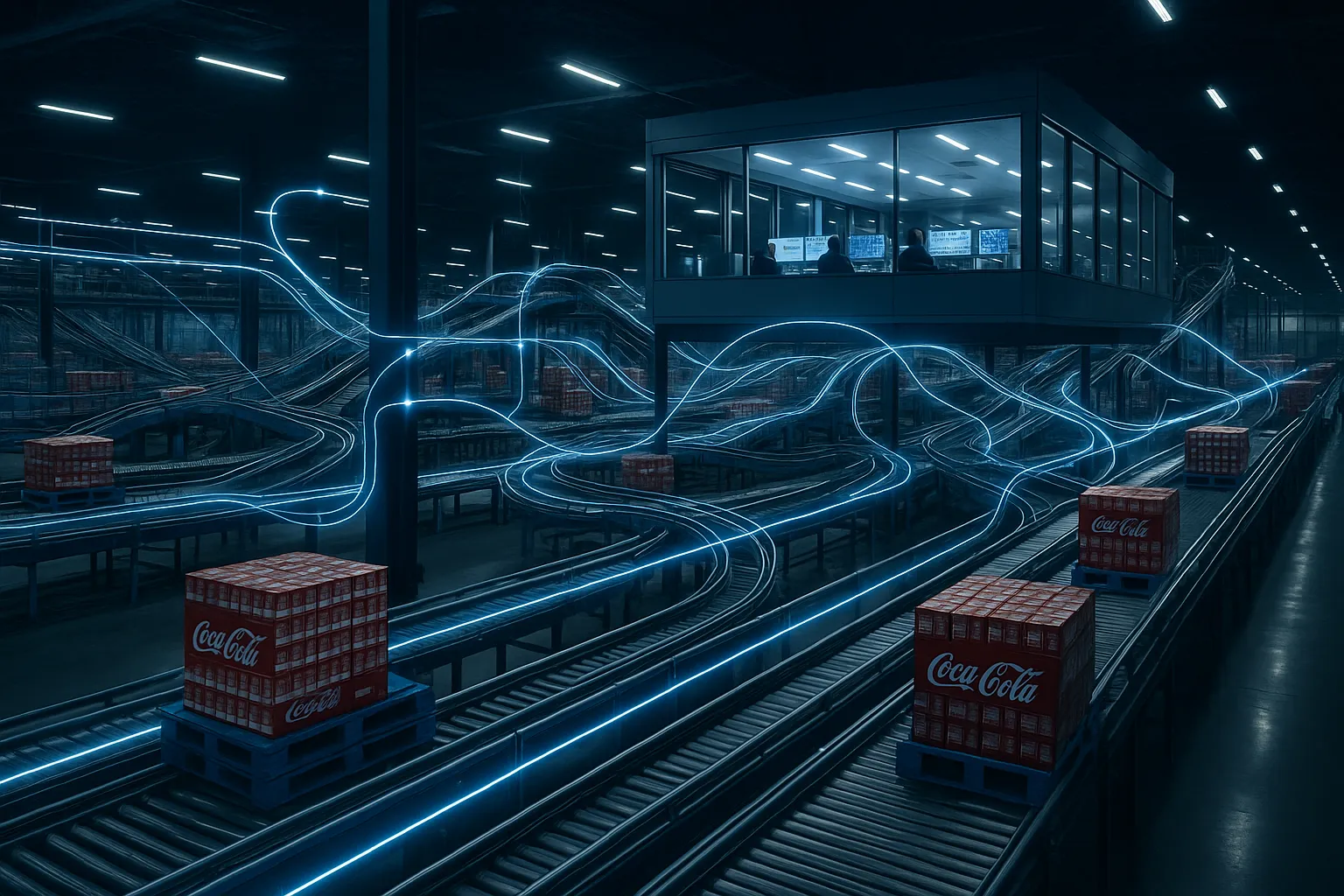
PepsiCo's collaboration with Siemens and NVIDIA centers on converting physical manufacturing and warehouse facilities into high-fidelity 3D digital twins. These aren't simplified dashboards or basic simulations. Using Siemens Digital Twin Composer built on NVIDIA Omniverse libraries, PepsiCo is creating physics-based virtual replicas of its U.S. facilities that simulate plant operations and the end-to-end supply chain.
As PepsiCo Chairman and CEO Ramon Laguarta explained at the announcement, "The scale and complexity of PepsiCo's business, from farm to shelf, is massive — and we are embedding AI throughout our operations to better meet the increasing demands of our consumers and customers."
Early pilots are already underway in U.S. manufacturing and warehouse facilities, with plans to scale globally. Within weeks of deployment, teams were able to optimize and validate new configurations to boost capacity and throughput — a process that traditionally takes months of physical trial and error.
Why This Matters: The Digital-First Planning Shift
The traditional approach to facility expansion and optimization in CPG is slow, expensive, and risky. Companies build or retrofit facilities based on projections, then spend months adjusting layouts and workflows post-construction. PepsiCo is flipping this model entirely with a digital-first planning strategy.
Instead of guessing and adjusting, PepsiCo's teams now use AI agents as co-designers within the digital twin environment to simulate, validate, and optimize facility layouts before any physical build begins. NVIDIA CEO Jensen Huang described it plainly: "For companies with real-world assets, digital twins are the foundation of their AI journey."
The implications extend far beyond PepsiCo. The broader digital twin market is experiencing explosive growth, valued at approximately $31.8 billion in 2026 and projected to grow at a CAGR of 27.5% through 2033, according to Grand View Research. The digital twin supply chain segment specifically is growing at a 19.2% CAGR, driven by Industry 4.0 adoption across manufacturing and logistics.
NVIDIA Omniverse: The Technology Backbone
At the heart of this deployment is NVIDIA Omniverse, a platform for building and operating physically accurate virtual worlds. Omniverse enables PepsiCo to create photorealistic, physics-based simulations of its facilities — including conveyor systems, robotic stations, inventory flows, and worker movements.
Siemens' Digital Twin Composer layers on top of Omniverse to combine 2D and 3D digital twin data with real-time physical information from sensors on the actual facility floor. The result is a managed, secure, high-fidelity 3D experience that covers the entire lifecycle of a facility — from initial design through daily operations.
This isn't just visual modeling. The physics-based nature of the simulation means that gravity, friction, throughput rates, and material handling dynamics all behave as they would in the real world. When PepsiCo tests a new conveyor layout or changes a picking zone configuration in the digital twin, the performance metrics they see closely mirror what would happen in the physical space.
What PepsiCo Gains: Concrete Operational Advantages
The partnership delivers several measurable benefits that any supply chain leader should note:
Compressed planning cycles. Facility redesigns that previously took months of physical prototyping can now be simulated and validated in weeks. PepsiCo's early U.S. pilots already demonstrated this acceleration.
Demand-supply synchronization. By modeling the entire end-to-end supply chain — not just individual facilities — PepsiCo can test how changes in one node affect the whole network before committing resources.
Capacity optimization without expansion. Rather than building new facilities, PepsiCo is using digital twins to find hidden capacity within its existing footprint, a critical advantage when construction costs continue to climb.
AI-driven continuous improvement. The digital twin environment becomes a testbed for AI agents that identify optimization opportunities humans might miss — from subtle layout improvements to predictive maintenance scheduling.
Lessons for Mid-Market CPG Shippers
You don't need PepsiCo's budget to start benefiting from digital twin thinking. Here's what mid-market companies can take away:
Start with simulation, not replication. Full-scale digital twins of entire supply chains are expensive. But targeted simulation of your highest-cost facility or most complex fulfillment workflow can deliver outsized ROI. Supply Chain Brain recently highlighted "digital sandboxes" as a practical middle ground — lightweight simulation tools that sit between spreadsheets and full digital twins.
Invest in data quality first. Digital twins are only as good as the data feeding them. Before investing in simulation platforms, ensure your WMS, TMS, and ERP systems are producing clean, interoperable data.
Think beyond the warehouse. PepsiCo's partnership explicitly covers the end-to-end supply chain, not just warehouse operations. The greatest value often comes from modeling how transportation, inventory, and facility decisions interact.
Watch the vendor landscape. Siemens, NVIDIA, and their competitors are rapidly democratizing digital twin tools. What requires a Fortune 500 budget today may be accessible to mid-market companies within 18 to 24 months as platforms mature and pricing evolves.
How CXTMS Supports Your Digital Twin Journey
Digital twins generate powerful insights, but those insights need to connect to real-world freight execution. CXTMS bridges this gap by providing the real-time freight data, rate benchmarking, and carrier performance analytics that digital twin models need to accurately simulate transportation decisions.
Whether you're modeling a new distribution center layout or testing how carrier mix changes affect delivery performance, CXTMS ensures your simulations are grounded in live market data — not assumptions.
Ready to connect your logistics data to smarter planning? Request a CXTMS demo and see how real-time freight intelligence powers better supply chain decisions.