Booking Process
The booking process is the sequence of steps through which a freight forwarder or shipper reserves cargo space with a carrier. From initial rate inquiry to confirmed booking, each stage involves specific information exchanges and decisions that determine how, when, and at what cost goods will be transported.
A well-executed booking process ensures that cargo space is secured, documentation requirements are understood, and all parties have aligned expectations before goods leave the origin.
A freight booking is a formal reservation of cargo space on a specific vessel, flight, or truck, confirmed by a carrier or freight forwarder, along with the associated service terms, rates, and departure schedule.
The Booking Workflow — Complete Visual Guide
The following diagram shows the complete freight booking workflow from initial rate inquiry through cargo tender and transport document issuance. Use this as a reference for timing, decision points, and required information at each stage:
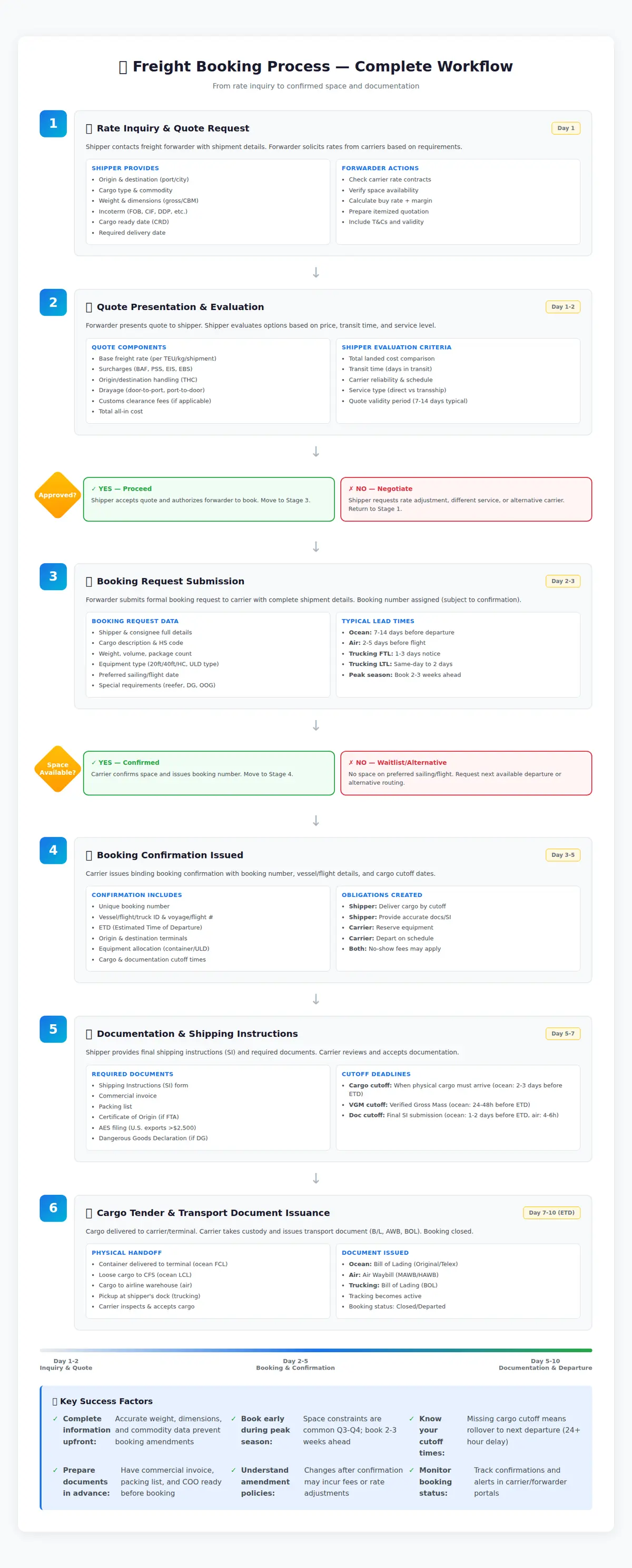
Workflow timing:
- Ocean freight: 7-14 days lead time (longer during peak season)
- Air freight: 2-5 days lead time (same-day possible for urgent shipments)
- Trucking (FTL): 1-3 days notice typical
- Trucking (LTL): Same-day to 2 days
Critical success factors:
- Provide complete, accurate cargo details at initial inquiry (prevents amendments)
- Book early during peak season (Q3-Q4) to secure space
- Know your cutoff times: cargo cutoff, VGM cutoff (ocean), and doc cutoff
- Prepare documents in advance (commercial invoice, packing list, COO)
- Understand amendment and cancellation policies before confirming
The Booking Workflow
The booking workflow varies slightly by transport mode (ocean, air, trucking) but follows a common pattern:
Key Stages
| Stage | Action | Information Required | Output |
|---|---|---|---|
| 1. Rate Inquiry | Shipper provides cargo details and requests pricing | Origin, destination, cargo type, weight/volume, Incoterm, timeline | Rate quotation from forwarder or carrier |
| 2. Quote Evaluation | Shipper reviews rates, transit times, and service options | Breakdown of base rates, surcharges, total charges | Decision to proceed or negotiate |
| 3. Booking Request | Forwarder submits formal booking to carrier | Complete shipment details, shipper/consignee info, commodity description | Booking number (subject to confirmation) |
| 4. Booking Confirmation | Carrier confirms space and issues booking number | N/A | Binding reservation with booking number, vessel/flight/truck details |
| 5. Documentation Submission | Shipper provides final shipping instructions and required documents | Commercial invoice, packing list, export licenses (if needed) | Documents reviewed and accepted by carrier |
| 6. Cargo Tender | Cargo delivered to carrier or terminal | Container stuffing list (ocean), AWB details (air), BOL draft (trucking) | Cargo in carrier's custody, tracking begins |
For ocean freight, bookings are typically made 7-14 days before the vessel's departure (earlier during peak season). For air freight, bookings may be made 2-5 days in advance, or even same-day for urgent shipments. Trucking bookings can often be same-day or next-day, depending on lane and capacity.
Rate Inquiry and Quotation
Before a booking can be made, shippers or forwarders must obtain rate quotes from carriers. The accuracy and completeness of the rate inquiry directly impacts quote reliability.
Information Required for Accurate Quotes
| Data Element | Why It Matters | Example |
|---|---|---|
| Origin & Destination | Determines routing, available carriers, base rates | "Los Angeles, CA to Hamburg, Germany" or "Shanghai to Chicago, IL" |
| Cargo Type | Affects handling, equipment, surcharges (DG, reefer, oversized) | "General dry goods, non-hazardous" or "Lithium batteries (UN3481)" |
| Weight & Dimensions | Calculates freight charges (W/M in ocean, DIM weight in air, class in LTL) | "1,200 kg gross, 3.5 CBM" or "850 lbs, 48x40x60 inches" |
| Incoterm | Defines who arranges and pays for main carriage | "FOB Shanghai" or "DDP Hamburg" |
| Cargo Ready Date / Required Delivery Date | Narrows carrier/service options, affects rates (expedited vs. standard) | "CRD: March 15, 2026" or "Must deliver by March 30" |
| Commodity Description | Required for tariff classification, compliance checks | "Apparel - cotton T-shirts" or "Automotive parts - brake pads" |
| Packaging | Influences handling (palletized, crated, loose cartons) | "40 cartons on 4 pallets" or "Loose cartons" |
| Special Requirements | Adds costs (temperature control, tail-lift delivery, inside delivery) | "Reefer container, maintain 2-8°C" or "Liftgate required" |
Rate Quote Components
A comprehensive freight quote breaks down charges transparently:
Ocean Freight Quote Example:
| Charge Type | Amount | Notes |
|---|---|---|
| Ocean Freight (per container) | $2,800 | Base rate for 40ft container, Shanghai → Los Angeles |
| Bunker Adjustment Factor (BAF) | $420 | Fuel surcharge, varies monthly |
| Peak Season Surcharge (PSS) | $500 | Applied during high-demand periods |
| Container Imbalance Surcharge (EIS) | $150 | For lanes with container shortages |
| Bill of Lading Fee | $45 | Document issuance |
| Total Ocean Freight | $3,915 | All-in carrier charges |
| Origin Terminal Handling (THC) | $200 | Carrier's terminal charges at origin |
| Destination Terminal Handling (THC) | $350 | Carrier's terminal charges at destination |
| Origin Drayage (to port) | $275 | Trucking from shipper's door to port |
| Destination Drayage (from port) | $320 | Trucking from port to consignee |
| Customs Clearance (destination) | $150 | Broker fee (if arranged by forwarder) |
| Total Door-to-Door | $5,210 | Complete landed cost estimate |
Freight rates are typically valid for a limited period (e.g., 7-14 days for ocean, 3-7 days for air) due to market volatility. After expiration, re-quoting may be necessary. Always confirm validity when evaluating quotes.
Rate Negotiation Strategies
Shippers and forwarders negotiate rates based on:
- Volume commitments — promising regular shipments (e.g., 10 TEU/month) earns volume discounts
- Service level trade-offs — accepting slower transit (e.g., via transshipment) for lower rates
- Seasonal timing — booking off-peak season (post-Chinese New Year, post-Golden Week) yields better rates
- Contract vs. spot — annual service contracts lock in rates but lack flexibility; spot bookings pay current market rates
- Multi-lane bundling — negotiating rates across multiple origin-destination pairs simultaneously for better overall pricing
Booking Confirmation
Once the shipper approves the quote, the forwarder submits a booking request to the carrier. The carrier reviews the request and, if space is available, issues a booking confirmation.
What a Booking Confirmation Includes
| Element | Description | Example |
|---|---|---|
| Booking Number | Unique identifier assigned by the carrier | "ABC123456789" (ocean), "020-12345678" (air) |
| Carrier Name & Service | Operating carrier and service level | "Maersk Line, TP7 (Trans-Pacific Express)" |
| Vessel/Flight/Truck Details | Specific departure information | "Vessel: MAERSK ATLANTA, Voyage: 301N, ETD: Apr 5" |
| Origin & Destination Terminals | Loading and discharge points | "Load: Port of Los Angeles (USLAX), Discharge: Port of Hamburg (DEHAM)" |
| Equipment Type | Container type (ocean), ULD type (air), trailer type (truck) | "1x40ft High Cube Container" or "2x LD-3 containers" |
| Cargo Cutoff Dates | Deadlines for cargo delivery, documentation submission | "Cargo cutoff: Apr 3, 12:00 PM; Doc cutoff: Apr 4, 5:00 PM" |
| Rates | Confirmed freight charges | "$2,800 + BAF $420 + PSS $500 = $3,720" |
| Special Instructions | Reefer settings, hazmat approvals, handling notes | "Reefer setpoint: 2°C, continuous operation" |
Booking Obligations
A confirmed booking creates obligations for both parties:
Shipper/Forwarder Obligations:
- Deliver cargo to the carrier by the cutoff time
- Provide accurate shipping instructions and documentation
- Declare cargo value, weight, and dimensions correctly
- Pay agreed freight charges (depending on Incoterm and payment terms)
Carrier Obligations:
- Reserve the specified equipment (container, pallet positions, truck)
- Depart on the scheduled date (subject to force majeure)
- Transport cargo safely and issue appropriate transport documents (B/L, AWB, BOL)
If cargo is not tendered after a booking is confirmed, carriers may charge no-show fees or booking cancellation fees (common in ocean freight, especially during peak season). Some carriers enforce rolling policies, automatically moving bookings to the next available departure if cargo misses the cutoff.
Pre-Shipment Documentation
Before cargo is loaded, several documents must be prepared and submitted to the carrier:
Shipping Instructions (SI)
The Shipping Instructions (SI) form is submitted by the shipper or forwarder to the carrier, providing all details needed to issue the Bill of Lading or Air Waybill. Key fields include:
| Field | Content | Purpose |
|---|---|---|
| Shipper | Full name, address, contact | Identifies the cargo sender |
| Consignee | Full name, address, contact | Identifies the cargo receiver |
| Notify Party | Entity to be notified upon arrival (often same as consignee) | Alerts receiver of cargo arrival |
| Commodity Description | Accurate, non-generic cargo description | Customs clearance, compliance |
| Marks & Numbers | Carton/pallet markings | Identifies cargo within container/shipment |
| Weight & Measurements | Gross weight, volume (CBM or cubic feet) | Determines freight charges, stowage |
| Number of Packages | Total cartons, pallets, or pieces | Verifies completeness upon delivery |
| Container Seal Numbers | Seal numbers applied to loaded containers (ocean) | Security, tamper-evidence |
| Freight Payment Terms | Prepaid or Collect | Determines who pays carrier charges |
| B/L Type | Original, Telex Release, Sea Waybill (ocean) | Defines ownership transfer method |
Commercial Invoice and Packing List
These documents provide detailed cargo information for customs authorities and buyers:
- Commercial Invoice — itemized list of goods with values, quantities, buyer/seller details, Incoterm, payment terms
- Packing List — carton-by-carton breakdown showing weights, dimensions, contents
Export Compliance Documents
Depending on the commodity and destination:
- AES (Automated Export System) Filing — U.S. exports over $2,500 require electronic filing with Census Bureau
- Export Licenses — controlled goods (defense articles, dual-use technology) require BIS or DDTC licenses
- Certificates of Origin — prove goods originate in a specific country (required for FTA preferential duty treatment)
Mode-Specific Documents
Ocean Freight:
- Container Packing List (also called "Container Load Plan") — details how cargo is loaded in the container
- VGM (Verified Gross Mass) — SOLAS requirement: verified weight of packed container, submitted before loading
Air Freight:
- Shipper's Letter of Instruction (SLI) — authorizes the forwarder to prepare the Air Waybill
- Dangerous Goods Declaration — if shipping hazmat, with IATA-compliant packing and labeling certifications
Trucking:
- BOL (Bill of Lading) — shipper's instructions for pickup, delivery, and handling
Booking Amendments and Cancellations
Shipment details often change after booking is confirmed. Carriers have policies for handling amendments and cancellations.
Common Amendment Scenarios
| Amendment Type | Process | Timing Considerations | Fees |
|---|---|---|---|
| Cargo Weight/Volume Change | Contact carrier or forwarder with updated details | Must be submitted before cargo cutoff | Freight rate may be recalculated; no fee if within allowed variance (typically ±5-10%) |
| Consignee/Notify Party Change | Submit revised shipping instructions | Can often be done up to document cutoff | Usually no fee for minor changes |
| Commodity Description Update | Provide corrected SI with accurate description | Before document cutoff (may require customs re-declaration if already cleared) | No fee if correcting error; may incur customs amendment fees |
| Sailing/Flight Change | Request to move booking to different departure | Subject to availability on new departure | May incur rebooking fee ($25-$100 ocean, $50-$150 air); rate may differ |
| Reefer Setpoint Change | Notify carrier of temperature adjustment | Before container is powered at terminal | Typically no fee if done early |
| Container Type Change | Request different equipment (e.g., 20ft → 40ft) | Subject to availability; preferably before cargo cutoff | Rate difference applies; possible equipment change fee |
Cancellation Policies
If a booking must be cancelled:
Ocean Freight:
- Before cargo cutoff — often no fee, but some carriers charge $50-$150 cancellation fee (especially peak season)
- After cargo cutoff (no-show) — carriers may charge full freight or substantial penalty (e.g., 50-100% of base freight)
- Contract bookings — may have minimum cargo commitments; consistent underperformance can result in volume penalties
Air Freight:
- Cancellations typically free if done before cargo is tendered
- Late cancellations (after space is reserved on a specific flight) may incur fees
Trucking:
- Same-day cancellations — most carriers charge cancellation fees (e.g., $50-$100 for LTL, higher for FTL)
- Advance notice — cancellations with 24+ hours notice usually fee-free
Amendment Best Practices
Anticipate potential amendments by booking slightly larger equipment or earlier departures when cargo is not yet finalized. It's easier to scale down (use part of a container) than to secure additional last-minute space during peak season.
Resources
| Resource | Description | Link |
|---|---|---|
| Maersk Spot Booking | Instant online ocean freight booking platform with rate transparency | maersk.com/booking |
| CMA CGM eBooking | Online booking system for CMA CGM ocean services | ebusiness.cma-cgm.com |
| Cargo.One | Digital air cargo booking platform connecting forwarders and airlines | cargo.one |
| IATA Cargo-XML | Industry-standard messaging protocol for air cargo bookings | iata.org/cargo-xml |
| Searates.com | Multi-carrier freight rate search and booking platform (ocean/air) | searates.com |
Related Topics
- Role of a Freight Forwarder — who typically manages the booking process
- Consolidation — how forwarders combine bookings for cost efficiency
- Ocean Freight Rates — understanding rate components in ocean bookings
- Bill of Lading — key document issued after booking confirmation
- Air Waybill — air cargo document issued after booking confirmation