War Risk Surcharges Are Back: A Shipper's Complete Guide to Understanding, Negotiating, and Managing Conflict-Driven Freight Premiums in 2026

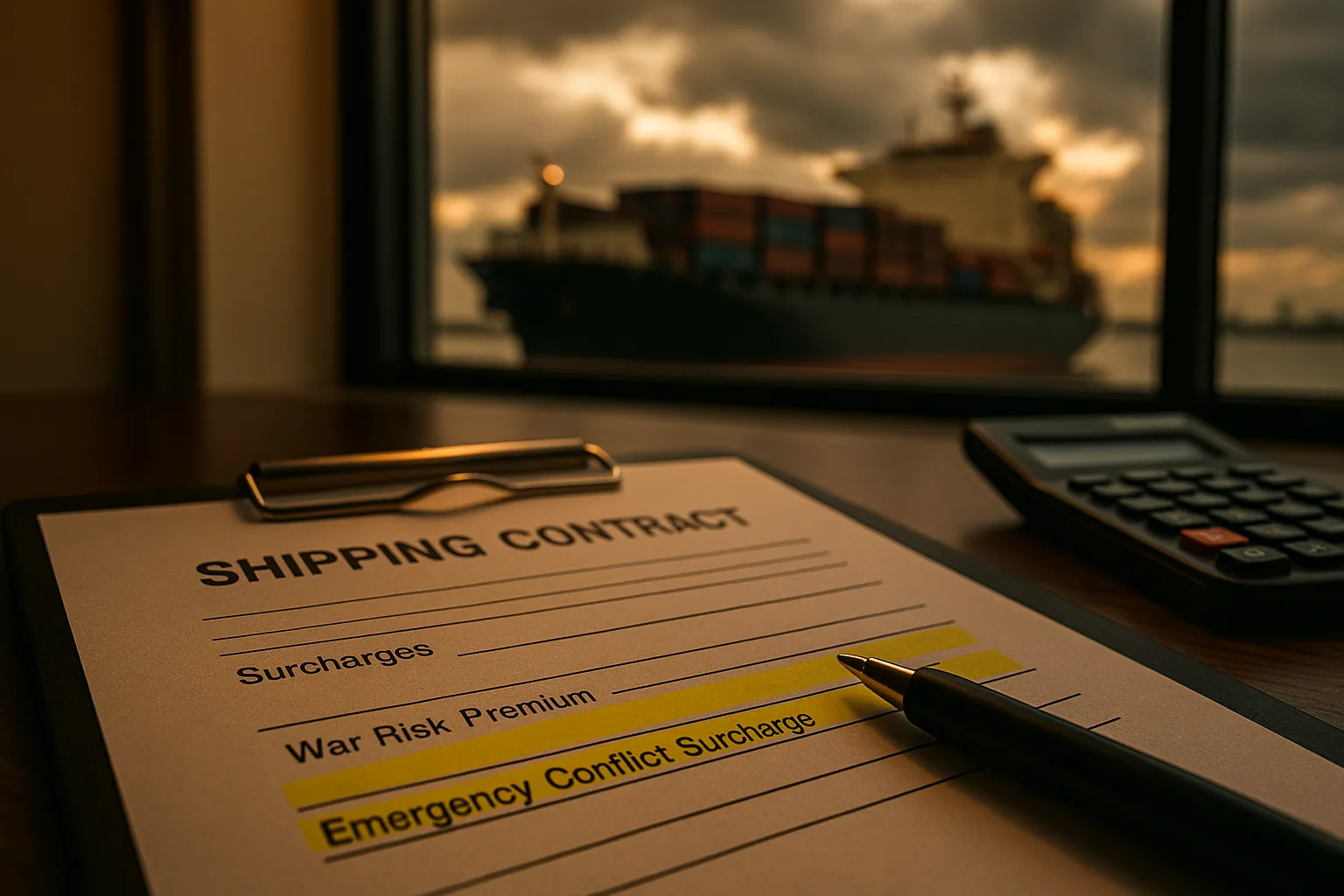
If you ship anything through or near the Persian Gulf, you've already seen the emails. Hapag-Lloyd, CMA CGM, and Maersk have all imposed war risk surcharges in the past 72 hours—and they're not small. We're talking $1,500 to $4,000 per container, applied retroactively to bookings already issued but not yet shipped.
War risk surcharges (WRS) are one of the least understood line items on a freight invoice, yet during geopolitical crises they can add more to your total landed cost than the base ocean freight rate itself. This guide breaks down what they are, what carriers are currently charging, and what you can actually do about it.
What Are War Risk Surcharges and How Are They Calculated?
A war risk surcharge is a fee that ocean carriers impose to cover the additional cost of operating vessels in or near conflict zones. Unlike standard freight rates, which are negotiated in advance and tied to supply-demand dynamics, war risk surcharges are triggered by external events and typically imposed with little notice.
The surcharge covers three primary cost categories. First, there's the carrier's own war risk insurance premium—the additional cost that insurers charge to cover hull and machinery in designated high-risk areas. Second, there are the operational costs of rerouting vessels around conflict zones, including extra fuel, additional transit days, and crew overtime. Third, carriers factor in the opportunity cost of vessel delays and potential cargo damage or loss.
The Joint War Committee (JWC) of Lloyd's Market Association maintains the official Listed Areas—regions where war risk insurance is required. When the JWC expands its Listed Areas, as it did for the Persian Gulf on March 1, 2026, carriers activate surcharges within hours.
What Carriers Are Charging Right Now
The surcharge landscape as of March 3, 2026 is significant and escalating fast.
Hapag-Lloyd announced a war risk surcharge of $1,500 per TEU for standard containers and $3,500 per container for reefer and special equipment on all cargo to and from the Upper Gulf, Arabian Gulf, and Persian Gulf. The surcharge applies to any booking issued on or after March 2, including cargo already on the water but not yet discharged. Hapag-Lloyd and Maersk have also ceased all Trans-Suez services through the Bab-El-Mandeb Strait, reverting to the longer Cape of Good Hope routing that adds 7–14 days of transit time.
CMA CGM imposed an emergency conflict surcharge ranging from $2,000 per 20-foot container to $4,000 per reefer container across all Gulf-bound and Red Sea port cargo, including destinations in Saudi Arabia, Egypt, Jordan, Djibouti, and Sudan.
Norden, one of the world's largest tanker operators, took the most drastic step—suspending all new business requiring transit through the Strait of Hormuz entirely.
These aren't theoretical numbers. For a mid-market shipper moving 500 TEUs per month through Gulf-connected trade lanes, Hapag-Lloyd's surcharge alone adds $750,000 in monthly freight costs overnight.
How Surcharges Compound: The Real Cost Stack
War risk surcharges don't operate in isolation. They stack on top of every other surcharge already embedded in your freight rate, and the compounding effect is what catches most shippers off guard.
Consider the full surcharge stack for a single 40-foot container moving from Jebel Ali to Rotterdam as of this week:
- Base ocean freight rate: $2,800
- Bunker Adjustment Factor (BAF): $650 (up 18% due to oil spike)
- War Risk Surcharge: $1,500–$3,000
- Emergency Conflict Surcharge: $2,000–$3,000
- Congestion Surcharge (Cape routing): $400–$600
- Peak Season Surcharge: $300
That's a total of $7,650 to $10,350 per container—up from roughly $3,750 just one week ago. The surcharges now exceed the base freight rate by a factor of two to three.
Maritime insurers are compounding the problem further. According to The Guardian, several major insurers have cancelled war risk coverage for Gulf transits entirely, leaving carriers unable to obtain the insurance required to enter the region at any price. When insurance becomes unavailable rather than merely expensive, carriers have no choice but to suspend service—eliminating capacity and pushing rates higher on alternative routes.
Negotiation Tactics: Protecting Your Bottom Line
You can't eliminate war risk surcharges, but you can negotiate how they're applied and limit your exposure. Here are five proven tactics.
1. Push for surcharge caps in your contracts. The most effective protection is negotiated before a crisis hits. Shippers with annual service contracts should insist on maximum surcharge caps—typically expressed as a percentage of the base rate or an absolute dollar ceiling per TEU. If your current contract doesn't include caps, use this crisis as leverage to add them during your next renewal.
2. Demand transparency on surcharge components. Carriers often bundle multiple fees under a single "emergency" surcharge label. Request an itemized breakdown showing the insurance premium component, the operational cost component, and the rerouting fuel cost separately. This transparency gives you a basis for challenging inflated charges.
3. Negotiate index-linked surcharges. Rather than accepting a carrier's unilateral surcharge, propose tying war risk premiums to a published index—such as Lloyd's JWC rates or the Baltic Exchange war risk assessments. Index-linking creates an objective basis for surcharge adjustments and prevents carriers from maintaining elevated surcharges after conditions improve.
4. Explore alternative routing before accepting surcharges. If your cargo doesn't have a time-critical delivery window, routing via the Cape of Good Hope avoids Gulf war risk zones entirely. The transit time penalty is 7–14 days, but you eliminate the war risk surcharge. Run the math: $3,000 saved per container versus 10 extra days of inventory carrying cost.
5. Consolidate volumes for negotiating power. Carriers offer better surcharge terms to high-volume shippers. If you're moving fewer than 200 TEUs monthly, consider joining a shipper consortium or working through a freight forwarder with aggregated volume to negotiate group rates.
Insurance Implications: Cargo War Risk Coverage
Shippers need to examine their own cargo insurance policies immediately. Standard marine cargo insurance typically excludes war risk perils. You need a separate war risk endorsement—and with insurers pulling coverage from the Gulf region, obtaining that endorsement is becoming both expensive and difficult.
Contact your cargo insurance broker this week to confirm whether your policy covers cargo in transit through or near the Gulf. If coverage has been cancelled or restricted, explore warehouse-to-warehouse policies that cover cargo at origin and destination but exclude the transit zone, combined with carrier liability for the ocean leg.
P&I clubs—the mutual insurance associations that cover carrier liability—are also reassessing their exposure. If your carrier's P&I coverage lapses for Gulf transits, the carrier may become personally liable for cargo losses, creating counterparty risk that shippers should evaluate.
How CXTMS Helps Shippers Manage Surcharge Volatility
Visibility is the first line of defense against surcharge shock. CXTMS provides automated surcharge tracking across all major carriers, flagging new surcharge announcements within hours of publication and calculating the total landed cost impact across your shipping portfolio.
Our rate management module models the full surcharge stack for every lane—base rate, BAF, WRS, congestion, and peak season—so you can see the true cost of each routing option before you book. When carriers impose new surcharges, CXTMS automatically recalculates your cost comparisons and surfaces alternative routes that may offer better total economics despite longer transit times.
For shippers managing contract renewals, CXTMS benchmarks your surcharge terms against market rates, helping you identify where your caps are too high, where your index-linking is missing, and where you have the most room to negotiate.
The Strait of Hormuz crisis won't be the last geopolitical disruption to hit your freight budget. Building surcharge resilience into your contracts and your TMS is the only way to protect your margins when the next crisis arrives.
Ready to take control of your freight costs? Request a CXTMS demo and see how automated surcharge tracking and rate optimization can save your team thousands per shipment—even when the world is on fire.