Walmart's 2026 Automation Peak: What IoT Pallets and Supplier Mandates Mean for Your Supply Chain


Walmart's CFO John David Rainey made it official during the company's latest earnings call: "We're hitting the peak of annual spending levels on supply chain automation." For the thousands of suppliers, 3PLs, and mid-market shippers moving freight through Walmart's network, that statement isn't just corporate strategy — it's a compliance countdown.
The Scale of Walmart's Automation Push
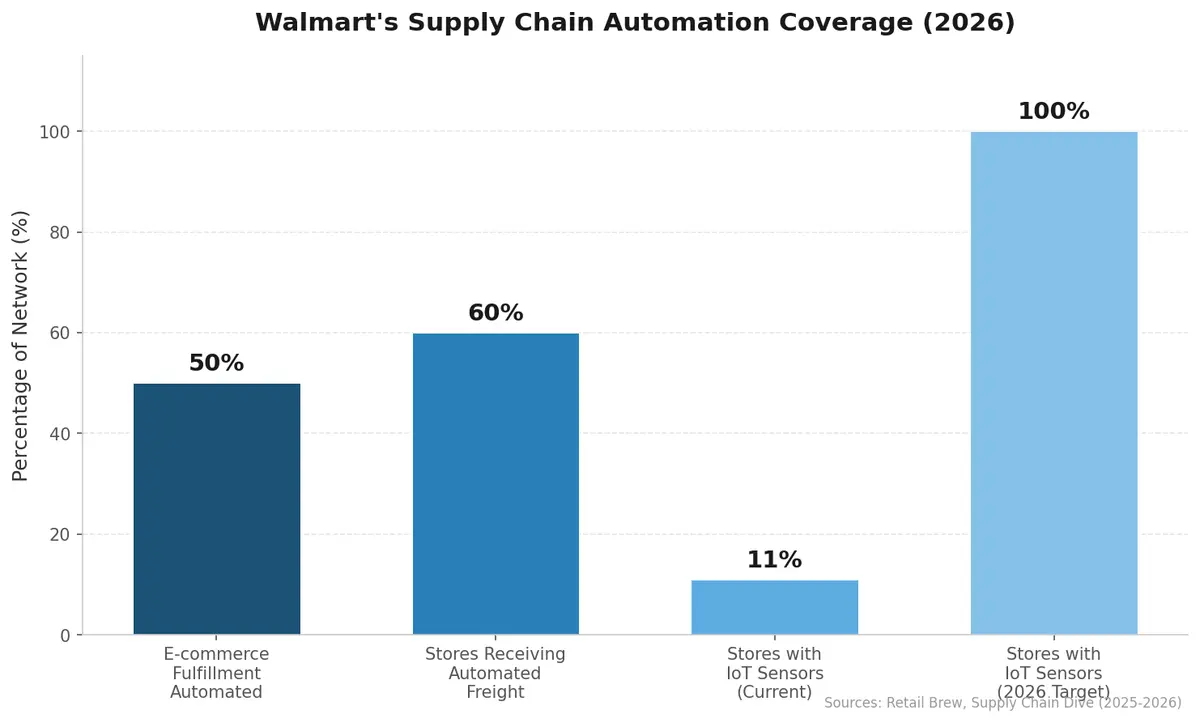
The numbers coming out of Bentonville paint a picture of a retailer transforming its entire logistics backbone simultaneously. Fifty percent of Walmart's e-commerce fulfillment center volume is already automated. Sixty percent of stores now receive automated freight. And according to CEO John Furner, a couple thousand facilities are slated for some form of automation upgrade in 2026.
This isn't incremental improvement — it's infrastructure replacement. Furner noted that several regional distribution centers recently retired conveyor belt systems that had been running for 20 to 30 years. The $330 million modernization of a single facility in Opelousas, Louisiana illustrates the capital intensity involved. That project, which retained the existing workforce and shifted employees into higher-skilled robotics-focused roles, is a template Walmart plans to replicate across its network.
"Technology-enabled productivity benefits are critical to our ability to grow our core omni-business at lower marginal cost," Rainey said. When Walmart talks about cutting its two largest costs — inventory and labor — through technology, every supplier in the network should be paying attention.
4,600 Stores, 40+ DCs: The IoT Pallet Expansion
Perhaps the most consequential development for suppliers is Walmart's expansion of ambient IoT sensor technology. Through its collaboration with Wiliot, Walmart has deployed millions of IoT sensors on pallets moving through its supply chain. Currently live across 500 stores, the rollout is set to expand to all 4,600 retail locations and more than 40 distribution centers throughout 2026.
These sensors — small enough to be embedded in packaging — provide real-time pallet-level tracking from distribution center to store shelf. No manual scanning. No paper trail. Just automated signals that confirm receipt, location, and condition.
"Positive confirmation of receipts in supply chain is very important," said Julien Bellanger, Wiliot's president. "Just a signal that is automatically created based on real data, and that both the supplier and Walmart will capture eventually."
The implications are significant. When Walmart can see exactly where every pallet is in real time, suppliers who deliver late, mislabel shipments, or fail to meet packaging standards will be immediately visible. The margin for error shrinks to near zero.
SQEP: The Compliance Framework Suppliers Can't Ignore
Walmart's Supplier Quality Excellence Program (SQEP) has been tightening the screws on vendor performance for the past two years. The program monitors PO accuracy, packaging compliance, labeling standards, and delivery performance through a dedicated dashboard portal.
Key SQEP requirements that intersect with the automation push include:
- GS1-128 barcode compliance on all pallet labels, linked to accurate ASN (Advance Ship Notice) data
- Grade A pallet standards with proper securing and documentation
- SSCC-18 barcodes on all food pallets, tied to EDI 856 shipment notifications
- OTIF (On-Time In-Full) delivery scores that now feed directly into supplier scorecards
For food suppliers specifically, Walmart's traceability requirements demand that every shipment include an ASN containing Key Data Elements (KDEs) for all deliveries. This aligns with the broader FSMA 204 food traceability rule and creates a dual compliance burden: meet both Walmart's internal standards and federal regulatory requirements simultaneously.
The Cascading Effect on Mid-Market Shippers
Walmart's automation demands don't stop at direct suppliers. The ripple effects reach deep into the supply chain:
3PLs must upgrade. If you're a third-party logistics provider handling Walmart-bound freight, your warehouse systems need to generate compliant ASNs, apply correct GS1-128 labels, and maintain the data accuracy that IoT sensors will now verify in real time.
Carriers face tighter windows. Automated receiving systems at Walmart facilities operate on precise schedules. When a couple thousand facilities run on automated freight processing, appointment compliance becomes non-negotiable.
Small suppliers bear disproportionate costs. A $330 million facility upgrade is a rounding error for Walmart. For a mid-market supplier shipping 50 pallets a week, investing in compliant labeling systems, EDI capabilities, and real-time tracking integration represents a meaningful technology investment.
The gap between suppliers who have modernized their logistics technology and those still running manual processes is about to become a competitive chasm.
How TMS Technology Bridges the Compliance Gap
This is where transportation management systems become essential infrastructure rather than optional software. Suppliers navigating Walmart's requirements need systems that can:
- Generate compliant EDI 856 ASNs with accurate KDEs, SSCC-18 references, and GS1-128 data automatically
- Enforce labeling standards through integrated printing and validation workflows
- Track OTIF performance in real time and flag at-risk shipments before they become scorecard penalties
- Maintain audit trails that satisfy both Walmart's SQEP dashboard and federal traceability regulations
The cost of non-compliance is escalating. Walmart's chargebacks for OTIF failures, labeling errors, and documentation gaps can erode margins quickly — particularly for suppliers operating on thin retail margins to begin with.
What Suppliers Should Do Now
With Walmart's automation spending peaking in 2026, the window for preparation is closing:
-
Audit your EDI capabilities. Can your systems generate fully compliant 856 ASNs with all required data elements? If you're still doing manual data entry, you're already behind.
-
Review your SQEP dashboard. Identify recurring issues and address root causes before IoT sensors make every deviation instantly visible.
-
Invest in TMS integration. The cost of a modern TMS that handles Walmart compliance automatically is a fraction of the chargebacks and lost business from non-compliance.
-
Prepare for case-level tracking. Wiliot has indicated that Walmart's eventual goal is tracking at the case level, not just pallet level. The granularity of required data will only increase.
Walmart's automation peak isn't a future event — it's happening right now, across thousands of facilities simultaneously. Suppliers who treat this as a technology project rather than a business survival imperative are making a costly mistake.
Need to modernize your supply chain for retail compliance? Contact CXTMS to see how our TMS platform automates EDI, labeling, and OTIF tracking for Walmart and other major retailers.