Supply Chain Orchestration Platforms: Why Integration Is Replacing Point Solutions in 2026

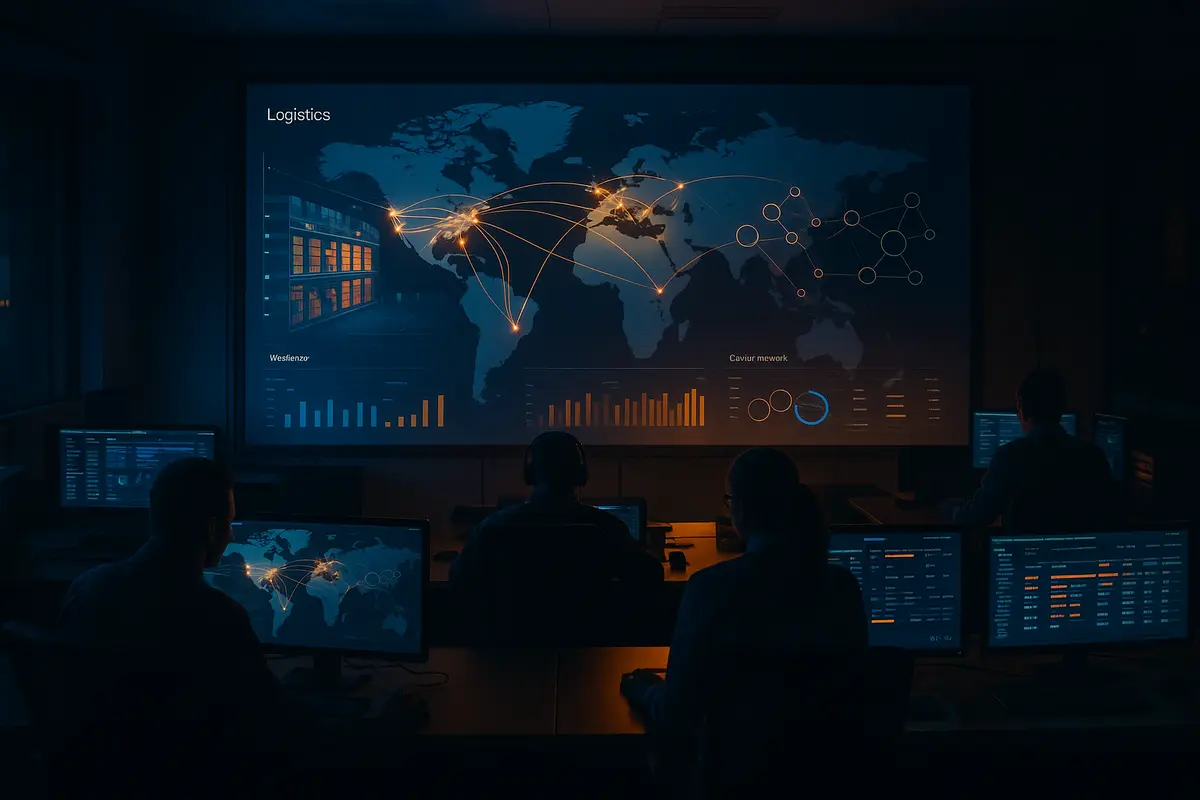
The average enterprise supply chain runs on seven to twelve disconnected software tools. A TMS here, a WMS there, a visibility platform bolted on top, a demand planning spreadsheet nobody trusts, and a handful of EDI translators holding it all together with digital duct tape. For years, this was accepted as the cost of doing business. In 2026, it's becoming the cost of falling behind.
The Point Solution Problem Has Reached a Breaking Point
The digital supply chain and logistics technology market was valued at $72 billion in 2025 and is projected to reach $146.92 billion by 2031, a near-doubling that signals more than incremental growth. It represents a fundamental rethinking of how logistics technology is architected.
For the past decade, companies bought best-of-breed point solutions for every function: rate shopping, carrier management, shipment tracking, freight audit, yard management, appointment scheduling. Each solved a narrow problem well. But together, they created a fragmented ecosystem where data lives in silos, decisions happen in isolation, and the humans in between spend more time synchronizing systems than actually optimizing operations.
The hidden cost isn't the software licenses—it's the coordination tax. Every manual handoff between systems introduces latency, errors, and missed opportunities. When a shipment delay in your TMS doesn't automatically trigger inventory rebalancing in your WMS or customer notification in your OMS, you're paying that tax with every disruption.
What Orchestration Actually Means (Beyond the Buzzword)
Supply chain orchestration has become one of those terms that means everything and nothing simultaneously. But strip away the marketing, and the concept is straightforward: orchestration is what happens when your systems stop just sharing data and start coordinating decisions.
As OpenText describes it, orchestration goes beyond traditional integration and visibility. Integration provides the plumbing connecting different systems. Visibility gives you transparency into what's happening. Orchestration is the conductor that uses that connectivity and visibility to autonomously coordinate actions and optimize outcomes across the entire value chain.
The distinction matters because most companies already have integration (APIs and EDI connecting their tools) and visibility (dashboards showing shipment status). What they lack is the decision layer—the intelligence that can detect a disruption, assess its network-wide impact, execute a mitigation plan, and incorporate the outcome into future decisions, all without waiting for a human to connect the dots.
The Second Phase of Supply Chain Technology
According to Logistics Viewpoints, the supply chain technology market is entering its second phase. The first phase—embedding AI into individual functions like forecasting, routing, and warehouse slotting—delivered real improvements. But each function still optimized locally within its silo.
The second phase is about collapsing coordination latency across nodes. When a shipment slips, inventory exposure should adjust immediately. Customer commitments should update automatically. Procurement buffers should rebalance without waiting for a planner to manually connect the dots. These are linked decisions, and treating them as isolated workflows introduces cost and delay.
This is where the competitive separation is forming. It won't be between companies that have AI and those that don't. It will be between companies that can coordinate decisions across functions in real time and those that still rely on manual synchronization between disconnected point solutions.
Why Companies Are Consolidating Now
Three forces are accelerating the shift from point solutions to unified platforms:
1. Data Integrity Under Autonomous Decision-Making
When systems begin executing decisions autonomously, data inconsistency stops being an IT nuisance and becomes an operational risk. Master data alignment, entity resolution, and consistent identifiers across platforms are exponentially easier to maintain in a single system than across a dozen integrations. AI doesn't correct weak data foundations—it amplifies them.
2. Total Cost of Ownership Is Becoming Transparent
Finance teams are getting better at calculating the true cost of fragmented technology stacks. It's not just license fees—it's the integration maintenance, the middleware subscriptions, the IT hours spent troubleshooting data sync failures, the consultant fees for every upgrade cycle, and the opportunity cost of slow decision-making. When you add it up, five point solutions often cost more than one unified platform.
3. Speed of Response Has Become a Differentiator
In a world of tariff volatility, port disruptions, and customer expectations set by same-day delivery, the companies that respond fastest win. A unified orchestration platform can execute a disruption response in minutes. A fragmented stack requires someone to check five dashboards, make three phone calls, and manually update two systems—a process that takes hours on a good day.
What to Look for in an Orchestration Platform
Not every platform claiming "orchestration" delivers it. Here's what separates genuine orchestration from rebranded integration:
- Cross-functional decision logic. Can the platform trigger actions across transportation, warehousing, and order management from a single event? Or does it just pass data between modules?
- Persistent context. Does the system learn from past disruptions and outcomes? Stateless assistants can answer questions, but orchestrating a network requires memory of supplier variability, seasonal patterns, and what worked last time.
- Graph-based reasoning. Supply chains are networks of dependencies. A platform that reasons only at the transaction level will remain reactive. One that understands relationships between lanes, facilities, SKUs, and partners can model cascade effects and recommend alternatives.
- Composable architecture. Ironically, the best unified platforms are also the most modular. Look for systems that let you start with core TMS or WMS functionality and expand into orchestration as your maturity grows.
The Orchestration Imperative for Mid-Market Shippers
Enterprise companies with dedicated IT teams and seven-figure budgets have been building orchestration capabilities for years—often through custom development on top of their ERP. The real transformation in 2026 is that mid-market shippers can now access these same capabilities through cloud-native platforms purpose-built for orchestration.
This matters because mid-market companies feel the point solution pain most acutely. They've outgrown spreadsheets and basic TMS tools but can't afford the integration overhead of managing a dozen best-of-breed solutions. A unified platform that handles transportation management, shipment visibility, carrier coordination, and operational analytics in a single system isn't a luxury for these companies—it's a survival requirement.
The next twelve months will define which companies build coherent intelligence layers and which remain stuck synchronizing disconnected tools. The market is separating. The question is which side of that divide you'll be on.
Ready to replace your fragmented tool stack with unified supply chain orchestration? Contact CXTMS for a demo and see how a single platform can eliminate coordination latency across your operations.