Coordination Latency: The New KPI Reshaping Supply Chain Technology Investment in 2026

Supply chain technology has entered a new era. After years of investing in AI-powered forecasting, route optimization, and real-time visibility, leading logistics organizations are discovering that the next competitive advantage isn't about smarter algorithms — it's about how fast those algorithms can coordinate decisions across the entire network.
Welcome to the age of coordination latency: the measurable gap between when a disruption occurs and when every affected function responds in unison.
What Is Coordination Latency?
Traditional supply chain KPIs — on-time in-full (OTIF), perfect order rate, inventory turnover — measure outcomes within functional silos. They tell you how well transportation, warehousing, or procurement performed individually. What they don't capture is the friction between those functions.
Coordination latency measures something fundamentally different: the time it takes for a disruption at one node to trigger an appropriate, coordinated response across all connected nodes.
When a shipment slips at a port, how long before inventory exposure adjusts? How long before customer commitments update? How long before procurement buffers rebalance? In most organizations, the answer is hours or days — because cross-functional coordination still depends on human escalation, email chains, and weekly planning meetings.
As Logistics Viewpoints recently argued, "The next separation in this market will not be between companies that have AI and those that do not. It will be between companies that can coordinate decisions across functions in real time and those that still rely on manual synchronization."
Phase 1 vs. Phase 2 of Supply Chain Technology
The last decade of supply chain digitization — call it Phase 1 — focused on embedding intelligence within individual functions. Planning got better forecasts. Transportation got smarter routing. Warehousing got optimized slotting. Each function improved locally, often dramatically.
But local optimization creates a ceiling. A warehouse that perfectly slots inventory based on yesterday's forecast can't adapt when transportation disruptions shift arrival patterns. A planning system that generates precise demand signals can't compensate when procurement lead times change due to a regulatory shift on a specific trade lane.
Phase 2 is about connecting those intelligent functions so they negotiate and adapt together in real time. It's the shift from system integration to decision integration — where inventory logic, transportation logic, sourcing logic, and customer logic share context and coordinate mitigation paths dynamically.
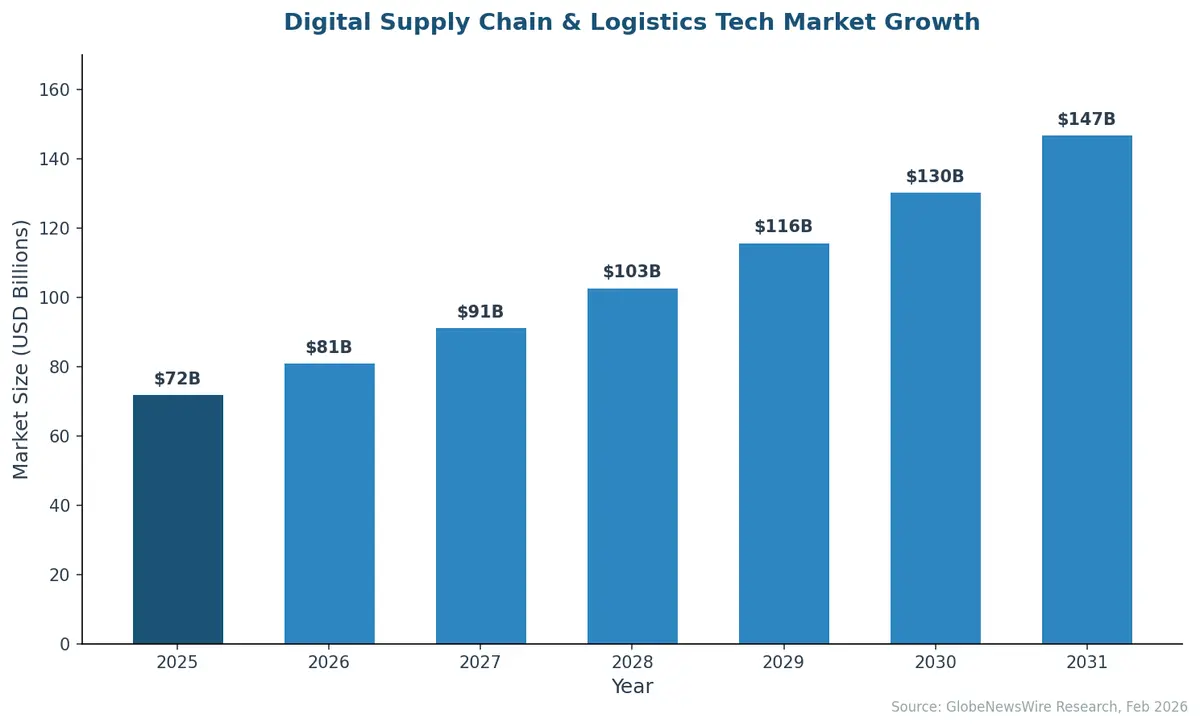
The digital supply chain and logistics tech market reflects this urgency. According to GlobeNewsWire research, the market is projected to grow from $72 billion in 2025 to $146.92 billion by 2031, a CAGR of 12.62%. That capital isn't flowing toward more dashboards — it's flowing toward orchestration, execution suites, and real-time coordination infrastructure.
Why Traditional KPIs Miss the Mark
Consider a common scenario: a container vessel arrives 48 hours late at a U.S. West Coast port. Here's what happens in a traditional operation:
- Transportation detects the delay through vessel tracking (minutes)
- Warehouse learns about it when someone forwards an email (hours)
- Sales discovers affected customer orders when a planner checks inventory availability (often the next day)
- Procurement adjusts safety stock buffers in the next weekly planning cycle (days)
Each function's KPIs may look fine in isolation. The vessel tracker updated promptly. The warehouse processed what it received efficiently. Sales hit their response SLA once they knew about the issue. But the coordination latency — the gap between the disruption event and a unified, network-wide response — was measured in days.
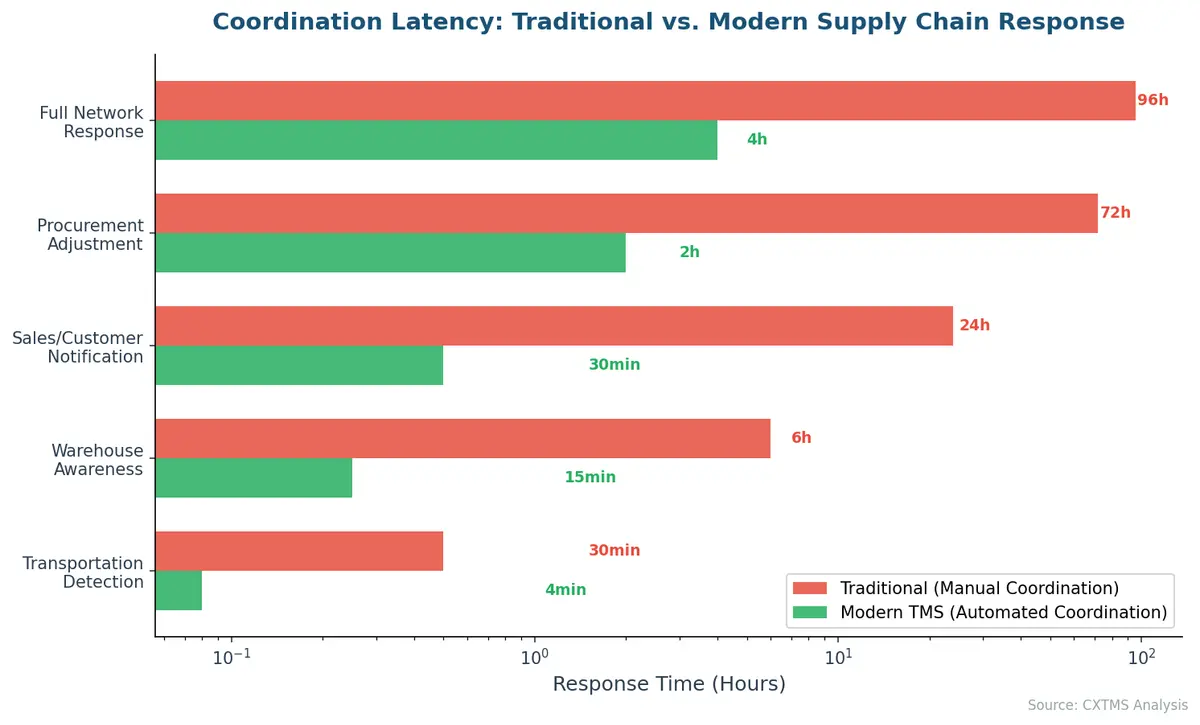
Companies with low coordination latency handle the same disruption differently. The vessel delay triggers an automated cascade: inventory exposure recalculates within minutes, customer commitments update in the same cycle, and procurement buffers rebalance before the next shift begins. The difference in financial impact is enormous.
The Integration Challenge Is Real
Collapsing coordination latency sounds compelling in theory. In practice, it requires solving problems that most organizations have deferred for years.
Data integrity comes first. According to SPS Commerce's 2026 Demand Report, 41% of supply chain organizations still face integration challenges between their ERP and WMS systems. Master data alignment, entity resolution, and consistent identifiers across systems remain foundational barriers. As the Logistics Viewpoints analysis puts it: "AI does not correct weak data foundations. It amplifies them."
Memory and context matter. Stateless point solutions can answer questions about the current state of the network. They cannot learn from patterns — supplier variability across seasons, regulatory nuances on specific trade lanes, or the outcomes of past mitigation strategies. Systems that reduce coordination latency must retain and apply operational context over time.
Graph-based reasoning is essential. Supply chains are networks of dependencies, not sequences of transactions. A port delay isn't a single incident — it cascades across lanes, SKUs, facilities, and customers. Systems that reason only at the document level remain reactive. Systems that model relationships can predict impact paths and recommend alternatives that respect the structure of the network.
How Modern TMS Platforms Reduce Coordination Latency
The TMS is evolving from a transportation-centric execution tool into the coordination layer that connects supply chain functions. Here's what that looks like in practice:
Unified event processing. When a shipment exception occurs, the TMS doesn't just update a tracking status — it triggers coordinated responses across inventory allocation, customer notification, and carrier rebooking in a single decision cycle.
Cross-functional visibility with action. Unlike standalone visibility platforms that show you problems, an integrated TMS provides both the signal and the response mechanism. Seeing that a shipment is late is table stakes. Automatically rerouting inventory, updating delivery windows, and adjusting downstream schedules — that's what collapses coordination latency.
Persistent operational context. Modern TMS platforms maintain a memory of carrier performance, lane-specific variability, and seasonal patterns. This institutional knowledge compounds over time, enabling faster and more accurate coordination with each disruption cycle.
Measuring Coordination Latency in Your Organization
If you want to start tracking coordination latency, begin with these questions:
- Disruption-to-detection time: How long after a supply chain event before all affected teams know about it?
- Detection-to-decision time: Once teams are aware, how long before a coordinated mitigation plan exists?
- Decision-to-execution time: How long before that plan is actually implemented across all affected systems?
- Total cycle time: From disruption to full network adjustment — are you measuring in minutes, hours, or days?
The companies leading the Phase 2 transition are compressing each of these intervals from days to hours, and from hours to minutes. Over the next 12 months, coordination latency will increasingly separate supply chain leaders from laggards — not by who has the best AI, but by who can close the loop fastest.
Ready to collapse coordination latency across your logistics network? Contact CXTMS for a demo of our unified TMS platform.