Maritime Cargo Insurance Premiums Surge 300% at Hormuz: How the World's Most Expensive Waterway Is Adding a Hidden Cost Layer for Every Shipper

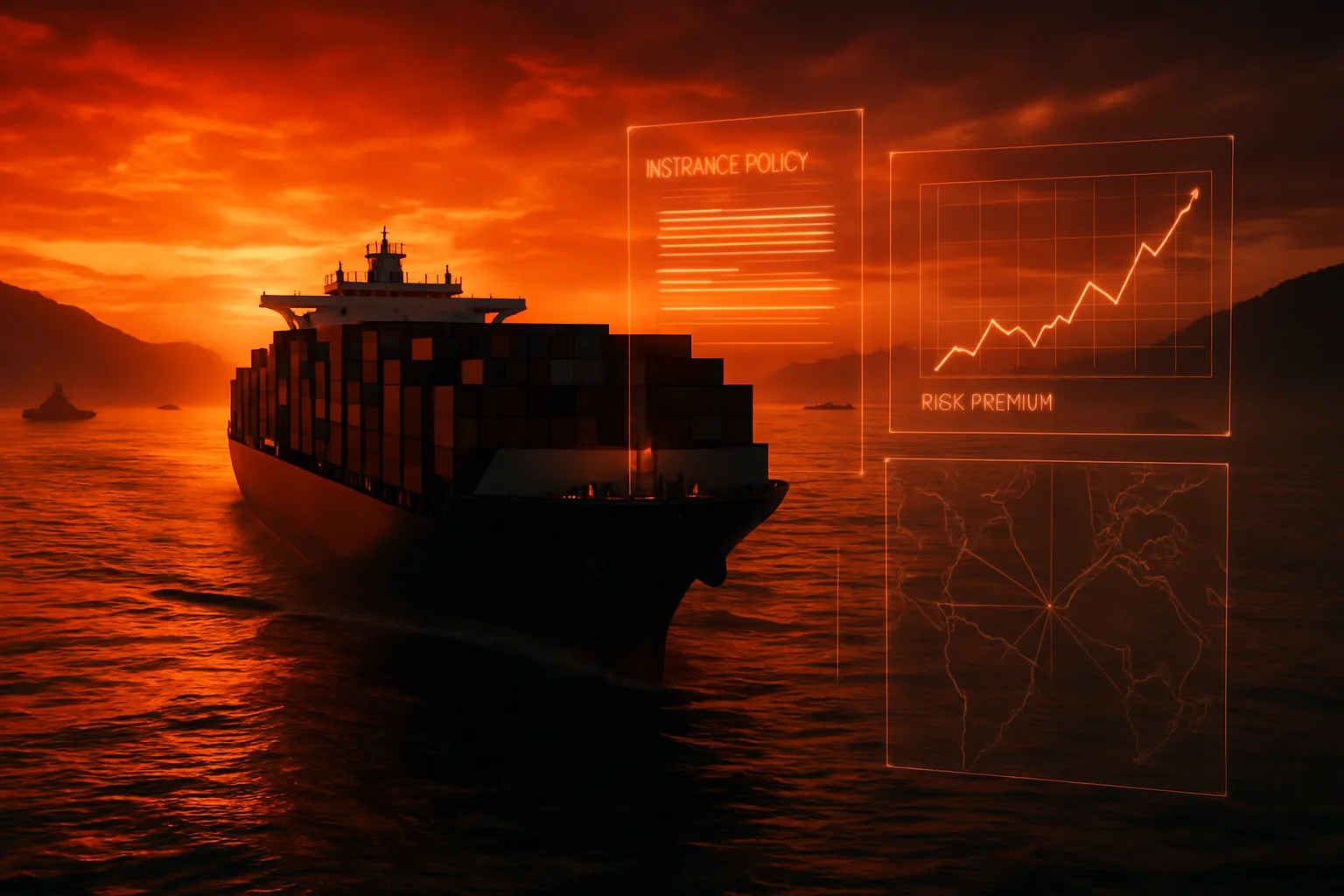
The Strait of Hormuz has always been one of the world's most strategically important waterways — roughly 20% of global oil trade and 30% of seaborne fertilizer supply normally passes through the narrow channel connecting the Persian Gulf to the Gulf of Oman. But in March 2026, it has earned a new distinction: the world's most expensive waterway to insure. War risk insurance premiums have surged 200% to 300% — and in some cases over 1,000% — transforming maritime cargo insurance from a routine line item into a structural cost layer that is reshaping freight economics for every shipper with ocean exposure.
The Numbers Behind the Surge
Before the Iran conflict erupted in early March, war-risk insurance for a vessel passing through the Persian Gulf sat at 0.02% to 0.05% of the vessel's value. For a tanker valued at $120 million, that translated to a premium of roughly $40,000 per voyage — a rounding error in the total cost of moving cargo.
Since hostilities began, premiums have jumped to 0.5% to 1% of vessel value, according to the UK-based Chartered Institute of Export and International Trade. That same $120 million tanker now faces a war-risk premium of $600,000 to $1.2 million for a single trip through the strait. For larger vessels, Jefferies analysts estimate the new insurance rate of 3% implies a hull war risk premium of approximately $7.5 million, up from around $625,000 before the conflict — a twelvefold increase.
Dylan Mortimer, marine hull UK war leader at insurance broker Marsh, estimates ratings are trending between 1% and 1.5% of vessel value, with variation depending on whether a vessel is east or west of the Hormuz chokepoint. As Dr. Michel Léonard, chief economist at the Insurance Information Institute, bluntly put it: "It's like insuring a burning building."
A $25.56 Billion Market Under Pressure
The insurance premium spike is hitting an already expanding market. According to MarkNtel Advisors' latest forecast, the global maritime cargo insurance market was valued at approximately $22.4 billion in 2025 and is projected to grow to $25.56 billion in 2026, reaching nearly $35.94 billion by 2032 at a CAGR of 5.84%. All Risk Coverage — the broadest form of marine cargo protection — represents roughly 57% of the market, meaning the majority of shippers are directly exposed to premium increases driven by geopolitical risk.
What makes this crisis structurally different from previous disruptions is the concentrated risk. Lloyd's Market Association CEO Sheila Cameron noted that approximately 1,000 vessels — about half of which are oil and gas tankers — with an aggregate hull value exceeding $25 billion remain in Persian Gulf and surrounding waters, with the vast majority insured in the London market. Jefferies estimated that potential industry losses from at least seven vessels damaged in the conflict's first week alone could reach up to $1.75 billion.
How Insurance Costs Cascade to Shippers
Most shippers don't buy war risk policies directly. But the cost reaches them through a cascading chain that is remarkably efficient at passing through expenses:
Carrier surcharges. Ocean carriers absorb the initial premium increase, then pass it on through emergency war risk surcharges. The Federal Maritime Commission confirmed it is closely monitoring the impact of the current conflict on shipping rates, using its statutory authority to ensure that carrier-imposed charges comply with the Shipping Act. But even within regulatory bounds, surcharges of $500 to $800 per container are being levied by major lines.
Freight rate inflation. Beyond explicit surcharges, the insurance cost embeds itself in base freight rates. Carriers rerouting around the Cape of Good Hope add 10 to 14 days of transit time, burning more fuel, tying up more vessel capacity, and incurring higher insurance costs on every additional day at sea. These costs layer into rate negotiations for months after the initial disruption.
Cargo insurance repricing. Shippers with their own cargo insurance policies face renewal increases as underwriters reprice risk across all maritime trade lanes — not just those transiting the Gulf. The contagion effect means that even shippers on transpacific or transatlantic routes see modest premium increases as reinsurers tighten capacity globally.
Landed cost distortion. When insurance, surcharges, and rate increases combine, the total landed cost impact can reach 3% to 5% for goods moving through affected trade lanes. For commodity shippers operating on thin margins, that spread can erase profitability entirely.
The Reinsurance Squeeze
Behind the headline premium increases, a quieter but potentially more consequential shift is occurring in the reinsurance market. Morningstar DBRS warned that reinsurers may respond to the crisis by raising the loss level at which their liability triggers, or by reducing capacity altogether. This would leave primary underwriters retaining more risk and potentially pressuring solvency levels — a dynamic that could lead to coverage withdrawals or exclusion zones that persist long after the conflict ends.
The Red Sea disruption of 2023-2024 established the template: war risk premiums in the Bab el-Mandeb strait remained elevated for over 12 months after Houthi attacks first spiked costs. The Hormuz crisis, given its larger scale and direct involvement of a state actor with missile and naval capabilities, could produce an even longer tail of elevated insurance costs.
Shipper Mitigation Strategies
Forward-thinking supply chain leaders are deploying several strategies to manage insurance cost exposure:
Parametric insurance policies. Unlike traditional indemnity policies that require lengthy claims processes, parametric policies pay out automatically when predefined triggers are met — such as a vessel entering a designated high-risk zone or transit times exceeding a threshold. These instruments provide faster liquidity and more predictable cost structures.
Self-insurance reserves. Large shippers with diversified portfolios are establishing dedicated reserves to self-insure a portion of their maritime risk, reducing reliance on a hardening commercial market. This requires robust actuarial modeling but can yield significant savings when premiums spike.
Alternative routing and modal shift. Where geography permits, shifting cargo to rail corridors (such as the China-Europe rail network) or air freight for high-value goods can avoid maritime war risk premiums entirely. The economics that made these alternatives uncompetitive before the crisis have shifted dramatically.
Contract restructuring. Reviewing freight contracts to understand who bears insurance cost pass-throughs — and negotiating caps or sharing mechanisms on war risk surcharges — gives shippers more predictable cost exposure in volatile markets.
Diversified sourcing. Reducing dependence on suppliers whose goods must transit conflict-exposed waterways is the most durable hedge, though it requires the longest lead time to implement.
Total Landed Cost Visibility Is No Longer Optional
The Hormuz insurance crisis exposes a fundamental gap in how most shippers calculate freight costs. Traditional rate comparison focuses on base ocean rates and standard accessorial charges. But when war risk premiums can add $600,000 to $7.5 million per vessel — costs that flow through as surcharges, rate increases, and cargo insurance repricing — the true cost of moving goods becomes invisible without comprehensive landed cost modeling.
CXTMS provides total landed cost analytics that incorporate insurance components, surcharges, transit time variability, and alternative routing scenarios into a unified cost picture. When the difference between a profitable shipment and a loss-making one comes down to an insurance surcharge buried three layers deep in a carrier invoice, visibility is not a luxury — it is the difference between informed decision-making and flying blind through the world's most expensive waterway.
Ready to see your true landed costs? Request a CXTMS demo and discover how total cost modeling protects your margins when maritime insurance markets are in turmoil.