Great Plains Fulfillment Capacity Is Becoming an E-Commerce Logistics Pressure Valve

For years, e-commerce fulfillment strategy was dominated by coastal gateways, big population centers, and the fastest possible access to parcel injection points. That model is not disappearing, but it is getting squeezed. Parcel costs are rising, customer delivery promises are tighter, and retailers are trying to keep inventory closer to demand without turning every warehouse expansion into a fixed-cost bet.
That is why new fulfillment capacity in the Great Plains matters.
FreightWaves reported this week that two e-commerce logistics providers are expanding in the center of the United States. Rush Order plans to open its fourth U.S. fulfillment center in the Dallas-Fort Worth area on July 1, giving the company 13 B2C fulfillment centers worldwide. The company said the new site will let it reach 93% of the U.S. population within two days by UPS Ground, with the remaining geography reachable in three days.
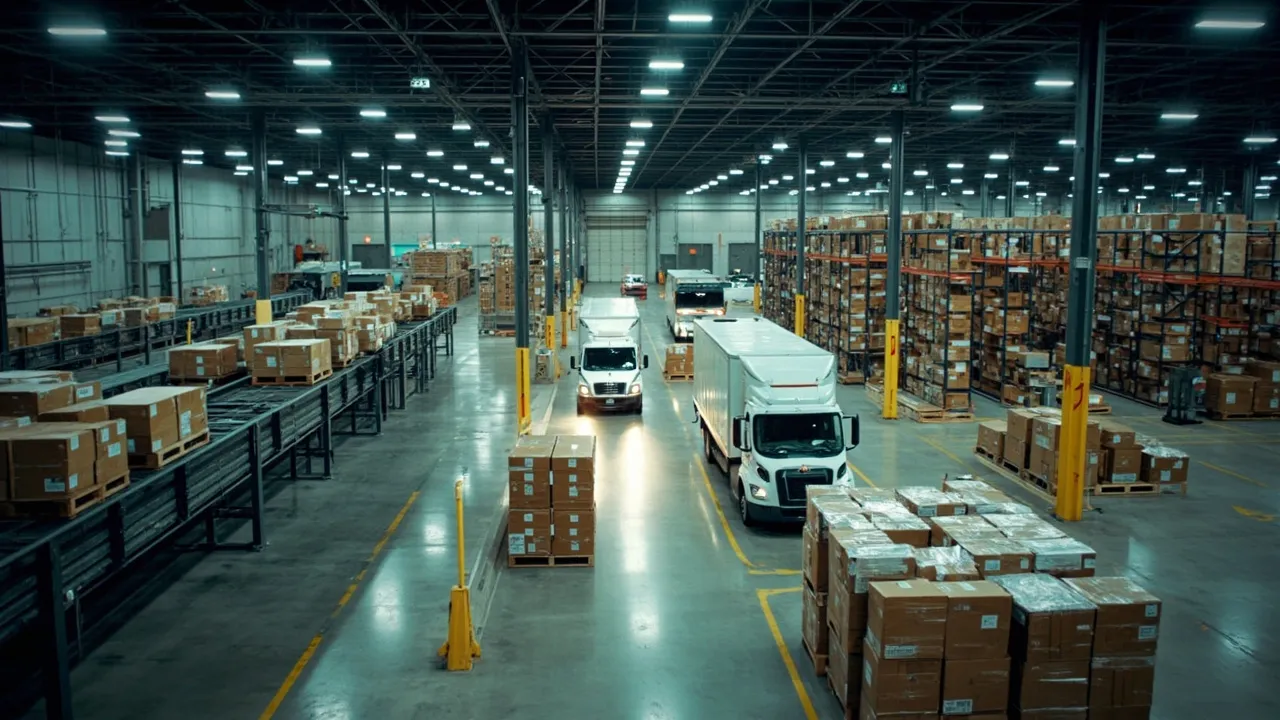
Encore Fulfillment also expanded into a 350,000-square-foot Oklahoma City facility, consolidating from an earlier location into one larger building. The site supports pick and pack, inventory management, wholesale distribution, and omnichannel order fulfillment. The operational detail that jumps out: products move from dock to shelf in one to two days, while warehouse routing software batches and routes orders through the facility and tenders outbound parcels to FedEx, UPS, and USPS based on the lowest-cost option.
This is not just more square footage. It is a signal that inland fulfillment nodes are becoming a pressure valve for e-commerce logistics.
Why the Great Plains is suddenly more interesting
The center of the country has a basic advantage that coastal networks cannot replicate: reach. Dallas-Fort Worth and Oklahoma City sit close enough to major southern, central, and Great Plains demand regions to make two-day ground service practical without relying entirely on premium air or expensive zone-skipping gymnastics.
That matters because last-mile and parcel economics are getting harder. Supply Chain Dive's 2026 logistics outlook noted that Q1 ground parcel rates were projected to be 38.9% higher than the January 2018 baseline, including a 5.4% year-over-year increase. It also quoted logistics experts warning that transportation has moved from a secondary cost line into a top-three expense for many e-commerce businesses.
When parcel transportation gets that expensive, network design becomes margin strategy. A regional warehouse can reduce zones, lower average delivery distance, improve delivery promises, and give operators more carrier options. But the warehouse only pays for itself if inventory velocity, labor productivity, and replenishment cadence are disciplined enough to offset the added node complexity.
That is the hard part. More buildings do not automatically create a better network. They create more places for inventory to be wrong.
Dock-to-shelf speed is the real differentiator
The most important number in the FreightWaves report may not be 350,000 square feet or 93% two-day coverage. It may be Encore's one-to-two-day dock-to-shelf flow.
Dock-to-shelf speed is where regional fulfillment either becomes a competitive advantage or turns into a slow, expensive holding pen. If inbound product sits in receiving for four days, the node cannot protect delivery promises. If putaway is clean but inventory accuracy is weak, the order management system will promise stock that is not pickable. If replenishment is late, retailers either split orders across facilities or pay more for expedited parcel moves.
Regional fulfillment only works when inbound receiving, inventory control, slotting, order batching, carrier selection, and exception handling move as one system. That is why warehouse routing software matters. The goal is not simply to automate a warehouse task. The goal is to connect order demand, pick paths, dock capacity, parcel cutoff times, and carrier economics into one operating rhythm.
In other words: the value is not the building. The value is the flow through the building.
Distributed networks are becoming mainstream
The Great Plains expansion also lines up with a broader shift in e-commerce supply chains. Inbound Logistics reported that 86% of surveyed e-commerce companies said they are likely to open additional fulfillment centers over the next three years. The same research found 87% are likely to change their primary manufacturing locations, showing that e-commerce firms are redesigning both supply and fulfillment networks around resilience and flexibility.
That is a big change from the old model of optimizing one central warehouse and hoping parcel carriers absorbed the complexity. Retailers now want inventory positioned closer to demand, but they also want optionality if tariffs, weather, labor disruption, carrier failures, or demand swings hit one part of the network.
Customer experience is driving the move as much as cost. Inbound Logistics noted that e-commerce leaders prioritized customer experience at 23%, ahead of cost savings and sustainability, both at 19%. That tracks with what operators see every day: customers may forgive a higher price faster than a broken delivery promise.
For midmarket retailers, the temptation is to copy the distributed network strategies of larger brands. That can work, but only if the decision is measured like an operations project, not a real estate announcement.
What retailers should measure before adding a regional node
Before adding Great Plains or interior fulfillment capacity, retailers should pressure-test four areas.
First, labor. A lower-cost location is not enough if the operation cannot hire, train, and retain people who can hit receiving, picking, packing, and carrier cutoff requirements. Labor stability matters as much as wage rate.
Second, parcel zones. The business case should model actual shipment history by ZIP code, service level, dimensional weight, surcharge profile, and carrier mix. A new node should reduce landed delivery cost, not just shorten a map distance.
Third, replenishment cadence. If suppliers, ports, or upstream distribution centers cannot feed the node consistently, regional inventory becomes stranded or chronically short. Replenishment planning must be tied to demand forecasts and transportation lead times.
Fourth, inventory accuracy. Distributed networks punish sloppy counts. A single central warehouse can hide bad data for a while. A multi-node network exposes it immediately through split shipments, backorders, customer service tickets, and emergency transfers.
CXTMS helps logistics teams manage that discipline across the transportation layer. A regional fulfillment strategy depends on reliable inbound milestones, carrier performance history, dock appointment visibility, exception escalation, and shipment cost data that operations and finance can both trust.
Interior fulfillment is not a fad. It is a practical response to parcel inflation, customer expectations, and network risk. The winners will not be the retailers with the most buildings. They will be the ones that can prove every node improves speed, cost, and control.
Want to see how CXTMS helps logistics teams coordinate regional fulfillment, carrier execution, and shipment visibility from one operating record? Book a CXTMS demo and see how cleaner execution data turns network design into measurable performance.