Freight Settlement Automation: How Real-Time Payment Reconciliation Is Eliminating the $9 Billion Invoice Dispute Problem

Every load that crosses the American freight network generates a paper trail — bills of lading, rate confirmations, proof of delivery documents, accessorial charges, and invoices. By the time a single shipment reaches its destination, carriers and shippers are managing half a dozen documents, each requiring validation before payment can flow. The result: an industry hemorrhaging an estimated $9 billion annually in invoice disputes, delayed payments, and reconciliation overhead.
But 2026 is the year that freight settlement finally catches up with the speed of freight itself. Real-time payment reconciliation — matching delivery confirmation to contract terms at the moment of proof-of-delivery capture — is replacing the legacy 30-day audit-then-pay cycle that has defined logistics finance for decades.
The Scale of the Invoice Dispute Problem
The numbers are staggering. Industry studies consistently find that 3% to 6% of all freight invoices contain errors, with some analyses putting the figure as high as 15% depending on the mode and complexity of shipments. For shippers moving thousands of loads per month, even a conservative error rate translates into millions of dollars in overpayments, underpayments, and contested charges annually.
The most common culprits are accessorial charge disputes — detention, layover, reconsignment, and fuel surcharge miscalculations — followed by misapplied contract rates and weight discrepancies. According to FreightWaves, the document barrier between delivery and cash remains one of the most persistent operational bottlenecks in trucking, with carriers managing complex paper trails that delay billing by days or even weeks.
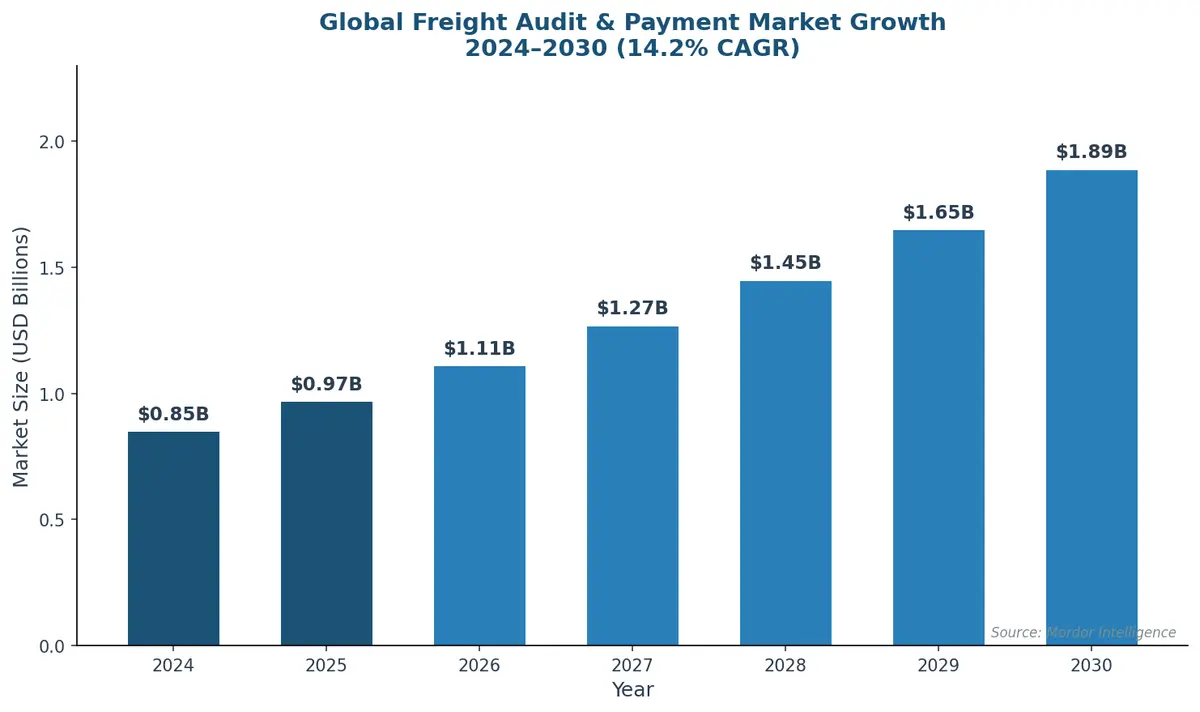
The freight audit and payment (FAP) market reflects the urgency. Mordor Intelligence projects the global FAP market will grow from $970 million in 2025 to $1.89 billion by 2030, expanding at a 14.2% CAGR as shippers increasingly demand automated solutions to replace manual audit processes.
From Post-Hoc Audit to Real-Time Settlement
The traditional freight payment workflow follows a familiar — and painfully slow — pattern:
- Carrier delivers the load and submits a proof of delivery (POD)
- Invoice arrives days or weeks later, often with discrepancies
- Audit team reviews the invoice against the rate confirmation and contract
- Disputes are filed for any discrepancies — a process that can take 30 to 90 days
- Payment is finally released, often 45 to 60 days after delivery
This cycle destroys cash flow for carriers, inflates administrative costs for shippers, and strains relationships across the supply chain. Small and mid-size carriers are hit hardest — many resort to freight factoring (selling invoices at a discount for immediate cash) simply because the payment timeline is too long to sustain operations.
Real-time settlement flips this model entirely. Instead of auditing after the fact, modern TMS platforms validate charges at the point of delivery confirmation:
- Rate confirmation is locked at tender acceptance with contract terms embedded digitally
- Delivery event triggers automatic matching — GPS confirmation, electronic POD, and contract terms are reconciled instantly
- Accessorials are validated in real time against pre-agreed rules (e.g., detention only after two-hour free time, verified by geofence timestamps)
- Payment is authorized immediately upon successful reconciliation, with exceptions flagged for human review
The result is a settlement cycle measured in hours, not months.
The Technology Stack Powering Instant Settlement
Three converging technologies are making real-time freight settlement viable at scale in 2026:
AI-Powered Document Processing
Intelligent document processing (IDP) platforms now classify, extract, and validate freight documentation at intake — BOLs, PODs, rate confirmations, and accessorial receipts — with accuracy rates exceeding 95%. This eliminates the manual data entry bottleneck that historically delayed billing by three to five days. As FreightWaves reports, the gap between delivery and cash is increasingly a document problem, not a willingness-to-pay problem.
Digital Contract Enforcement
Modern TMS platforms store contract terms as structured, machine-readable data rather than PDF attachments. When a delivery event occurs, the system automatically matches the shipment against the correct contract, applies the negotiated rate, validates accessorial eligibility, and calculates the exact payment amount — all without human intervention.
Blockchain and Immutable Settlement Records
While blockchain adoption in logistics has been gradual, freight settlement is emerging as one of its most practical applications. Immutable ledger technology creates a shared, tamper-proof record of every rate agreement, delivery confirmation, and payment authorization. Both carrier and shipper see the same data, eliminating the "my records say X, yours say Y" disputes that consume weeks of back-and-forth.
The Business Case: Beyond Cost Savings
The financial impact of real-time settlement extends far beyond reducing audit costs:
- Cash flow acceleration for carriers: Payments in 24-48 hours instead of 45-60 days reduces carrier dependence on factoring services that typically charge 2-5% of invoice value
- Working capital optimization for shippers: Predictable, automated payment schedules improve cash flow forecasting and reduce accounts payable overhead
- Relationship preservation: Disputes are the leading cause of carrier-shipper relationship deterioration — eliminating them through pre-validated settlement strengthens partnerships
- Capacity access: Carriers prioritize shippers who pay quickly and accurately, especially in tight capacity markets — fast settlement becomes a competitive advantage for freight procurement
Nearly 69% of regional logistics companies already use freight audit tools for reconciliation, according to Global Growth Insights research. The next frontier is moving those tools from retrospective audit to prospective settlement.
What Shippers Should Do Now
The transition from audit-based payment to real-time settlement doesn't happen overnight, but forward-thinking shippers can begin laying the groundwork:
Digitize your contract repository. If your carrier agreements live in PDFs and spreadsheets, automated reconciliation is impossible. Convert rate agreements into structured, machine-readable formats within your TMS.
Standardize accessorial rules. The majority of freight disputes stem from ambiguous accessorial terms. Define clear, measurable triggers (detention starts at X hours, verified by Y method) and embed them in digital contracts.
Invest in electronic POD capture. Real-time settlement requires real-time delivery confirmation. Ensure your carrier network supports electronic POD with GPS timestamps and photographic evidence.
Choose a TMS with native payment orchestration. The most capable platforms in 2026 don't just manage transportation — they orchestrate the entire order-to-settlement lifecycle, from rate confirmation through automated payment release.
How CXTMS Approaches Freight Settlement
CXTMS was built with the understanding that transportation management doesn't end at delivery — it ends at settlement. The platform's integrated payment workflow connects rate confirmation, shipment tracking, delivery verification, and invoice reconciliation into a single automated pipeline. By validating charges against contract terms at the moment of delivery confirmation, CXTMS eliminates the lag between service completion and payment authorization that drives disputes, delays, and strained carrier relationships.
Tired of freight invoice disputes draining your team's time and your company's cash? Contact CXTMS for a demo of automated freight settlement.