CPKC's Single-Line Network Revolution: How North America's First Trinational Railroad Is Reshaping Intermodal Freight in 2026


When Canadian Pacific and Kansas City Southern completed their historic merger to form Canadian Pacific Kansas City (CPKC), they created something that had never existed before: a single railroad stretching from Canada through the United States into Mexico. Now, with record-low operating ratios and double-digit intermodal growth, CPKC's trinational network is fundamentally changing how freight moves across North America.
The Historic Merger That Created a Continent-Spanning Railroad
The CP-KCS merger, finalized in 2023, wasn't just another railroad consolidation. It created the only Class I railroad connecting all three USMCA trading partners on a single line — from Vancouver and Montreal in Canada, through Kansas City and Dallas in the United States, to Lázaro Cárdenas and Mexico City in Mexico.
This trinational footprint gives CPKC a structural advantage no other railroad can replicate. Before the merger, shipping goods from Canada to Mexico by rail required at least two carriers, with interchange handoffs that added days to transit times and introduced reliability risks at every connection point. CPKC eliminated that friction entirely.
By Q2 2025, the company had already achieved over C$220 million in annualized merger synergies — ahead of schedule — through workforce optimization, shared maintenance facilities, and procurement savings.
2025 Results: Record Margins Prove the Model Works
CPKC's full-year 2025 results tell a compelling story of operational excellence. The railroad posted $15.1 billion in revenue, up 4% year-over-year, with a record-low core adjusted operating ratio of 59.9% — a 140 basis-point improvement that represents best-in-class efficiency among North American Class I railroads.
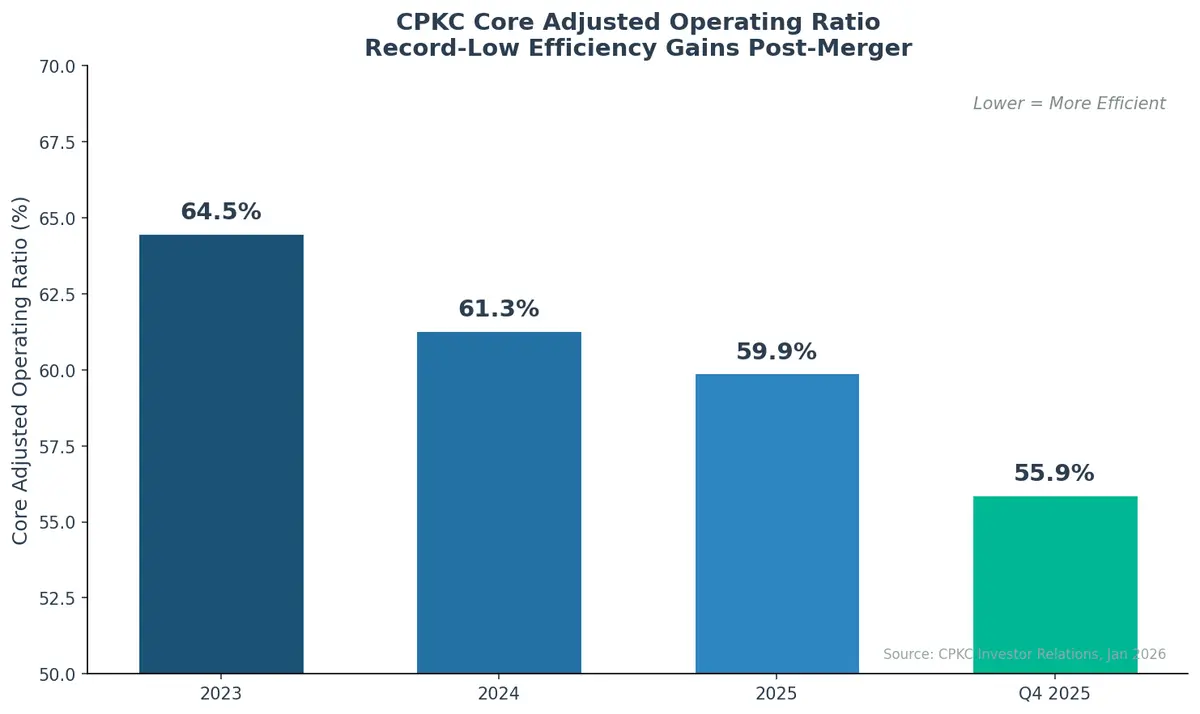
Fourth-quarter performance was even stronger, with a core adjusted operating ratio of 55.9% and record metrics in train weights, network speed, locomotive productivity, and car miles per car day. Core adjusted diluted earnings per share grew 8% for the full year, reaching $4.61.
For three consecutive years, CPKC has led the industry with the lowest FRA-reportable train accident frequency among Class I railroads — extending Canadian Pacific's legacy of 17 consecutive years of safety leadership.
Intermodal Growth: The Trinational Advantage in Action
The most dramatic proof of CPKC's network effect is in intermodal freight. In Q3 2025, domestic intermodal volume surged 13%, while international intermodal grew 10%. These aren't marginal gains — they represent a structural shift in how shippers route cross-border freight.
Several catalysts are driving this growth:
- Refrigerated intermodal from Kansas City: The launch of cold-chain shipments from the Americold facility at CPKC's Kansas City terminal opened an entirely new market for temperature-sensitive cross-border goods.
- Cross-border auto parts traffic: CPKC's closed-loop auto rack model connects assembly plants and ramps across all three countries, carrying record automotive volumes.
- International container growth: Traffic from the Gemini alliance of Maersk and Hapag-Lloyd is flowing through Vancouver, Saint John (New Brunswick), and Lázaro Cárdenas.
- CSX interline service: A new partnership connecting Texas and Mexico with the U.S. Southeast now offers truck-competitive 30-hour service between Dallas and Atlanta.
Single-Line Advantage: Why Eliminating Interchanges Matters
For shippers accustomed to multi-carrier rail moves, the single-line advantage is transformative. Every interchange between railroads introduces delay, damage risk, and data handoff failures. On a traditional two-carrier Canada-to-Mexico move, freight might sit 12 to 24 hours at an interchange yard waiting for the next carrier to pick it up.
CPKC eliminates these interchange delays entirely on its trinational routes. The result is faster, more predictable transit times — critical for just-in-time manufacturing supply chains in automotive, electronics, and consumer goods.
The railroad's Q3 2025 operational metrics reflected this advantage: average train velocity improved 1%, terminal dwell decreased 2%, and both train length and weight increased 2%. These incremental gains compound across thousands of daily shipments.
USMCA Trade Lanes: Automotive, Agriculture, and Energy
CPKC's network is uniquely positioned to capitalize on the industries driving USMCA trade growth:
Automotive: With production facilities spread across all three countries, automakers need seamless cross-border movement of parts and finished vehicles. CPKC's single-line service between Canadian, American, and Mexican assembly plants eliminates the complexity of multi-carrier coordination.
Agriculture: Record grain harvests are flowing south from Canada through CPKC's network. U.S. grain shipments to Mexico drove significant bulk revenue growth in 2025, and 2026 guidance projects continued strength as Mexico's import demand grows.
Energy and chemicals: Potash from Saskatchewan, petroleum products from the U.S. Gulf Coast, and industrial chemicals all move efficiently on CPKC's north-south corridors without the interchange delays that plague east-west competitors.
2026 Outlook: Continued Growth Ahead
CPKC's 2026 guidance projects low double-digit core adjusted EPS growth, mid-single-digit volume growth measured in revenue ton-miles, and $2.65 billion in capital expenditures — a 15% reduction from 2025 as integration spending winds down.
CEO Keith Creel signaled confidence: "Record grain harvests and a pipeline of unique growth opportunities position this company to continue producing differentiated results."
For shippers, the message is clear: CPKC's trinational network is no longer a future promise — it's delivering measurable results today. Companies that haven't yet explored single-line rail options for their North American supply chains are leaving transit time, reliability, and cost savings on the table.
How TMS Platforms Enable Smarter Rail Routing
The rise of CPKC's trinational network creates new complexity for transportation management. Shippers now have routing options that didn't exist three years ago — single-line moves that may be faster and cheaper than traditional multi-carrier or truck alternatives.
Modern TMS platforms address this by integrating rail carrier rate tables, transit time calculations, and intermodal terminal data into unified routing engines. When a shipper needs to move automotive parts from Ontario to Monterrey, the TMS can automatically compare CPKC's single-line option against truck, interline rail, and multimodal alternatives — factoring in cost, transit time, carbon emissions, and reliability scores.
As CPKC continues expanding its service offerings and terminal network, the shippers who benefit most will be those with transportation management systems capable of dynamically incorporating these new options into their routing decisions.
Looking to optimize your North American freight routing with the latest intermodal options? Contact CXTMS for a demo of our TMS platform.