The Cognitive Industrial Revolution: Why Redesigning Workflows Matters More Than Deploying AI in Supply Chain Operations


Most supply chain organizations are investing heavily in artificial intelligence. Yet the returns remain stubbornly elusive. McKinsey's 2025 State of AI report reveals that only about 6% of companies qualify as AI high performers—meaning 88% are failing to extract meaningful bottom-line impact from their AI investments. The difference isn't the technology. It's the workflow.
Welcome to the Cognitive Industrial Revolution
The term "Cognitive Industrial Revolution" captures a shift as profound as the ones that came before it. The first Industrial Revolution augmented human muscle with steam power. The Digital Revolution augmented human memory with data. Now, as ZDNet reports, we are entering a third transformation: the augmentation of human reasoning with agentic AI—systems capable of reasoning, coordinating, and acting across complex workflows.
But here's the critical insight most organizations miss: success in this revolution won't belong to companies with the most advanced AI models. It will belong to those that redesign their organizational workflows to allow intelligence to operate with trusted context and true agency.
This means moving from "Systems of Record" that document history to "Systems of Agency" that actively orchestrate the future.
Why Bolting AI onto Legacy Processes Fails
If AI is layered onto yesterday's fragmented planning systems, it simply automates yesterday's limitations. This is the uncomfortable truth confronting logistics leaders in 2026.
Consider how most supply chain operations still function: sequential handoffs where humans serve as "digital glue," manually connecting disparate systems. Data entry, conflict reconciliation, email-based approvals, spreadsheet updates—these workflows were designed for a slower, more predictable world. According to McKinsey's supply chain risk survey, 82% of supply chain leaders report their operations are already affected by new tariffs, impacting 20% to 40% of supply chain activity. The tempo of disruption has accelerated beyond what legacy workflows can absorb.
When organizations deploy AI within these outdated structures, they get faster versions of broken processes. Demand planning, inventory management, pricing, sourcing, and logistics continue operating in parallel silos—connected only by periodic reviews and manual reconciliation. Each function optimizes locally while no one optimizes across the network.
The Workflow Redesign Imperative
McKinsey's data makes the case clearly: among the 25 organizational attributes tested, workflow redesign has the single biggest impact on whether AI initiatives succeed.
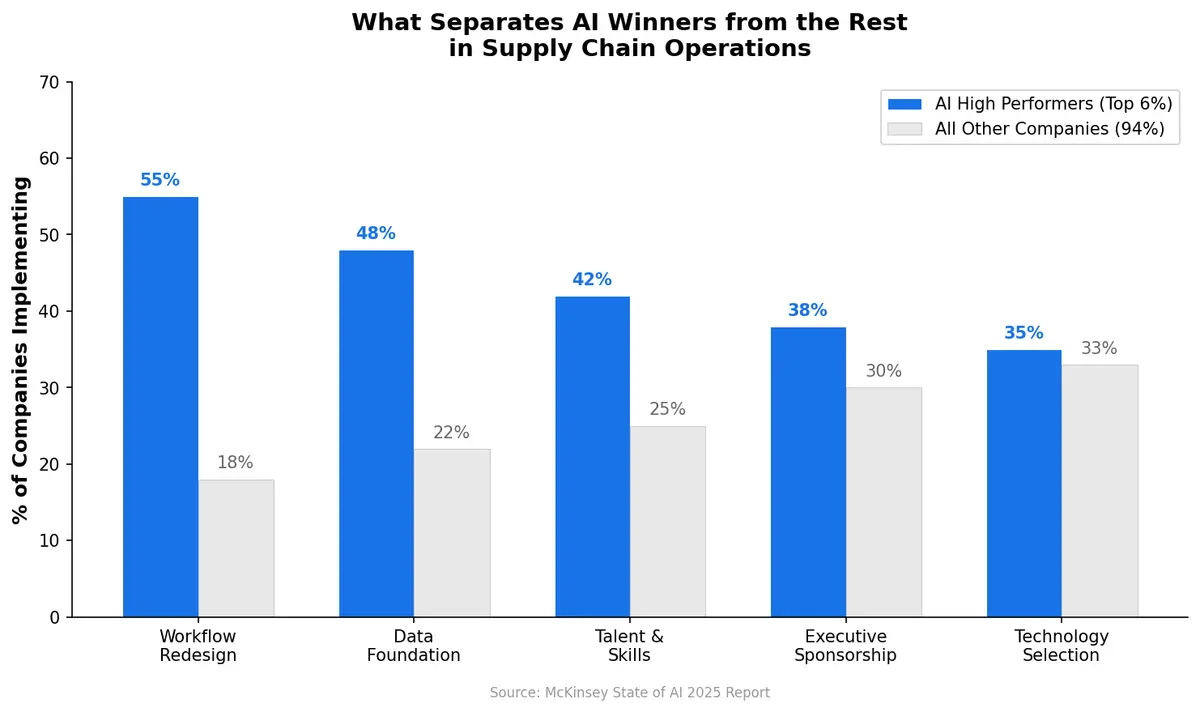 Fifty-five percent of AI high performers report that their organization has fundamentally redesigned individual workflows to deploy AI—compared to a fraction of that among underperformers.
This isn't about incremental process improvement. It's about rethinking how decisions flow through an organization:
From sequential to parallel. Traditional logistics planning moves linearly—forecast, then plan inventory, then schedule transport, then execute. Workflow-first organizations run these processes concurrently, with AI coordinating dependencies in real time.
From reactive to predictive. Legacy workflows respond to disruptions after they occur. Redesigned workflows use AI to detect signals—weather patterns, port congestion, supplier variability—and adjust before problems materialize.
From siloed to networked. When data is harmonized into a unified network model, AI can detect relationships that siloed systems cannot: how weather sensitivity affects demand, how supplier lead-time variability impacts inventory positioning, how customer profitability should influence fulfillment priority.
The Digital Twin Foundation
True workflow transformation requires a structural foundation. As industry analysts have noted, a supply chain digital twin—a network-based representation of the entire operating model including products, locations, suppliers, constraints, and financial flows—fundamentally changes what AI can accomplish.
The ERP remains the system of record for execution. The digital twin becomes the system of intelligence for decision-making with network-wide visibility. Without this unified model, AI is limited to optimizing fragments. With it, AI can reason across the entire supply network.
This is why the most successful AI deployments in logistics don't start with model selection or algorithm tuning. They start with architecture—building the data foundation and workflow design that allow AI to operate as intended.
From Digital Twins to Agentic Orchestration
The next evolution is already underway: agentic AI systems that don't just analyze data but actively coordinate workflows across organizational boundaries. These systems can manage exception handling, route optimization, carrier negotiations, and compliance checks—not as isolated tasks, but as orchestrated workflows where each decision considers the full operational context.
The key requirement, however, remains the same: the workflow must be designed for agency. An AI agent operating within a legacy sequential process will hit the same bottlenecks humans do. An AI agent operating within a purpose-built parallel workflow can deliver the 50%+ productivity gains that BCG's research suggests are possible—but only for organizations willing to do the hard work of process redesign first.
The Practical Playbook for Workflow-First AI
For logistics leaders ready to embrace the Cognitive Industrial Revolution, the path forward follows a clear sequence:
-
Map your current decision flows. Document how information actually moves through your supply chain—not the org chart version, but the reality of emails, spreadsheets, and manual handoffs.
-
Identify the human glue. Find every point where a person is manually connecting two systems or translating data between teams. These are your highest-value redesign targets.
-
Design the ideal workflow. Before selecting any AI tool, architect the process as it should work—parallel, predictive, and networked. Then determine where AI adds the most value.
-
Build on API-native infrastructure. Legacy systems with bolt-on integrations will constrain your redesigned workflows. Modern, API-first platforms enable the fluid data exchange that agentic AI requires.
-
Measure workflow outcomes, not AI metrics. Model accuracy is irrelevant if the workflow doesn't deliver faster decisions, lower costs, or better service levels.
Why Architecture Matters More Than Algorithms
The Cognitive Industrial Revolution isn't a technology upgrade—it's an organizational transformation. The companies that will lead logistics in the next decade aren't necessarily those with the biggest AI budgets. They're the ones willing to fundamentally question how work gets done and redesign their operations from the ground up.
CXTMS was built with this philosophy at its core. Rather than bolting AI onto legacy freight management processes, CXTMS provides an API-native, workflow-first platform where every logistics process—from rate procurement to delivery confirmation—is designed for intelligent orchestration from day one.
Ready to redesign your logistics workflows for the AI era? Contact CXTMS for a demo and see how workflow-first architecture delivers the transformation that technology alone cannot.