The AI Implementation Gap: Why BCG Says Technology Alone Won't Fix Supply Chain Planning in 2026


Everyone is investing in AI for supply chain planning. Almost no one is getting the returns they expected. That's the uncomfortable reality laid bare by BCG's new report, Supply Chain Planning 2026: Why AI Alone Isn't Enough — and the data behind it should give every logistics executive pause.
The Numbers Don't Lie: AI Adoption Is Outpacing AI Impact
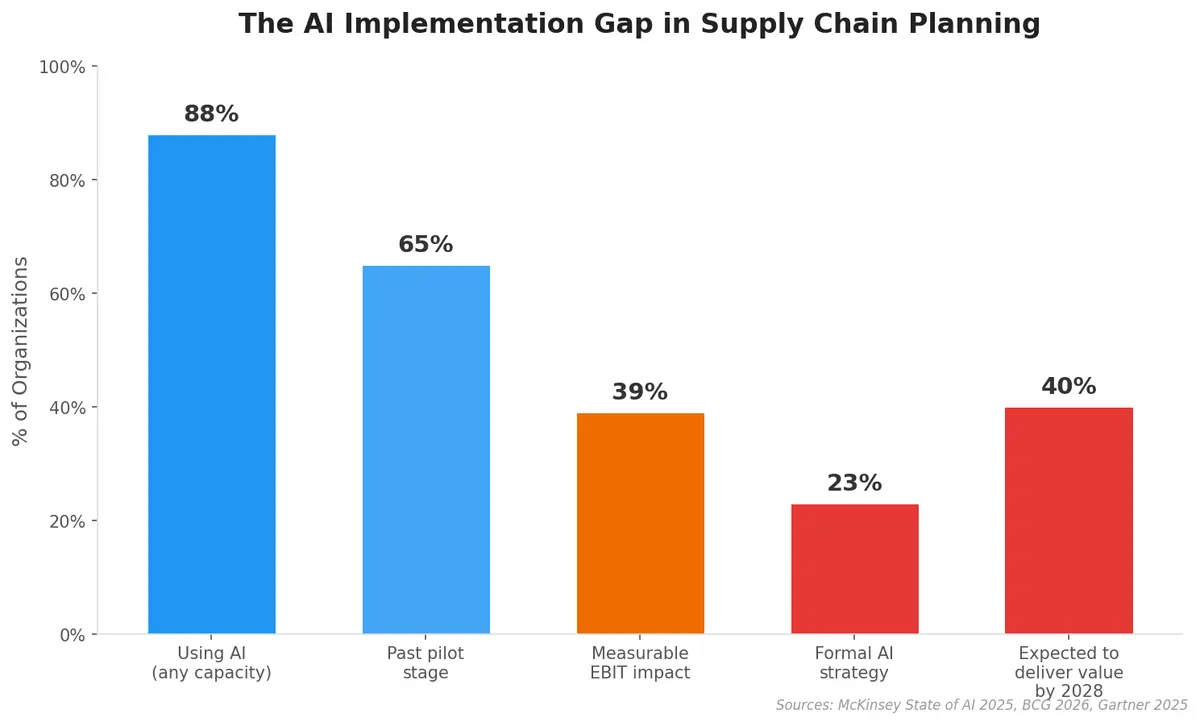
The gap between AI adoption and AI value creation has become a chasm. According to McKinsey's State of AI research, while 88% of organizations now use AI in some capacity, only 39% can point to measurable EBIT impact. That means the majority of companies deploying AI are running expensive science experiments — not driving bottom-line performance.
BCG's 2026 supply chain planning report doubles down on this finding, examining why companies that have moved well past the pilot stage still struggle to translate AI capabilities into operational gains. The consultancy finds that the differentiator between leaders and laggards isn't the technology itself — it's how planners apply advanced capabilities to drive performance.
A Gartner prediction reinforces the trend: 60% of supply chain digital adoption efforts will fail to deliver promised value by 2028, largely due to insufficient investment in learning and development.
The Planner Problem: Automating Yesterday's Limitations
Here's the core insight most companies miss: layering AI onto fragmented, legacy planning systems doesn't create intelligent supply chains. It automates yesterday's limitations faster.
Supply chain planning in most organizations still runs on disconnected spreadsheets, siloed ERP modules, and planning processes designed for a pre-pandemic world. When companies deploy AI on top of these fractured foundations, the technology inherits every flaw, every data gap, and every process inefficiency baked into the existing system.
A July 2025 MIT NANDA study quantified the scale of the problem: 95% of enterprise AI pilots deliver zero measurable return. Companies poured $30–40 billion into generative AI initiatives. Almost nothing showed up on the P&L.
The failure mode is predictable. An AI demand forecasting model trained on dirty historical data produces confident but inaccurate predictions. An AI-powered exception management system built on top of manual workflows generates alerts nobody acts on. An intelligent planning copilot layered onto a planning process that hasn't been redesigned in a decade simply makes bad decisions faster.
What Leaders Do Differently
BCG's research identifies a clear pattern separating the companies that extract real value from AI and those that don't: leaders redesign workflows before deploying technology.
This means rethinking the end-to-end planning process — not just automating individual steps. Leaders ask fundamentally different questions:
- What decisions should AI make autonomously? Routine reorder points, standard allocation adjustments, and predictable demand shifts don't need human oversight. Leaders delegate these entirely.
- Where does human judgment remain critical? New product launches, supplier relationship decisions, and strategic network changes still require experienced planners. Leaders protect these touchpoints.
- How should the planner's role evolve? Instead of running models and crunching numbers, planners in leading organizations become exception managers and strategic decision-makers — focusing on the 5% of situations that AI can't handle.
Only 23% of supply chain organizations have a formal AI strategy, according to Gartner. Without one, AI deployment becomes a series of disconnected experiments rather than a coordinated transformation.
The 50% Productivity Promise vs. Reality
Vendors and consultants love to cite potential productivity gains of 50% or more from AI in supply chain planning. And those numbers aren't fabricated — leading organizations do achieve them. But they represent the ceiling, not the floor.
The reality for most companies looks very different. BCG's research suggests that organizations taking a technology-first approach — buying AI tools and expecting planners to figure them out — typically see productivity improvements in the single digits. Some see negative returns when you factor in implementation costs, change management overhead, and the productivity dip during transition.
The companies hitting 50%+ gains share three characteristics:
- Integrated data foundations. They invested in cleaning, connecting, and governing their supply chain data before deploying AI. No amount of algorithmic sophistication compensates for fragmented data.
- Process redesign. They rebuilt planning workflows from scratch, designing processes around AI capabilities rather than retrofitting AI into existing processes.
- Planner upskilling. They invested heavily in training planners to work alongside AI — understanding model outputs, knowing when to override recommendations, and managing by exception rather than by routine.
Bridging the Gap: Practical Steps for 2026
The implementation gap isn't a technology problem — it's an organizational one. Companies looking to close it should focus on three priorities:
Start with data integrity, not algorithms. The most sophisticated AI model in the world can't compensate for incomplete shipment records, inconsistent SKU classifications, or demand data trapped in regional spreadsheets. Audit your planning data before investing in AI capabilities.
Redesign the process, then automate it. Map your current planning workflow end-to-end. Identify which steps add value and which exist because "that's how we've always done it." Eliminate the waste first, then apply AI to the streamlined process.
Invest in people as much as technology. Gartner's warning about L&D investment isn't theoretical — it's the primary reason digital adoption fails. Planners need training not just on new tools, but on new ways of working. Budget for change management at the same level as technology licensing.
How CXTMS Helps Close the Implementation Gap
At CXTMS, we built our platform with the implementation gap in mind. Instead of bolting AI onto legacy processes, our TMS integrates intelligent planning directly into streamlined logistics workflows — connecting rate management, shipment execution, and performance analytics in a single system.
Our approach means your team doesn't need to become data scientists. AI-driven recommendations surface within the workflows planners already use, with transparent reasoning that builds trust and enables smart overrides when human judgment matters most.
Ready to close the AI implementation gap in your logistics operations? Contact CXTMS for a demo and see how integrated intelligence drives real results.