An Arkansas Port’s Rail Rebuild Shows Why Inland Ports Need Disaster-Ready Capacity Plans

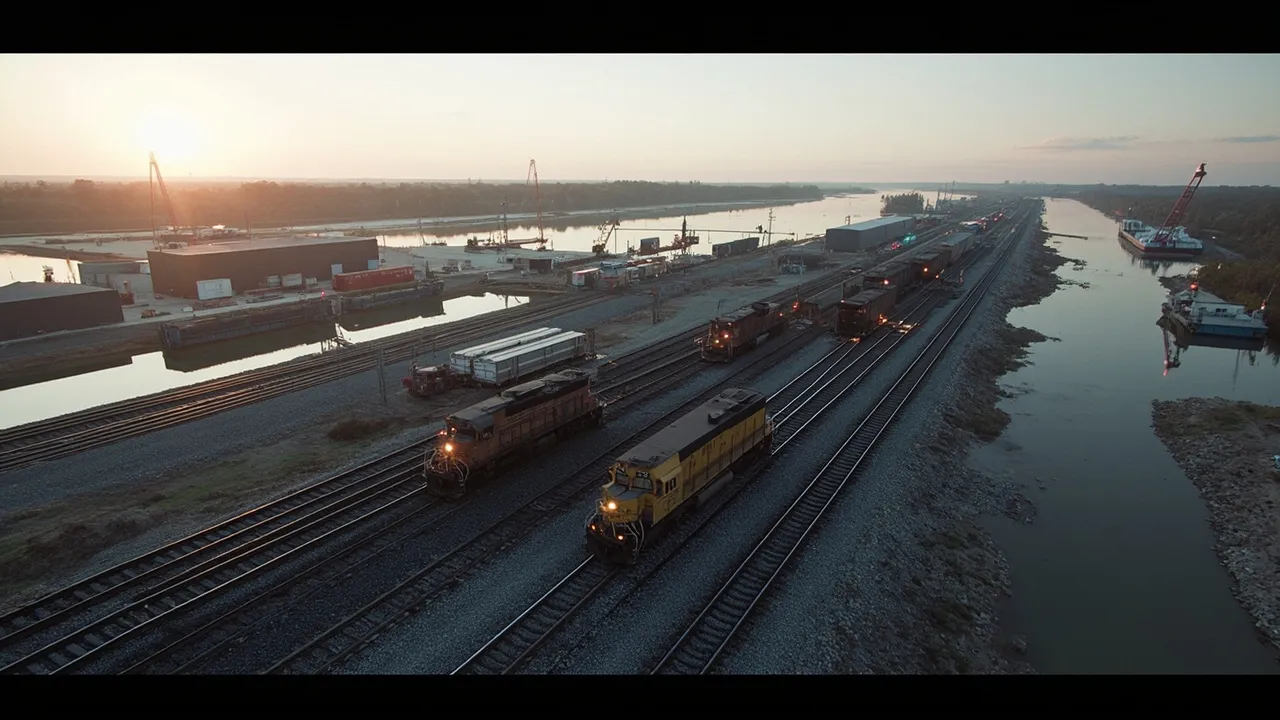
Inland ports are easy to underestimate until one of them goes down. They do not have the visibility of Los Angeles, Savannah, Houston, or New York-New Jersey. They rarely dominate national freight headlines. But for agricultural shippers, manufacturers, bulk terminals, and regional distributors, a small rail-served river port can be the difference between a resilient network and a costly scramble.
That is the real lesson from the Arkansas River. Talk Business & Politics reported that the Port of Fort Smith, operated by Five Rivers Distribution, will receive $8.1 million in federal funding to modernize and expand rail capacity after the destructive 2019 flood. The port authority must match 20%, or $1.62 million, and the rebuild includes plans for three 30,000-square-foot warehouses to handle freight arriving by rail.
On paper, that sounds like a local infrastructure story. For freight planners, it is bigger than that. It is a reminder that inland ports need disaster-ready capacity plans before the water rises, the track washes out, or the only practical transload point in a region loses throughput.
Inland ports are network shock absorbers
The Arkansas facility is not a mega-port. FreightWaves noted that the 28-acre port handles about 1,000 railcars annually, including inbound bulk feeds, poultry and cattle feed supplement, and wire coils used in manufacturing. It is served by the Arkansas & Missouri Railroad and connects to Union Pacific, BNSF, and CPKC.
Those details matter because they describe exactly why inland nodes are operationally important. The port sits at the intersection of barge, truck, and rail. It supports freight that is heavy, regional, industrial, and often poorly suited to pure truckload networks. For agricultural and manufacturing shippers, that kind of node can absorb overflow, reduce highway dependency, consolidate bulk freight, and preserve optionality when capacity tightens elsewhere.
A port that handles 1,000 railcars a year may not look strategic in a national dashboard. But if those railcars carry feed ingredients into a poultry region or wire coils into local production, the node is critical to the businesses that depend on it. Network design has to measure criticality by operational consequence, not just volume.
Recovery capacity cannot be improvised
The 2019 Arkansas River flood shows why. FreightWaves reported that the port was “all but destroyed” when the river crested more than 40 feet above flood stage. By 2024, the port authority had already spent more than $6 million on restoration using grants, insurance payouts, and FEMA support. A $1.7 million, 30,000-square-foot bulk storage warehouse was partially funded by a $500,000 Arkansas Waterways Commission grant, and another $1.8 million was granted in 2025 for a 20,000-square-foot warehouse and bulk storage pad.
That sequence is important. Recovery did not happen through one check or one construction project. It required layered funding, staged restoration, warehouse replacement, bulk storage, rail capacity planning, and a multi-year rebuild timeline that now points toward first-quarter 2027 completion for the new warehouse design.
Shippers should not read that timeline as a public-sector problem. It is a freight-continuity problem. If an inland port, short line, transload yard, or bulk storage node disappears for months, cargo does not politely wait. It moves by longer drayage, alternate rail ramps, more expensive truckload, temporary storage, customer allocations, or emergency sourcing.
The companies that manage that transition well are not the ones with the longest binder on disaster recovery. They are the ones that already know which nodes are critical, which alternates are practical, and how fast they can re-rate lanes when the normal route fails.
Rail demand makes node resilience more valuable
The timing also matters because rail volume is not standing still. Logistics Management reported that U.S. rail carloads for the week ending May 23 reached 230,831, up 2.2% year over year, while intermodal containers and trailers reached 292,743, up 11.5%. Through the first 20 weeks of 2026, U.S. rail carloads were up 3.3% annually and intermodal units were up 1.4%.
That growth puts more value on reliable rail-served nodes. When rail is gaining share or absorbing more freight, disruptions at smaller terminals can create outsized consequences. A shipper that loses a familiar transload site may discover that the alternate ramp has different hours, equipment limits, commodity restrictions, drayage coverage, storage constraints, or appointment rules.
This is where resilience planning gets practical. Rail-served inland ports need recovery plans that cover track access, short-line dependencies, warehouse capacity, bulk storage, lift equipment, truck gates, drayage partners, carrier interchange points, and customer communication. The plan should not be theoretical. It should include named alternates, rate structures, contact owners, and trigger points for switching modes.
Infrastructure risk is becoming climate risk
The Arkansas case also fits a broader infrastructure pattern. SupplyChainBrain reported that ASCE gave U.S. ports a B and rail a B-minus in its latest infrastructure report card, among the strongest grades in an otherwise middling national assessment. But ASCE also warned that aging infrastructure is increasingly vulnerable to natural disasters as extreme weather events rise, and called for resilient infrastructure built to withstand intense hurricanes, flooding, and wildfires.
That is the uncomfortable truth for inland logistics. A network can be efficient in normal weather and brittle in abnormal weather. The low-cost route can be the least recoverable route. The local port can look redundant until the only alternatives require two extra drayage legs and a week of customer-service triage.
What CXTMS-style planning should capture
For freight forwarders and logistics teams, the answer is not to avoid inland ports. That would be expensive and short-sighted. The answer is to manage them as critical nodes with clear continuity rules.
Start with node criticality. Which inland ports, rail ramps, short lines, warehouses, and transload yards support production-critical freight, seasonal agricultural flows, high-value cargo, or customer commitments with little slack? Rank them by consequence, not just spend.
Then map backup capacity. For each critical node, identify alternate rail-served locations, drayage providers, truckload conversion options, warehouse overflow sites, and customer allocation rules. Confirm constraints before disruption: commodity handling, storage type, loading equipment, gate hours, insurance, hazmat rules, and appointment capacity.
Finally, turn the plan into execution logic. CXTMS can help teams connect node criticality, carrier routing, shipment visibility, exception alerts, and alternate-capacity playbooks in one operating layer. When a rail-served port is constrained, teams need more than a spreadsheet. They need fast answers: which shipments are affected, which customers are exposed, which alternate lanes are approved, and what cost-service tradeoff should be triggered.
The Arkansas rebuild is a hopeful story because capacity is coming back stronger. But the lesson is blunt: inland freight resilience cannot begin after the flood. It has to be designed into the network while the tracks are dry.
Ready to map critical nodes, backup capacity, and disruption playbooks across your freight network? Request a CXTMS demo and see how connected transportation management turns resilience planning into execution.