Fujairah's New Container Terminals Put Strait of Hormuz Avoidance Into Network Design

For decades, the Strait of Hormuz has been treated as an unavoidable geographic fact for containerized trade serving the Gulf. DP World's planned terminals on the United Arab Emirates' eastern coast could turn avoidance of that chokepoint into a practical network-design option.
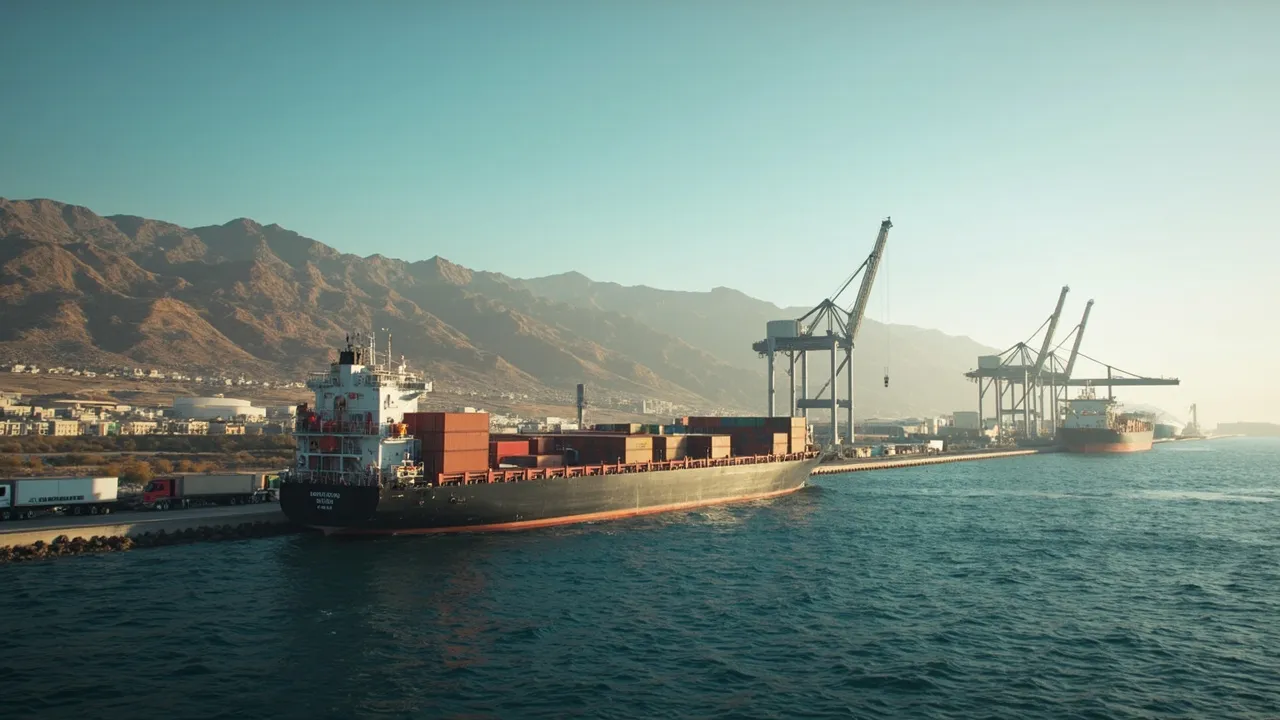
The port operator has reached an agreement in principle with Fujairah Ports Authority for a 50-year concession covering two deepwater facilities: the Al Rugaylat container and multipurpose terminal and the Dibba general cargo terminal. Both sit on the Gulf of Oman, outside the strait.
According to SupplyChainBrain's report on the agreement, the terminals are expected to provide combined annual capacity of 2.5 million twenty-foot equivalent units, 190,000 vehicles, and up to 5.3 million tons of general cargo. Development will be phased and could take as long as 30 months.
Those figures make Fujairah more than an emergency discharge point. They create the prospect of a repeatable eastern gateway—but only if shippers design the inland and data layers as carefully as the ocean move.
The Strategic Value Is Geography
Jebel Ali remains the region's dominant container hub, but vessels reaching it must pass through Hormuz. Fujairah faces the Indian Ocean, allowing a ship to call without entering the Persian Gulf. That distinction matters when naval restrictions, insurance exclusions, security incidents, or carrier suspensions constrain the strait.
The scale of the exposure became clear earlier in 2026. Supply Chain Dive reported that more than 700 vessels were backed up during the first week of March, affecting about 10% of the world's container fleet. The same report estimated that roughly 2 million TEUs aboard Gulf-linked vessels or booked over the following 90 days could be affected.
An eastern gateway cannot eliminate regional risk, but it can separate two risks that have traditionally been bundled together: the ocean passage through Hormuz and the inland delivery into Gulf markets. A container discharged at Fujairah can move west by truck or rail connection while its vessel stays outside the constrained waterway.
That is valuable optionality. It is not free capacity.
Avoidance Moves Cost Into the Inland Network
Routing cargo through Fujairah replaces a portion of the ocean move with inland handling and transfer. Shippers therefore need to compare total landed cost, not port-to-port freight rates.
The new path may require an additional truck leg, terminal lift, chassis handoff, customs movement, security procedure, and appointment. Cargo bound for Dubai, Abu Dhabi, or another Gulf market may also consume more driver hours and road capacity than a conventional Jebel Ali discharge. If volume arrives in a surge, a theoretically open port can still create queues at gates, depots, and distribution centers.
Inventory policy changes too. A company using Fujairah only after a closure may need more safety stock because carrier schedules, inland transit times, and customs procedures are less predictable during the activation period. A company using it routinely can build steadier flows, contracted drayage, and known clearance processes—but may pay a recurring cost premium for resilience.
The right comparison includes:
- ocean freight, surcharges, and war-risk insurance;
- port handling, storage, and demurrage exposure;
- inland transport and equipment availability;
- customs transit and inspection time;
- inventory carrying cost and service penalties;
- the probability and duration of a Hormuz disruption.
The lowest-cost route in a stable month may not be the lowest expected-cost route across a volatile year.
Capacity Must Be Tested at Every Handoff
The planned 2.5 million-TEU capacity is substantial, especially compared with Fujairah's current container capability. Yet terminal nameplate capacity is only one constraint in an end-to-end route.
A resilience plan can fail if there are not enough trucks, bonded carriers, chassis, customs staff, inspection bays, warehouse slots, or road windows to absorb diverted containers. The inland corridor linking Fujairah with Jebel Ali and surrounding logistics zones must perform under peak conditions, not merely average demand.
Shippers should ask carriers and logistics providers specific questions before designating the port as a contingency gateway:
- Which services will call the terminals, at what frequency, and with what allocation?
- How much inland capacity is contractually reserved during a regional disruption?
- Can cargo move under bond, and which customs documents must be prepared before arrival?
- Where will empty containers and chassis be returned?
- What storage, detention, and demurrage rules apply when the inland leg is constrained?
- Which cargo types require special permits, inspection, refrigeration, or secure handling?
A vague promise to "reroute through Fujairah" is not a plan. A plan identifies the service, handoffs, capacity commitments, decision thresholds, and accountable parties.
Treat Fujairah as a Designed Scenario
Transportation teams need a digital scenario for the eastern gateway before they need the route operationally. That scenario should contain validated lead times, costs, customs requirements, carrier options, facility calendars, and inland milestones.
It should also define activation rules. One company might shift 20% of Gulf-bound cargo when insurance premiums exceed a threshold. Another might pre-position inventory when vessel cancellations reach a set level. Critical shipments may move through Fujairah by default, while cost-sensitive freight remains on the traditional path until risk rises.
Control-tower visibility is essential once cargo is diverted. Teams need to see the container's discharge, customs status, inland appointment, equipment assignment, gate event, and final delivery in one workflow. Otherwise, the chokepoint has merely moved from the strait to a collection of emails and spreadsheets.
The terminals will not make Hormuz irrelevant, nor will they replace the enormous throughput of established Gulf ports. Their importance is more practical: they give shippers a credible second topology for serving the UAE and neighboring markets.
The companies that benefit most will be those that model the route now, contract the scarce inland resources, and rehearse activation before the next disruption.
Build resilient routing into daily transportation execution. Request a CXTMS demo to see how centralized planning, milestone visibility, and exception workflows help teams manage alternate gateways.