A $40 Million Lumber Expansion Puts On-Site Rail Back in the Plant-Location Model

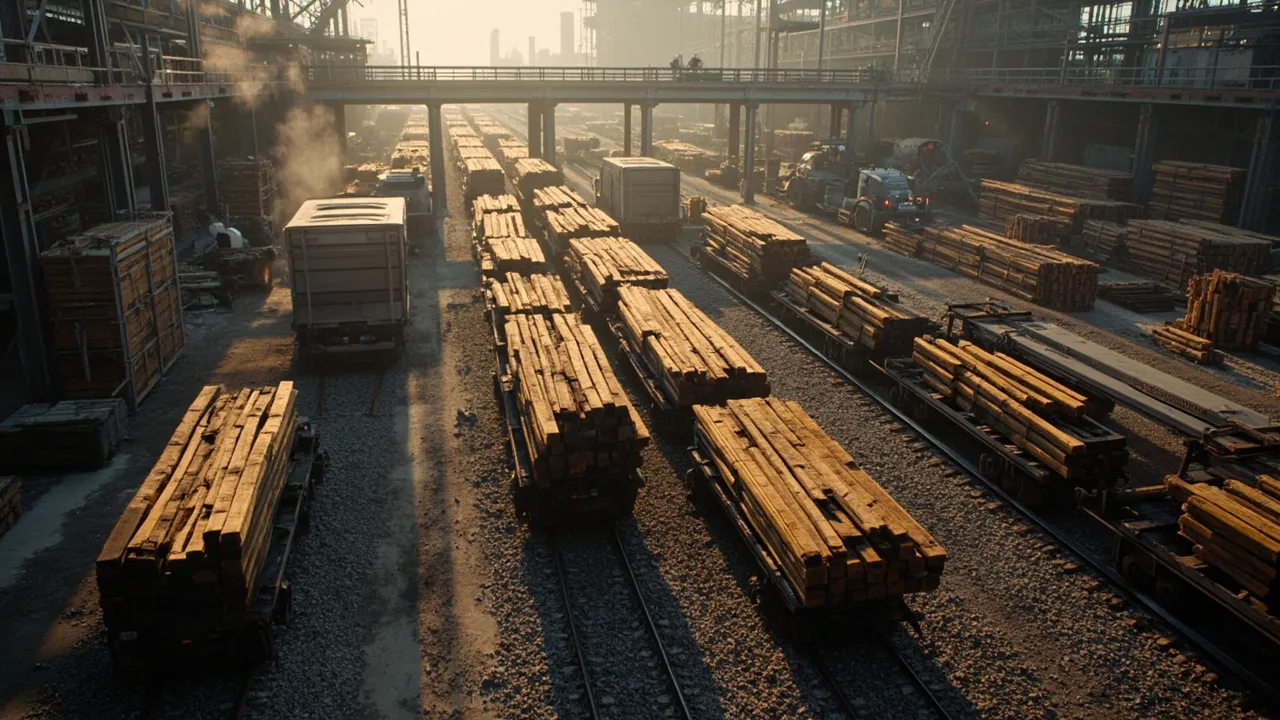
Plant-location studies often begin with labor, land, taxes, utilities, and highway access. For heavy industrial operations, that list is incomplete. A rail siding that reaches the production site can change the cost, capacity, and resilience of every inbound and outbound move—and it needs to be modeled before the site is chosen, not added as an afterthought.
Great Southern Wood-NC offers a timely example. The lumber producer plans a new treatment facility at Laurinburg-Maxton Airport in Scotland County, North Carolina, with an investment expected to reach $40 million. Direct rail infrastructure is part of the design, turning the project into a useful case study for manufacturers weighing a rail-served site against a truck-only alternative.
The siding is part of the production system
Supply Chain Dive reports that the North Carolina Railroad Company plans to invest up to $600,000 in on-site rail infrastructure for the facility. Once operating, Great Southern Wood-NC expects to receive and distribute at least 421 railcar shipments annually by 2030.
That minimum equals roughly eight railcars per week when averaged across a year, but an average is not an operating plan. Lumber supply, treatment schedules, construction demand, railroad service days, and customer receiving hours can concentrate volume. The siding must hold the cars expected on a peak switching day, plus enough buffer to keep production running when a pickup or delivery slips.
Direct access removes a costly handoff. Without it, a plant may receive lumber by truck, use transload terminals to transfer rail freight, or dray railcars' contents between an off-site facility and the production line. Each option adds handling, appointments, inventory, damage exposure, and another party whose operating hours can constrain throughput. On-site rail does not eliminate complexity; it moves that complexity into track design, switching coordination, and railcar inventory control.
Compare rail and truck with the same assumptions
A fair modal comparison must measure the entire door-to-door move. Rail economics should include switching charges, railcar lease or detention, track maintenance, loading equipment, and the truck leg at destinations without rail access. Truck economics should include linehaul, fuel, driver time, loading appointments, and the number of individual movements required to replace a railcar's payload.
Capacity matters as much as rate. Trucks provide flexible dispatch and are well suited to shorter distances, variable quantities, and customers without sidings. Rail works best when dense, repeatable volume can move in larger batches. For a lumber plant, the right design is likely a portfolio: rail for suitable high-volume lanes and truck for regional deliveries, urgent orders, and recovery when rail service is disrupted.
Emissions should also be calculated by lane rather than asserted as a universal percentage. FreightWaves explains that Association of American Railroads estimates use 437.9 ton-miles per gallon after a 10% geographic adjustment. The same source says freight rail accounts for 0.5% of total U.S. greenhouse-gas emissions and 1.9% of transportation-related emissions. Those industry figures make rail attractive for dense long-haul freight, but actual results still depend on route, commodity, locomotive mix, railcar weight, and first- and last-mile handling.
Connect mill output to railcar movement
Track alone does not create flow. The plant needs a shared data record that connects a production lot, railcar, shipment, customer order, and delivery appointment. Without that chain, cars can sit while the mill produces the wrong grade, shipment status can diverge from the railroad's record, and customer service may promise inventory that is blocked behind another car on the siding.
At minimum, the operating handoff should capture:
- production order, lumber type, treatment specification, quantity, and ready time;
- railcar ID, capacity, placement status, loading start and completion timestamps;
- switch request, railroad service window, estimated departure, and interchange events;
- shipment destination, consignee requirements, arrival estimate, and unloading appointment;
- exception owner, next action, revised milestone, and customer notification status.
This information lets planners sequence production against cars that are physically available rather than cars assumed to be available. It also allows transportation teams to distinguish a production delay from a missed switch, a railroad delay, or a customer-side unloading problem. That distinction is essential because each exception calls for a different response.
Put physical rail constraints in the location score
A rail-served site should not receive a simple yes-or-no score. Decision makers need to test the usable capacity and service pattern behind the label. A practical checklist includes:
- Siding capacity: How many loaded and empty cars can the plant hold without blocking loading positions or the lead track?
- Switching windows: How often will the railroad serve the site, on which days, and what is the cutoff for a switch request?
- Track geometry and load limits: Can the track, turnouts, and clearances accept the required car types and weights?
- Loading productivity: How long does each car occupy the loading spot, and can production sustain that rate?
- Storage and demurrage: Where will early cars wait, and when do railroad or equipment charges begin?
- Network reach: Which suppliers and customers are rail served, and where will transloading still be required?
- Disruption fallback: Which truck carriers, transload sites, and alternate rail gateways can protect priority orders?
The model should then stress-test a missed switch, a multi-day line outage, a production surge, and a customer that cannot unload on schedule. If the facility cannot preserve production or customer service under those scenarios, the apparent rail advantage may depend on fragile assumptions.
Treat rail readiness as a launch milestone
For the North Carolina project, the projected 421 annual railcars are not merely a transportation forecast. They influence track length, loading labor, inventory buffers, switching agreements, and the mix of customers the plant can serve economically. Those dependencies should have owners and readiness dates alongside construction and equipment installation.
Before launch, the operator should validate railroad master data, conduct test switches, establish car-location scans, rehearse exception escalation, and confirm truck fallbacks. After launch, weekly reviews should track cars ordered versus supplied, loading cycle time, missed switches, dwell, demurrage, and on-time customer delivery. A plant-location decision becomes valuable only when the planned access produces reliable shipment execution.
Coordinate rail-served operations with CXTMS
CXTMS connects production-ready freight, rail and truck milestones, customer appointments, and exception workflows in one operational view. Request a CXTMS demo to see how your team can turn multimodal infrastructure into dependable capacity.