Integrated Lift-Truck Screens Are Quietly Solving the Warehouse Automation Adoption Problem

Warehouse automation has spent years chasing the hard problems: navigation, safety, fleet orchestration, battery life, payload capacity, and integration with warehouse systems. Those problems matter. But many deployments still struggle at the point where the machine meets the shift worker.
That is why integrated screens on autonomous lift trucks and mobile robots deserve more attention. They are not flashy. They do not make the robot faster on a demo floor. But they can make automation understandable, repeatable, and usable during a normal warehouse shift.
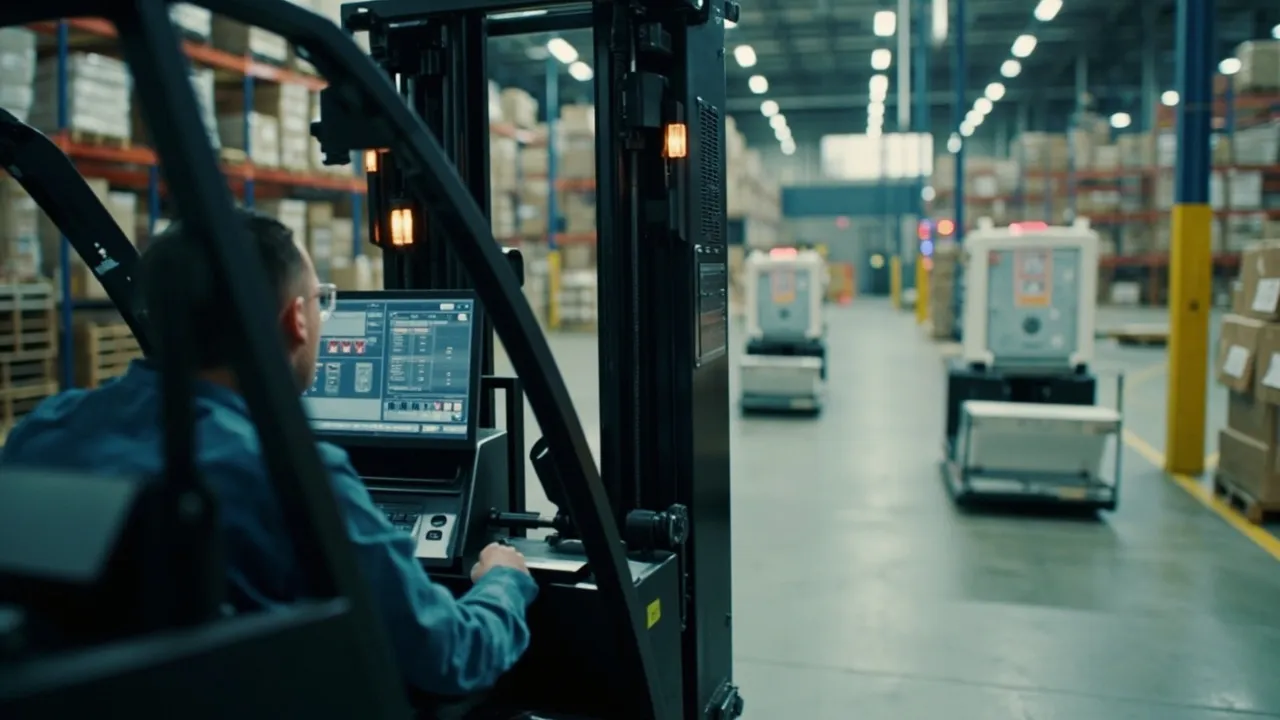
As Modern Materials Handling reports, built-in mobile interfaces are increasingly being designed into autonomous lift trucks and robots rather than bolted on through separate handheld devices. The practical features are simple: mission status, battery state, maintenance menus, local assist prompts, barcode information, pallet pickup instructions, and even one-button “Go” workflows.
That simplicity is the point. Warehouse automation adoption is not just a robotics problem. It is a workflow-design problem.
The Market Is Growing Faster Than Operator Readiness
The business case for autonomous forklifts is getting harder to ignore. Mordor Intelligence estimates the autonomous forklift market at $2.86 billion in 2025, growing from $3.21 billion in 2026 to $5.72 billion by 2031, a 12.23% CAGR. Logistics and warehousing accounted for 49.05% of market share in 2025, and electric systems represented 71.40% of the market.
Those figures explain why more warehouse leaders are reviewing autonomous lift trucks, AMRs, and mixed robotic fleets. Labor availability remains tight, e-commerce service expectations keep rising, and multi-shift facilities want more consistent throughput without adding proportional headcount.
But growth does not automatically mean adoption is easy. Mordor also notes that autonomous forklifts can cost 70% to 400% more than conventional models, with advanced sensor and software maintenance reaching $15,000 per truck annually. The same report cites documented productivity gains ranging from 25% to 100% and potential yearly labor savings of $50,000 to $100,000 per vehicle in multi-shift operations.
That combination creates a familiar executive question: if the upside is strong and the cost is real, what determines whether the project actually works?
Too often, the missing answer is operator-facing workflow.
Why Separate Handhelds Create Friction
A traditional warehouse technology stack often asks workers to coordinate between equipment, handheld scanners, voice prompts, printed labels, WMS screens, and supervisor instructions. That becomes messier when autonomous equipment is introduced.
If an operator has to interpret a system message on one device, confirm a pallet on another, check robot status somewhere else, and then decide whether the machine is ready to move, the automation has redistributed complexity.
Integrated lift-truck screens attack that problem directly. According to MMH, these interfaces are purpose-built for the robot and its workflow, presenting only what is needed in that moment.
That matters in high-volume operations because most warehouse process variation happens at handoff points. A robot arrives at a pickup location. A pallet is not staged correctly. A barcode needs confirmation. A load requires local assistance. A worker needs to know whether to intervene or let the system continue.
A screen mounted on the equipment can turn those moments into guided micro-decisions. It can show the current mission, battery level, pickup instruction, barcode prompt, maintenance option, or local assist request exactly where the work is happening.
The “Go” Button Is More Strategic Than It Looks
The most interesting example from MMH is also the least dramatic: a simple “Go” button that lets an operator confirm a load and send the robot to its next stop.
That sounds basic. It is not. It defines the human-machine contract.
In a manual operation, the operator owns the movement. In a fully autonomous dream scenario, the system owns everything. Real warehouses live in the middle. They need operators to supervise, confirm, recover, and collaborate with automated equipment while still keeping freight moving.
A one-button workflow gives the worker a clear role. The system brings the equipment into position. The operator verifies the physical world. The interface captures the confirmation. The robot proceeds. The WMS, WES, or fleet manager receives a clean workflow signal instead of a messy exception trail.
That is how automation becomes operationally boring in the best possible way.
Screens Are the Adoption Layer Between Robots and Systems
Warehouse leaders often evaluate automation from the top down: ROI model, fleet size, facility layout, system integration, safety case, and vendor roadmap. Those are necessary questions. They are not sufficient.
The adoption layer sits lower. It asks what the worker sees at 2:15 p.m. when a robot needs help near a congested pick face, whether a temp worker on day three can understand the next action without calling a supervisor, and whether barcode validation, local assist, and task assignment are embedded in the process.
Integrated screens can reduce training burden, cut errors, clarify local-assist requests, and reduce device-management overhead because the warehouse is not relying on a separate fleet of handhelds for every robot interaction.
This is especially important as facilities move toward mixed automation: autonomous forklifts, pallet movers, AMRs, conveyors, sortation systems, dock scheduling tools, yard platforms, and transportation management systems. The more automated the network becomes, the more important human-facing clarity becomes.
Questions to Ask Before Buying More Robots
Before approving another automation purchase, warehouse and logistics leaders should ask a few blunt questions:
- What exactly does the operator see when the robot needs confirmation or assistance?
- Can a new worker complete the workflow without navigating multiple apps?
- Are barcode prompts, load confirmation, and exception handling built into the equipment interface?
- Does the screen expose only the next useful action, or does it dump system data on the worker?
- How are local assist events captured, routed, and analyzed after the shift?
- Can the TMS, WMS, or execution layer see enough status data to plan downstream labor, dock, and transportation work?
The last question is where warehouse automation connects to broader logistics performance. A robot that moves pallets efficiently still has to serve inbound receiving, outbound staging, dock turns, carrier appointments, and customer delivery commitments. If task status stays trapped inside the warehouse, transportation planners remain blind.
CXTMS Connects Warehouse Signals to Transportation Execution
Integrated lift-truck screens are not just a user-interface upgrade. They are a sign that automation maturity is shifting from “Can the robot move?” to “Can the operation coordinate?”
That shift matters for freight forwarders, 3PLs, and shippers trying to connect warehouse activity with transportation execution. When pallet movement, staging status, exceptions, and dock readiness become clearer inside the facility, transportation teams can make better appointment, carrier, and routing decisions outside the facility.
CXTMS helps logistics teams turn those operational signals into transportation workflows: shipment planning, carrier coordination, exception management, visibility, and communication. The goal is not automation for its own sake. The goal is a cleaner handoff from warehouse work to freight execution.
If your team is investing in warehouse automation, make sure the workflow layer is as strong as the hardware. Request a CXTMS demo to see how transportation management can connect facility activity to faster, more reliable freight operations.