Software-Defined Commercial Trucks Arrive: How Volvo's 10,000-Update-Per-Day OTA Program Is Transforming Fleet Performance

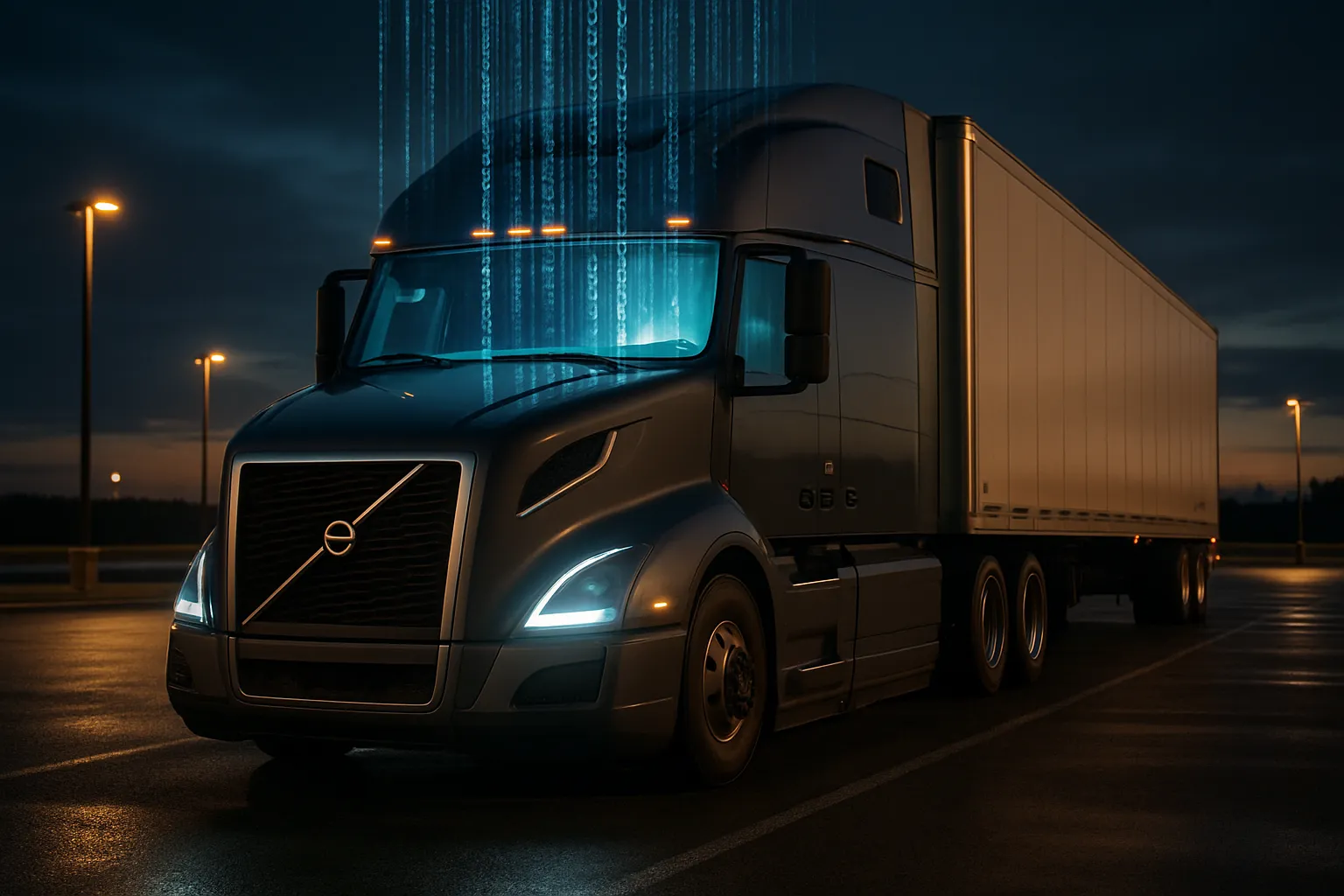
Your smartphone updates itself overnight. Your laptop patches security vulnerabilities while you sleep. But until recently, a 40-ton Class 8 truck needed a trip to the dealer just to get a software calibration — costing fleets hours of downtime for every update cycle.
That era is ending. At the American Trucking Associations' Technology & Maintenance Council (TMC) annual meeting in Nashville this month, Volvo Trucks North America revealed that its automatic over-the-air (OTA) update program has reached a tipping point: the company can now dispatch up to 10,000 software updates per day across its connected fleet, and trucks running the latest software are experiencing 24% fewer unplanned stops.
Welcome to the age of the software-defined truck.
From 25% to 80% in Six Months
The numbers tell a compelling story. Six months ago, only about 25% of Volvo's connected North American fleet was running the latest software. Today, that figure has climbed past 80% — a transformation driven by making automatic updates the default setting rather than requiring fleet managers to manually request releases.
"Our new trucks here in North America — the all-new Volvo VNL and the all-new Volvo VNR — function much like smartphones on wheels," said Peter Voorhoeve, president of Volvo Trucks North America. "A truck delivered today will not be the same truck one year later; it continues to evolve."
The update system evaluates the entire connected fleet daily, identifying which trucks need new software for engine, transmission, and battery management systems. Drivers receive notifications when updates are available and can install them while parked or during scheduled breaks — no dealer visit required, no revenue miles lost.
Before flipping the switch to automatic updates, Volvo consulted its fleet customers directly. The result? Fewer than 1% chose to opt out. Fleets overwhelmingly recognized that staying current on software means staying on the road.
The 24% Uptime Advantage
The business case for OTA updates goes far beyond convenience. According to Maddie Sullivan, product marketing manager at Volvo Trucks, trucks running the latest software see approximately 24% fewer unplanned stops compared to those on outdated calibrations.
For a fleet running 500 trucks, a 24% reduction in unplanned stops translates directly to thousands of additional revenue miles per year. When you factor in the cost of roadside breakdowns — towing fees, emergency repairs, missed delivery windows, and driver detention — the financial impact compounds rapidly.
This is happening against a backdrop where the fleet management market exceeded $27 billion in 2025 and is projected to grow at a 16.9% CAGR through 2035, driven largely by connected vehicle technology and digital transformation. OTA updates are becoming the foundational layer that makes every other fleet technology investment more effective.
What "Software-Defined" Actually Means for Fleet Operations
The concept of a software-defined vehicle (SDV) has been percolating in the passenger car industry for years — Tesla being the most visible example. But in commercial trucking, the implications are different and arguably more impactful.
A software-defined truck means:
-
Continuous fuel efficiency improvements without hardware changes. Volvo's new VNL platform, with over 15,000 units in commercial traffic and more than 15 million customer miles logged, is consistently delivering a 10% fuel efficiency gain over previous models. At California's current diesel prices of $6.09 per gallon, that adds roughly 3% directly to a carrier's bottom line — often the difference between profit and loss in today's thin-margin freight environment.
-
Remote diagnostics and predictive maintenance that identify issues before they become roadside failures. The truck's software monitors thousands of parameters in real time, flagging anomalies and scheduling preventive service during planned downtime.
-
Feature deployment at scale without requiring physical recalls or dealer campaigns. New safety features, emissions optimizations, and performance enhancements can reach an entire fleet within days rather than months.
-
Reduced dealer dependency for routine calibration work, freeing up service bay capacity for complex repairs that actually require hands-on attention.
The Competitive Landscape: OEMs Racing to Connect
Volvo isn't operating in a vacuum. The entire heavy-duty truck OEM landscape is pivoting toward connected, software-defined platforms:
PACCAR has formed a strategic partnership with Platform Science to build an integrated all-in-one telematics platform for Kenworth and Peterbilt trucks, aiming to create an adaptive ecosystem where fleet operators can access a broad suite of digital solutions through a single interface.
Cummins is advancing its own software-defined vehicle architecture, combining predictive diagnostics and OTA update capabilities with its powertrain technology to offer fleet operators intelligent, real-time performance optimization.
International Trucks has extended OTA capabilities to adjustable performance parameters on its LT Series models, allowing fleet managers to approve updates that drivers can activate directly from the vehicle dashboard.
The convergence is clear: within the next few years, a truck that can't receive remote software updates will be as outdated as a truck without GPS. The predictive maintenance market alone is projected to reach $15.6 billion by 2030, and OTA updates are the delivery mechanism that makes predictive maintenance actionable at scale.
The New Frontier: Truck-Trailer Connectivity
Volvo is already pushing beyond the cab. At the same TMC event, the company announced a joint development program with Tectran Manufacturing to create a next-generation tractor-trailer connector supporting high-speed wireless data communication.
Today's industry-standard SAE J560 seven-pin connector — designed decades ago for basic lighting and electrical functions — simply can't handle the data demands of modern connected trucking. Volvo's solution adds secure, short-range wireless communication within the existing connector housing, enabling real-time data exchange between truck and trailer for enhanced braking coordination, propulsion optimization, and trailer diagnostics.
"A modern truck is a highly sophisticated, connected machine. The trailer has to evolve at the same pace," said Magnus Gustafson, Volvo's vice president of connected services.
This matters for shippers because trailer-level visibility — temperature monitoring, load status, door open/close events, and predictive maintenance for trailer components — has been a persistent blind spot in supply chain visibility. Bridging the truck-trailer data gap could unlock a new tier of real-time freight intelligence.
What This Means for Shippers and Carriers
The shift to software-defined trucks creates ripple effects across the logistics ecosystem:
For carriers, the calculus on truck procurement is changing. A truck's total cost of ownership now includes the value of its software roadmap — the future improvements that will be delivered over the air during the vehicle's service life. Carriers should evaluate OEM connected services platforms as carefully as they evaluate powertrain specifications.
For shippers, carrier technology adoption becomes a meaningful differentiator in procurement decisions. Fleets running software-current trucks deliver measurably better uptime, which translates to more reliable pickup and delivery performance. Asking carriers about their OTA adoption rates and connected fleet percentage is becoming a legitimate freight procurement question.
For brokers and 3PLs, real-time vehicle health data flowing from connected trucks creates new opportunities for intelligent carrier matching — routing time-sensitive loads to trucks with the highest predicted uptime probability.
How CXTMS Integrates With the Connected Fleet Revolution
The software-defined truck doesn't operate in isolation. Its value multiplies when real-time vehicle data connects to the broader logistics technology stack.
CXTMS fleet integrations are designed to ingest and act on the real-time vehicle health, location, and performance data that connected truck platforms generate. When a carrier's Volvo VNL flags a potential maintenance issue via OTA diagnostics, CXTMS can factor that signal into load planning — proactively reassigning shipments before a breakdown occurs rather than scrambling after one.
Combined with multi-modal optimization and predictive analytics, CXTMS helps shippers and carriers turn the flood of connected truck data into actionable logistics decisions.
Ready to see how real-time fleet intelligence fits into your logistics strategy? Request a CXTMS demo and discover how connected vehicle data integration can drive measurable uptime and cost improvements across your transportation network.