Supply Chain Disruption Winners: How Geopolitical Reshuffling Creates Unlikely Logistics Beneficiaries in 2026

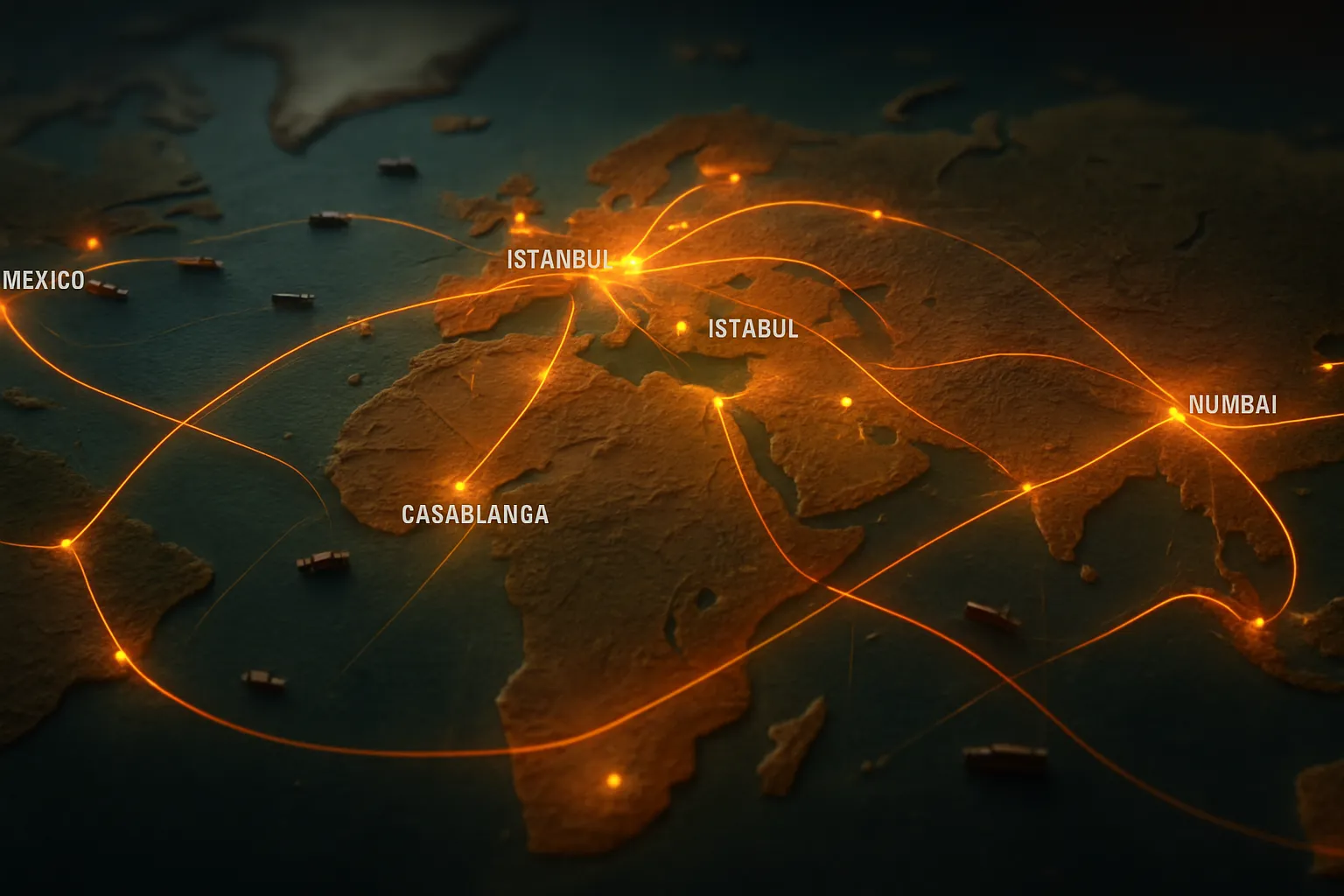
Every crisis reshapes the map. When Suez Canal blockages rerouted ocean freight, when IEEPA tariffs upended US–China trade flows, when Strait of Hormuz tensions threatened energy supply lines — each disruption didn't just create victims. It created winners. Countries, corridors, and logistics providers that were positioned to absorb redirected trade flows saw investment, volume, and infrastructure growth that would have taken a decade under normal conditions.
In 2026, the accumulation of overlapping geopolitical shocks has accelerated this reshuffling to an unprecedented pace. The question for shippers is no longer whether supply chain geography is changing, but which emerging nodes deserve strategic investment — and which represent fleeting opportunity.
The Disruption Dividend: Why Crises Redistribute Logistics Value
Supply chain disruptions function like tectonic shifts. They don't eliminate trade — they redirect it. When tariffs make one sourcing corridor uneconomical, volume migrates to alternatives. When port congestion paralyzes a hub, feeder networks to secondary ports expand. When geopolitical risk makes a region untenable for inventory positioning, warehousing demand surges in safer jurisdictions.
As FreightWaves reported, freight winners in 2026 are the companies and corridors that built for disruption rather than merely reacting to it. "As margins tighten, companies become more willing to test alternative routes, carriers and cross-border strategies," noted uShip CEO Mike Williams, pointing specifically to U.S.–Mexico trade as a stabilizing force for North American freight demand.
The pattern is consistent across regions: disruption creates temporary chaos, then permanent reallocation. Here are the four biggest beneficiaries of 2026's geopolitical reshuffling.
Winner #1: Mexico and the Nearshoring Supercycle
Mexico's transformation from a nearshoring talking point to a manufacturing powerhouse has reached an inflection point. Foreign direct investment in Mexico's manufacturing sector jumped more than 10% year over year to hit $34.3 billion in the first half of 2025 alone, with 36% of that capital flowing directly into manufacturing, according to Global Trade Magazine. The transportation equipment industry captured a disproportionate 41% of total manufacturing FDI — a sharp increase from 2022 levels that signals structural, not cyclical, investment.
What makes Mexico's position uniquely resilient in 2026 is the convergence of push and pull factors. The push: IEEPA tariff aftermath, ongoing US–China trade tensions, and regulatory uncertainty around Chinese-origin goods. The pull: USMCA preferential access, geographic proximity enabling just-in-time delivery to US markets, and a young workforce with growing advanced manufacturing skills.
For shippers, the practical implication is clear. Cross-border US–Mexico freight lanes are experiencing sustained volume growth, and the logistics infrastructure to support that growth — border crossing capacity, intermodal facilities, and warehousing in Monterrey, Guadalajara, and the Bajío corridor — is expanding rapidly.
Winner #2: India's Leap From Alternative to Primary Source
India's role in global supply chains has undergone a qualitative shift. What began as a "China-plus-one" diversification hedge has evolved into something far more structural. India's manufacturing sector is experiencing steady expansion driven by strong domestic demand, Production-Linked Incentive (PLI) investments, infrastructure buildout, and the accelerating China-plus-one strategy adopted by multinational corporations.
QIMA's Q1 2026 Supply Chain Barometer reveals the scale of this shift: for North American buyers, the combined share of the top three supplier countries — China, India, and Vietnam — fell from 61% to 54% in a single year, indicating that sourcing is becoming more distributed even as India captures an increasing share of the non-China allocation.
The sectors where India is gaining fastest tell the story: electronics manufacturing, pharmaceuticals, automotive components, and textiles. Apple's continued expansion of iPhone production through Foxconn and Tata Electronics facilities in Tamil Nadu and Karnataka has created a halo effect, with tier-two and tier-three suppliers following anchor manufacturers into the Indian ecosystem.
For logistics operators and shippers, India's ascent means growing demand for ocean freight capacity on India–US and India–Europe tradelanes, expanded air cargo infrastructure at airports like Hyderabad and Bengaluru, and an emerging need for sophisticated last-mile distribution networks within India itself.
Winner #3: Morocco and Turkey as Europe's New Sourcing Frontier
While nearshoring conversations in North America center on Mexico, European supply chain leaders are quietly building their own alternative sourcing infrastructure — with Morocco and Turkey emerging as the primary beneficiaries.
Morocco's logistics market is valued at $13.80 billion in 2025 and is projected to reach $16.32 billion by 2030, growing at a 3.41% CAGR, according to Mordor Intelligence. That growth is underpinned by more than $15 billion in infrastructure investment since 2010, including the Tanger Med port complex — now one of the Mediterranean's busiest transshipment hubs — and a network of free-trade zones designed to attract European manufacturers.
The Red Sea disruptions that rerouted Asia–Europe shipping around the Cape of Good Hope served as a catalyst. Brands like Asos and Boohoo accelerated sourcing shifts to Morocco and Turkey to circumvent the longer lead times and inflated costs of rerouted Asian goods. Turkey's existing manufacturing depth in automotive, textiles, and electronics — combined with its customs union with the EU — makes it a natural complement to Morocco's lower-cost labor advantage.
For shippers serving European markets, these corridors offer dramatically shorter lead times compared to Asian sourcing: days rather than weeks, with the bonus of avoiding the geopolitical risk concentrations that continue to plague Red Sea and Suez Canal routes.
Winner #4: Regional Distribution Firms Gaining From Hub Decentralization
Perhaps the most underappreciated beneficiaries of 2026's disruptions are the regional warehousing and distribution companies that are capturing demand as supply chains decentralize.
The Association for Supply Chain Management (ASCM) ranked agility and resilience as one of the defining supply chain priorities for 2026, noting that agile sourcing strategies are increasingly overtaking rigid, centralized planning models. In practice, this means companies are shifting from a small number of mega-distribution centers to networks of smaller, strategically positioned regional facilities.
This decentralization creates opportunity for mid-market logistics providers who know their regional markets intimately. Rather than routing everything through coastal mega-ports and centralized DCs, shippers are building buffer inventory at inland hubs, establishing regional cross-dock facilities near manufacturing clusters, and contracting with local carriers who can provide surge capacity during disruptions.
The warehousing sector reflects this shift: demand for industrial real estate in secondary markets — from Querétaro to Pune to Tangier — is outpacing traditional gateway cities. Companies that can offer flexible, technology-enabled warehousing in these emerging nodes are winning contracts that would have been unimaginable five years ago.
The De-Risking Framework: From Single-Source to Multi-Node Networks
Identifying disruption winners is useful intelligence, but the strategic imperative for shippers goes deeper. The companies outperforming in 2026 aren't simply swapping one concentrated source for another. They're building multi-node networks designed to absorb shocks without breaking.
This means maintaining qualified suppliers across at least two geographic regions for critical inputs, positioning safety stock in markets that serve as both consumption centers and distribution hubs, and building carrier relationships in emerging corridors before capacity tightens.
The framework requires three capabilities that most legacy supply chain planning tools lack: real-time visibility into geopolitical risk by corridor, the ability to model cost and lead-time trade-offs across alternative sourcing scenarios, and dynamic routing that adjusts to disruptions as they unfold rather than after the damage is done.
How CXTMS Helps Shippers Capitalize on Emerging Corridors
CXTMS is built for exactly this kind of multi-node supply chain complexity. Our network modeling tools help shippers evaluate emerging logistics corridors — from US–Mexico cross-border lanes to India and Morocco sourcing routes — with real-time cost, transit time, and risk analytics.
Rather than reacting to the next disruption, CXTMS enables proactive corridor diversification: identifying which emerging hubs align with your product mix, modeling inventory positioning across decentralized networks, and maintaining carrier relationships across regions so you can shift volume when conditions change.
The geopolitical reshuffling of 2026 isn't a temporary dislocation — it's a permanent restructuring of global trade geography. The shippers who recognize this and invest in the tools to navigate it will find themselves on the winning side of disruption.
Ready to model your multi-node supply chain strategy? Request a CXTMS demo and see how corridor-level analytics can turn disruption into competitive advantage.