Suez Services Resume: Rebaseline Transit Times Before Restoring Old Routes

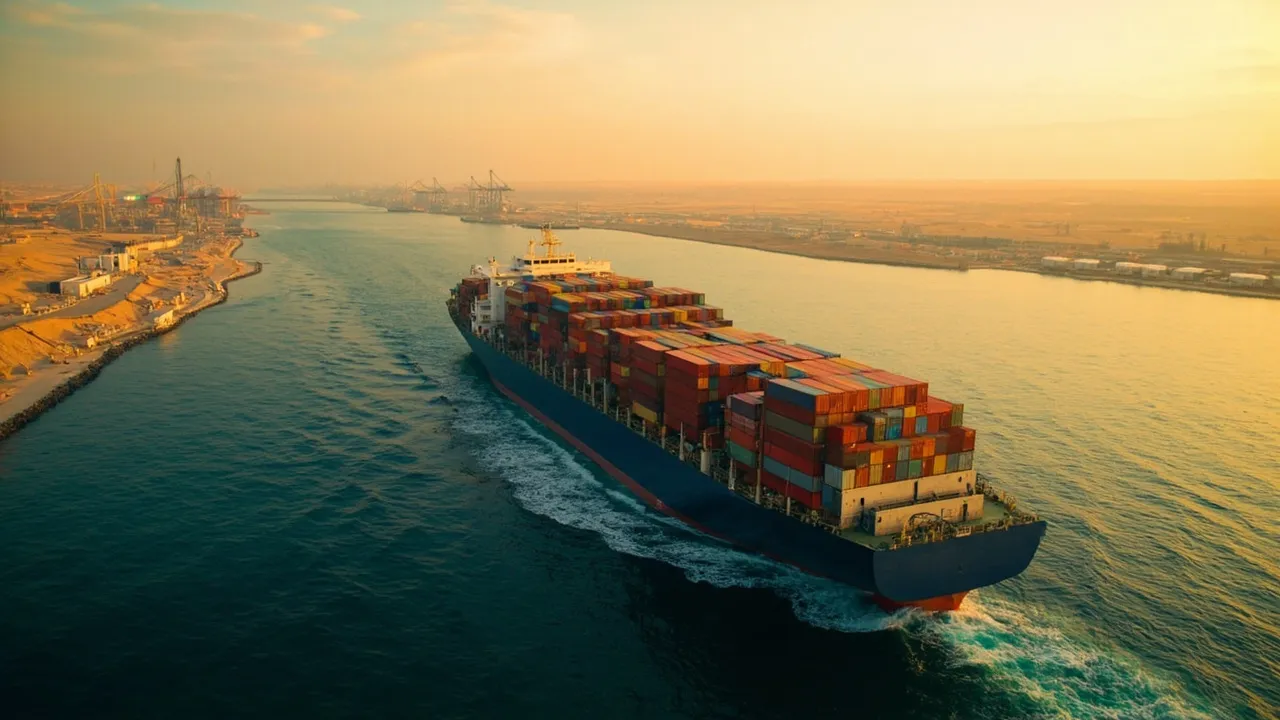
The return of container services to the Suez Canal is meaningful, but it is not the same as a return to pre-disruption reliability. A published schedule shows carrier intent. It does not prove that vessels will call every advertised port, connections will hold, insurers will keep terms stable, or transit-time variability will immediately disappear.
That distinction matters now that Maersk and Hapag-Lloyd are routing four shared services through the canal again. Shippers should capture the potential time advantage without treating the first sailings as a signal to restore every old routing rule. The safer approach is to rebaseline each lane with observed events, increase allocation in stages, and change customer promises only when variance—not merely average speed—has stabilized.
Four services are evidence of progress, not full normalization
SupplyChainBrain reported that the carriers are resuming Suez transits for four joint container routes. This expands the set of practical options available to shippers after prolonged diversions around the Cape of Good Hope.
The economic attraction is clear. In January, Reuters reported that a Suez routing could cut about one week from transit compared with the alternative. A seven-day improvement can reduce pipeline inventory, accelerate cash conversion, and lower the probability of missing a production or retail window.
But the year's operating history also argues for caution. After earlier resumptions, carriers diverted vessels again when regional security deteriorated. Service availability can therefore change between booking, departure, and arrival. Even when a vessel completes the canal transit, network recovery may produce bunching, blank sailings, revised port rotations, or missed feeder connections.
The decision is not simply “Suez or Cape.” It is how much volume to expose, on which origin-destination pairs, under what evidence threshold, and with which fallback plan.
Build a lane baseline from actual events
Start with a lane-level baseline, not a carrier-wide assumption. A service can perform well from one Asian origin to Northern Europe while a transshipment-dependent route remains volatile.
For every trial shipment, capture planned and actual timestamps for booking confirmation, empty release, gate-in, vessel departure, each port call, canal passage, transshipment discharge and load, destination arrival, availability, and final pickup. Connect those events to the schedule version that was valid when the booking was accepted. Otherwise, a later schedule update can make an originally late move appear on time.
Five evidence categories should drive the routing decision:
- Physical execution: Did the named vessel make the advertised calls and complete the Suez transit?
- Security conditions: Did carrier advisories or naval-protection requirements change during the voyage?
- Commercial terms: Did insurance, war-risk, emergency, or rerouting charges change after booking?
- Schedule integrity: Were sailings blanked, rolled, or substituted, and did transshipment connections hold?
- End-to-end outcome: What were the actual door-to-door transit and total landed transportation cost?
Measure the median transit, but also calculate the 80th or 90th percentile and the spread between planned and actual arrival. A lane averaging 25 days with a 10-day swing is harder to promise than one averaging 28 days with a two-day swing.
Restore volume through phased allocation
A phased allocation rule lets the transportation team learn without placing the entire supply plan on an immature service pattern.
In the observation phase, route a small set of non-critical shipments through the resumed service while preserving Cape-routed or alternative-carrier capacity. Favor cargo with adequate inventory coverage, flexible delivery windows, and low downstream shutdown risk. Do not use the first sailing for a component that could stop a plant.
Move to a validation phase only after several departures produce complete event records. Compare actual port rotations, transit distributions, connection success, added charges, and claims against the fallback route. Increase the share gradually if performance stays inside agreed thresholds.
Finally, use a scaled phase for lanes that meet the standard across multiple sailing cycles. Even then, retain concentration limits and an automatic rollback trigger. A new security advisory, consecutive missed connections, a material insurance change, or a sharp rise in blank sailings should stop further allocation and return affected bookings to the contingency plan.
This method turns a geopolitical judgment into a controlled operating decision. The team is not predicting whether the corridor will remain stable indefinitely; it is limiting exposure and reacting to measurable changes.
Separate market pressure from route performance
Suez normalization is unfolding while ocean networks remain busy. Supply Chain Dive forecasts U.S. container imports of 2.31 million TEUs in September, up 9.6% year over year, before an expected 1.7% year-over-year decline to 2.11 million TEUs in October.
Those volumes can distort the early evidence. A rolled booking or delayed connection may reflect peak demand at a port rather than the canal routing itself. Conversely, a fast first voyage during a favorable window does not establish repeatable performance. Code exceptions by cause—security diversion, blank sailing, terminal congestion, equipment shortage, feeder failure, customs hold, or inland delay—so analysts do not assign every variance to Suez.
Commercial reviews should also compare total cost rather than base ocean rate. Include war-risk and emergency surcharges, insurance changes, detention and demurrage, transshipment dwell, inventory carrying cost, and the cost of protecting the shipment with extra buffer stock.
Change ETAs and inventory buffers last
The one-week theoretical advantage should not immediately become a seven-day reduction in the customer promise. Keep the external ETA conservative while trials establish a reliable lane distribution. Internally, show both the carrier ETA and a risk-adjusted ETA based on observed variance.
Reduce inventory buffers only after the lane has met its transit and connection thresholds for several cycles. Segment that decision by product: low-value replenishment cargo can tolerate more uncertainty than scarce components, regulated goods, launches, or seasonal merchandise. Record every buffer change with its data window, approver, and rollback threshold.
The resumed Suez services create a genuine opportunity to shorten supply lines. The winners will not be the shippers that move fastest on an announcement. They will be the ones that collect clean lane evidence, scale exposure deliberately, and translate stable execution—not optimistic schedules—into better promises and lower inventory.
Ready to compare route performance, manage exceptions, and control ocean allocations from one shipment record? Request a CXTMS demo to build a more resilient routing workflow.