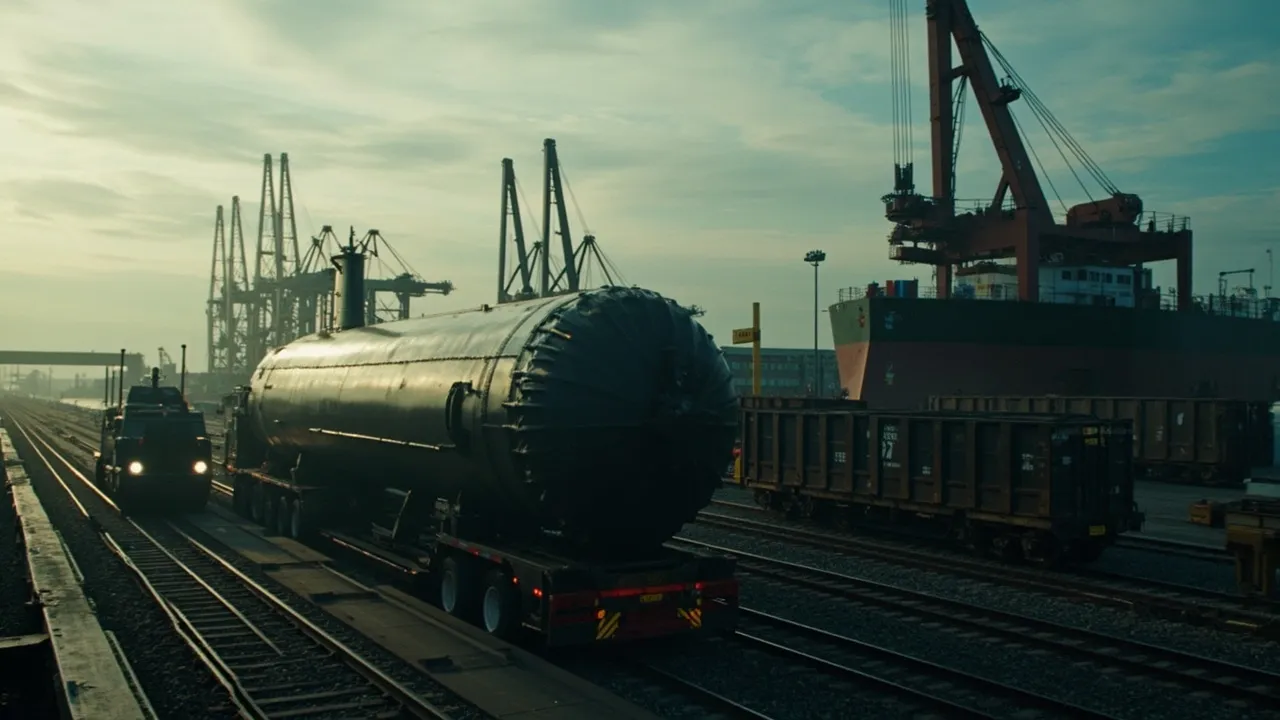
Middle East and Africa Freight Growth Now Depends on Corridor Resilience


The Middle East and Africa freight market has the growth profile every logistics operator wants: strategic geography, rising infrastructure investment, expanding consumer demand, and more trade moving through ports, airports, roads, free zones, and inland hubs. But the region also has the operating profile that exposes weak transportation control. Corridor reliability now matters as much as capacity.
Mordor Intelligence estimates the Middle East and Africa freight and logistics market at $321.36 billion in 2026, up from $305.07 billion in 2025, with projected growth to $416.75 billion by 2031 at a 5.34% CAGR. That is not a niche opportunity. It is a large, expanding logistics arena connecting Asia, Europe, Africa, and the Gulf.
The catch is simple: growth moving through volatile corridors is not the same thing as easy growth. Forwarders and shippers cannot assume one ocean routing, one border process, one carrier pool, or one inland handoff will hold steady. In MEA logistics, the winning question is no longer “Can we book the move?” It is “Can we keep the shipment under control when the route changes?”
The Market Is Growing Across Modes
Mordor’s segment data shows why the region is strategically important. Freight transport led the market with 59.21% share in 2025. Sea and inland waterways accounted for 52.84% of freight forwarding mode share, while road held 40.88% of freight transport. The same report projects sea and inland waterways to expand at a 5.49% CAGR, and courier, express, and parcel services to grow even faster at 5.57% CAGR through 2031.
That mix matters. MEA logistics is not one mode with a few supporting lanes. It is a multimodal network where port performance, ocean routing, air cargo capacity, road availability, customs processes, and last-mile execution all affect the final promise to the customer.
For freight forwarders, this creates commercial opportunity and operational exposure at the same time. A customer may need ocean freight through a Gulf hub, inland transport into a free zone, cross-border movement into a neighboring market, customs brokerage, final distribution, and exception reporting in one service package. If any segment fails silently, the whole customer experience deteriorates.
Disruption Turns Corridors Into Living Systems
The region’s location is its advantage and its vulnerability. MEA corridors sit close to some of the world’s most important maritime chokepoints, energy flows, and fast-changing geopolitical risks. When tension rises, the impact does not stay abstract.
Reuters reported that the cost of shipping a container from Asia to the United States had doubled since the start of the Iran war, driven by higher fuel prices and importers pulling demand forward to avoid further cost increases. Reuters also reported that some air freight rates had risen by as much as 70% on certain routes earlier in the conflict as flight restrictions, blocked ocean movements, and jet fuel costs hit logistics networks.
Those figures are not only relevant to Asia-U.S. shippers. They show how quickly corridor stress can ripple into mode choice, booking behavior, transit time expectations, and customer pricing. When fuel rises, ocean lanes reroute, airspace narrows, or port calls shift, MEA freight planners need alternatives ready before the exception hits the customer inbox.
This is where many logistics teams still run too manually. They have carrier contacts, spreadsheets, port updates, and experienced operators, but not always a live control layer that connects routing plans to milestones, documents, customer commitments, and exception workflows.
Corridor Resilience Has Four Building Blocks
The first building block is alternative routing. A resilient MEA freight plan should document practical backup paths by trade lane, not just theoretical options. Which port can absorb a diverted container? Which airport pairs work if air cargo capacity tightens? Which road legs have realistic lead times under border congestion? Which lanes need pre-approved premium options?
The second is carrier redundancy. Redundancy is not about adding names to a carrier list. It means understanding coverage, equipment availability, compliance history, document performance, claims behavior, and response speed by lane. If the primary provider fails, the backup carrier must already be operationally usable.
The third is customs readiness. In many MEA corridors, paperwork speed is service speed. Free zones, bonded movements, re-exports, local regulations, and customer-specific documents can decide whether a shipment moves or waits. Teams need document status, brokerage ownership, inspection triggers, and missing-data alerts visible before freight reaches the bottleneck.
The fourth is milestone-based exception management. A shipment is not “fine” just because no one has complained yet. Forwarders need planned versus actual milestones across pickup, gate-in, departure, arrival, customs release, handoff, delivery appointment, and proof of delivery. When a milestone slips, the system should trigger a decision: rebook, escalate, notify, reroute, or reprice.
Visibility Is Now a Growth Requirement
Inbound Logistics has argued that global supply chain strategy in 2026 is being shaped by technology, agility, geopolitical shifts, and resilience. Its recent supply chain takeaways highlight how uncertainty is pushing companies toward more operational visibility and better planning discipline, not just more capacity.
That is exactly the MEA freight problem. Growth will bring more shipments, but more shipments also mean more handoffs, more document dependencies, more exception points, and more customers expecting accurate answers. A forwarder that cannot see corridor risk early will spend its growth years apologizing for delays it should have anticipated.
Visibility should not mean a passive map. For volatile multimodal corridors, visibility has to include decision context: which shipment is at risk, why it is at risk, who owns the next action, what alternatives exist, what the customer was promised, and how the financial impact is being tracked.
What Forwarders Should Fix First
Forwarders serving MEA corridors should start with the lanes where service failures hurt the most: time-sensitive imports, high-value air cargo, project freight, temperature-sensitive goods, consumer launch inventory, and cross-border distribution. These lanes deserve a documented control model.
That model should include standard milestone templates by mode, lane-specific exception thresholds, backup carrier rules, customs document checklists, customer notification playbooks, and a way to compare actual performance against the plan. The goal is not perfection. The goal is to prevent every disruption from becoming a one-off scramble.
Once that foundation exists, teams can make better commercial decisions. They can price risk more accurately, choose carriers based on reliability rather than habit, show customers evidence instead of excuses, and identify which corridors need investment before volume scales.
CXTMS Makes Corridor Control Practical
The MEA freight market is big enough to reward ambitious logistics teams, but volatile enough to punish loose execution. A $321.36 billion market growing toward $416.75 billion will not be won by operators that only react after a delay becomes visible.
CXTMS gives forwarders a practical control layer for volatile multimodal corridors: shipment milestones, carrier assignments, document workflows, customs status, appointment visibility, customer communication, and exception escalation in one operating environment. That matters when freight plans change quickly and every handoff needs accountability.
If your Middle East and Africa freight strategy depends on corridors that can shift overnight, schedule a CXTMS demo. Growth is coming, but corridor resilience is what turns that growth into reliable service.