Food & Beverage Supply Chains Face a Perfect Storm: Traceability, Compliance, and Peak Season Pressure in 2026

The food and beverage industry is entering 2026 under extraordinary pressure. A convergence of tightening traceability mandates, surging cargo theft, and the annual peak season crunch is forcing brands and logistics providers to fundamentally rethink how they design, operate, and protect their supply chains.
The Triple Threat Facing F&B Supply Chains
Three forces are colliding simultaneously in 2026 that make this year uniquely challenging for food and beverage logistics:
Regulatory tightening — The FDA's FSMA Section 204 Food Traceability Rule, originally set for a January 2026 compliance deadline, has been extended to July 2028. But the extension isn't a reprieve — it's an acknowledgment that the industry wasn't ready. The rule requires end-to-end traceability for high-risk foods including leafy greens, fresh-cut fruits, shell eggs, nut butters, and certain cheeses. Every entity in the supply chain — from grower to retailer — must maintain Key Data Elements (KDEs) at every Critical Tracking Event (CTE).
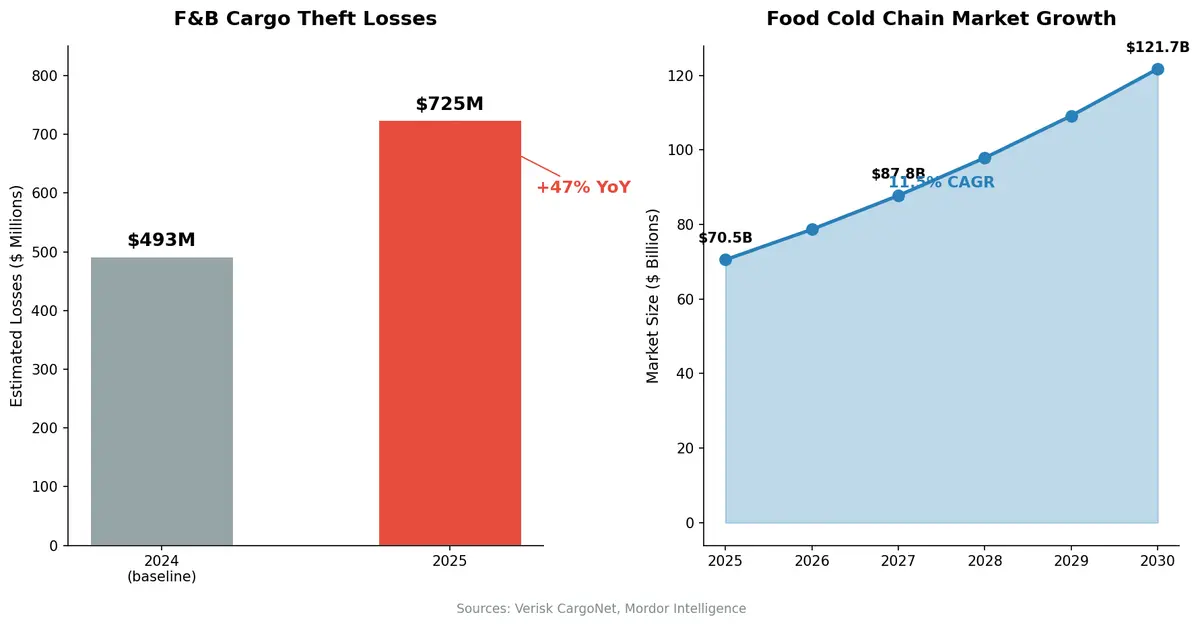
Cargo theft escalation — According to Verisk CargoNet data cited by ITS Logistics, estimated cargo theft losses reached $725 million in 2025, with food and beverage representing the top stolen commodity. Incidents targeting F&B shipments increased 47% year-over-year — a staggering rise that reflects both the high resale value of consumable goods and the vulnerability of temperature-controlled loads during transit.
Peak season pressure — Beverage peak season typically runs mid-May through mid-July, with shippers ramping operations as early as March. This year, brands must scale volume while simultaneously tightening compliance controls and defending against theft — a combination that exposes every structural weakness in the network.
Why Peak Season Reveals — Not Creates — Supply Chain Risk
Kasia Wenker, Vice President of Solutions Engineering at ITS Logistics, captured the core issue precisely: "Peak season in food and beverage does not create risk; it reveals the structural weaknesses already embedded in the network."
This insight reframes how F&B companies should approach seasonal planning. Brands that perform consistently through demand spikes are those that design operating models for year-round resilience, traceability, and controlled scale — not those that bolt on temporary capacity when volumes surge.
ITS Logistics has responded by building a nationwide network of dedicated Food & Beverage Hubs that combine food-grade facilities, standardized operating procedures, and centralized quality governance. The network provides two-day reach to the majority of the U.S. population while supporting direct-to-consumer, B2B, retail replenishment, and marketplace fulfillment channels.
The Cold Chain Market Is Booming — But Complexity Is Growing Faster
The global food cold chain market reflects the scale of this challenge. According to Mordor Intelligence, the food cold chain market is expected to reach $70.55 billion in 2025 and grow at a CAGR of 11.53% to hit $121.77 billion by 2030. The broader cold chain logistics market is even larger — Grand View Research estimates it at $371 billion in 2025, growing at 20.5% CAGR through 2033.
This explosive growth brings a paradox: more cold chain infrastructure means more data, more compliance touchpoints, and more opportunities for things to go wrong. Every temperature-controlled facility, every refrigerated truck, and every handoff between carriers represents a Critical Tracking Event that FSMA 204 requires companies to document.
FSMA 204: The Extended Deadline Is a Warning, Not a Gift
When the FDA pushed the FSMA 204 compliance deadline from January 2026 to July 2028, many in the industry exhaled. But as Food Logistics reports, the extension reflects the FDA's recognition of just how complex implementation truly is.
The rule covers the Food Traceability List (FTL) — a set of high-risk foods that have historically been linked to outbreaks. For these products, companies must track:
- Key Data Elements (KDEs): Lot codes, quantities, locations, dates, and trading partner information at each supply chain node
- Critical Tracking Events (CTEs): Growing, receiving, transforming, creating, shipping — every handoff must be documented
- Sortable electronic records: Paper-based systems won't cut it. The FDA expects records to be searchable and sortable within 24 hours of a request
For food and beverage businesses generating over $250,000 in annual revenue — which encompasses the vast majority of the industry — compliance isn't optional. And companies that wait until 2028 to start building traceability infrastructure will find themselves scrambling.
Inventory Discipline Under Margin Pressure
Beyond compliance, F&B supply chains face intensifying margin pressure from sourcing volatility, transportation cost variability, and working-capital constraints. Brands must operate with tighter inventory discipline while maintaining higher service expectations — a balance that requires sophisticated technology to achieve.
The days of holding excess safety stock as a buffer are over. Modern F&B logistics demands real-time visibility into inventory positions across multiple facilities, channels, and fulfillment modes. Companies need to know not just where their products are, but their temperature history, lot codes, and remaining shelf life at every point in the chain.
Building Resilient F&B Supply Chains with Technology
The companies emerging strongest from this perfect storm share common traits: they've invested in integrated technology platforms that connect traceability data, inventory management, transportation planning, and compliance reporting into a unified system.
Key capabilities that F&B logistics leaders need in 2026 include:
- End-to-end lot-level traceability across all trading partners and transportation modes
- Temperature monitoring integration with automated exception alerts for cold chain deviations
- Multi-channel fulfillment orchestration that maintains compliance whether shipping DTC, B2B, or to retail
- Cargo security protocols including carrier vetting, route optimization, and real-time shipment visibility
- Regulatory reporting automation that can produce FSMA-compliant records within the FDA's 24-hour window
The Path Forward
The food and beverage supply chain in 2026 demands more than operational excellence — it demands structural resilience. With $725 million in annual cargo theft targeting F&B as the top commodity, FSMA 204 requiring unprecedented traceability infrastructure, and peak season amplifying every vulnerability, brands can no longer afford to treat logistics as a cost center.
The winners will be those who build compliance, visibility, and security into the foundation of their supply chains — not as afterthoughts bolted on when regulators come knocking or theft losses mount.
Managing food and beverage logistics complexity? Contact CXTMS for a demo of how our platform delivers end-to-end traceability, cold chain visibility, and compliance automation for F&B supply chains.