The Fictiv 2026 Manufacturing Report: 97% AI Adoption and What It Means for Supply Chain Leaders

Fictiv and MISUMI Global have released their 11th Annual State of Manufacturing & Supply Chain Report, surveying over 300 senior supply chain and manufacturing leaders. The headline number is striking: 97% of manufacturing leaders now say digital manufacturing platforms are essential for production, and AI has shifted from experimental to foundational across the industry.
AI Is No Longer Optional — It's Infrastructure
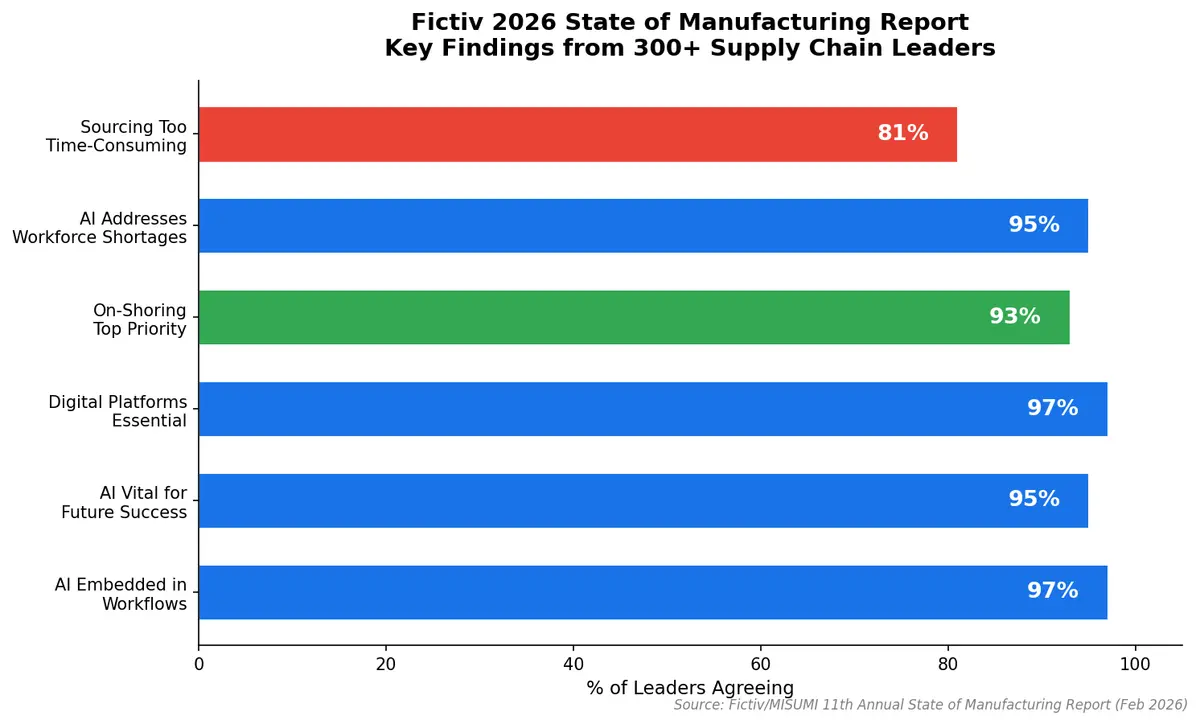
The report's most significant finding is the sheer ubiquity of AI adoption. A full 97% of respondents say AI is already embedded across core manufacturing and supply chain workflows, with 95% considering it a requirement rather than an option for their company's future success.
This isn't aspirational thinking. Leaders are reporting real productivity gains and expect more: many anticipate AI-driven productivity improvements of 50% or more, with some projecting two-to-five-times efficiency gains as workflows are redesigned around automation and intelligence.
At the same time, 95% of respondents confirm that AI and automation are helping address chronic workforce shortages — though they emphasize that AI cannot replace specialized human expertise. The technology is augmenting teams, not eliminating them.
Digital Platforms Have Reached Critical Mass
Belief in digital manufacturing platforms has risen steadily year over year, reaching the 97% threshold in 2026. For supply chain leaders, this signals that the era of fragmented, manual procurement and sourcing workflows is ending.
The data backs this up: 83% of engineers currently spend four or more hours per week on procurement-related workflows — a massive drain on technical talent. Meanwhile, 93% of leaders report that productivity improves when administrative tasks are offloaded to digital platforms.
For logistics and TMS professionals, the implication is clear. Manufacturing is increasingly digital-first, and the supply chains that serve manufacturing need to match that sophistication. Paper-based processes, spreadsheet tracking, and disconnected systems are becoming competitive liabilities.
On-Shoring Accelerates Under Tariff Pressure
The report highlights a decisive shift toward domestic manufacturing: 93% of leaders say moving manufacturing back to the U.S. is a top priority. This on-shoring push is driven by a convergence of tariff pressures, supply chain resilience concerns, and the desire for shorter lead times.
However, the transition isn't simple. 77% of respondents say trade compliance requirements are too complex to manage without external expertise, and 99% now consider supplier tariff and trade expertise essential in partner selection. Rising raw-material costs are actively reshaping sourcing strategies for 98% of leaders surveyed.
This complexity creates enormous demand for technology that can manage multi-region compliance, duty optimization, and supplier qualification — exactly the capabilities that modern TMS platforms provide.
Supplier Sourcing Remains a Pain Point
Despite digital transformation gains, 81% of leaders say supplier sourcing and manufacturing remain too time-consuming and costly. The challenge isn't a lack of suppliers — it's the difficulty of qualifying, onboarding, and managing them across increasingly complex global networks.
Manufacturing planning was cited as the area experiencing the greatest complexity pressure across the production lifecycle. As companies diversify supply bases to reduce single-source risk, the administrative burden multiplies.
This is where integrated supply chain platforms deliver the most value: consolidating supplier data, automating qualification workflows, and providing real-time visibility across the entire manufacturing supply chain.
From Digital to Physical AI
One of the report's forward-looking insights is the emergence of what industry analysts call "physical AI" — the convergence of foundation models with robotics and manufacturing automation. As Supply Chain Dive has reported, companies like American Eagle and Dollar General are already deploying layered AI strategies that span digital decision-making through physical warehouse operations.
For manufacturing, this means AI is moving beyond demand forecasting and procurement optimization into the factory floor itself. The companies that build integrated digital-physical AI capabilities will have a structural advantage in cost, speed, and quality.
What This Means for TMS and Logistics Strategy
The Fictiv report underscores a fundamental shift: manufacturing supply chains are now technology-first operations. For logistics leaders, the takeaways are actionable:
- Integration is non-negotiable. Manufacturing partners expect their logistics providers to operate on digital platforms with API connectivity and real-time data exchange.
- Trade compliance technology is a differentiator. With 77% of manufacturers struggling with compliance complexity, TMS platforms that automate duty calculations, tariff classification, and trade documentation win business.
- On-shoring creates new logistics patterns. As manufacturing moves back to the U.S. and nearshore locations, domestic transportation networks need optimization for new origin-destination pairs.
- AI readiness is table stakes. If 97% of your manufacturing customers use AI in their workflows, your logistics platform must integrate seamlessly with their AI-driven planning systems.
The manufacturing sector's transformation is a leading indicator for the broader supply chain. Companies that align their logistics technology with the direction manufacturing is heading will capture the growth. Those still running on legacy systems risk being left behind.
Ready to modernize your supply chain technology? Contact CXTMS to see how our platform integrates with AI-driven manufacturing workflows.