Biometric Authentication in Freight: How Identity Technology Is Securing Logistics Operations in 2026

Cargo theft in the United States now costs an estimated $35 billion annually, according to Homeland Security Investigations via the National Insurance Crime Bureau. Strategic theft — where criminals impersonate legitimate carriers to steal entire loads — has risen a staggering 1,500% since Q1 2021, according to the American Trucking Associations. The average value of a stolen load exceeded $330,000 per incident in 2025, roughly double the prior year.
The common thread in nearly every one of these schemes? Identity fraud. Fake carrier credentials, spoofed USDOT numbers, and compromised broker accounts are the tools of modern cargo criminals. In response, the logistics industry is turning to biometric authentication — fingerprint scanners, facial recognition, and cryptographic identity binding — to close the identity gaps that traditional verification methods can't address.
FMCSA's Biometric Identity Mandate: The Industry's Turning Point
The most significant development in freight identity security arrived in April 2025, when the Federal Motor Carrier Safety Administration (FMCSA) integrated mandatory identity verification into the Unified Registration System (URS). Every new motor carrier, broker, or freight forwarder must now verify their identity through a partnership with IDEMIA, a global leader in biometric and cryptographic solutions.
The process requires applicants to submit verifiable personal or business identification, including biometric data, before receiving operating authority. Between April 7 and June 30, 2025 alone, FMCSA processed over 38,000 unique applicants through the new system — and the fraud detection results have been striking.
Previously, criminal organizations could register fraudulent carrier authorities in minutes using stolen identities. The biometric verification layer now forces every applicant to prove they are who they claim to be, effectively breaking the business model of identity-based freight fraud. As FreightWaves reported at their 2025 Domestic Supply Chain Summit, identity spoofing and double brokering are at "an all-time high," making FMCSA's biometric mandate a critical countermeasure.
Warehouse and Facility Access: Fingerprint, Face, and Iris
Beyond carrier registration, biometric technology is rapidly penetrating physical logistics infrastructure. The global fingerprint access control system market reached $5.1 billion in 2026, and the broader biometrics market is projected to hit $60 billion by 2026, growing at a 14.4% CAGR through 2034, according to IMARC Group.
In warehouse and distribution center environments, biometric access control solves problems that badge-and-PIN systems cannot:
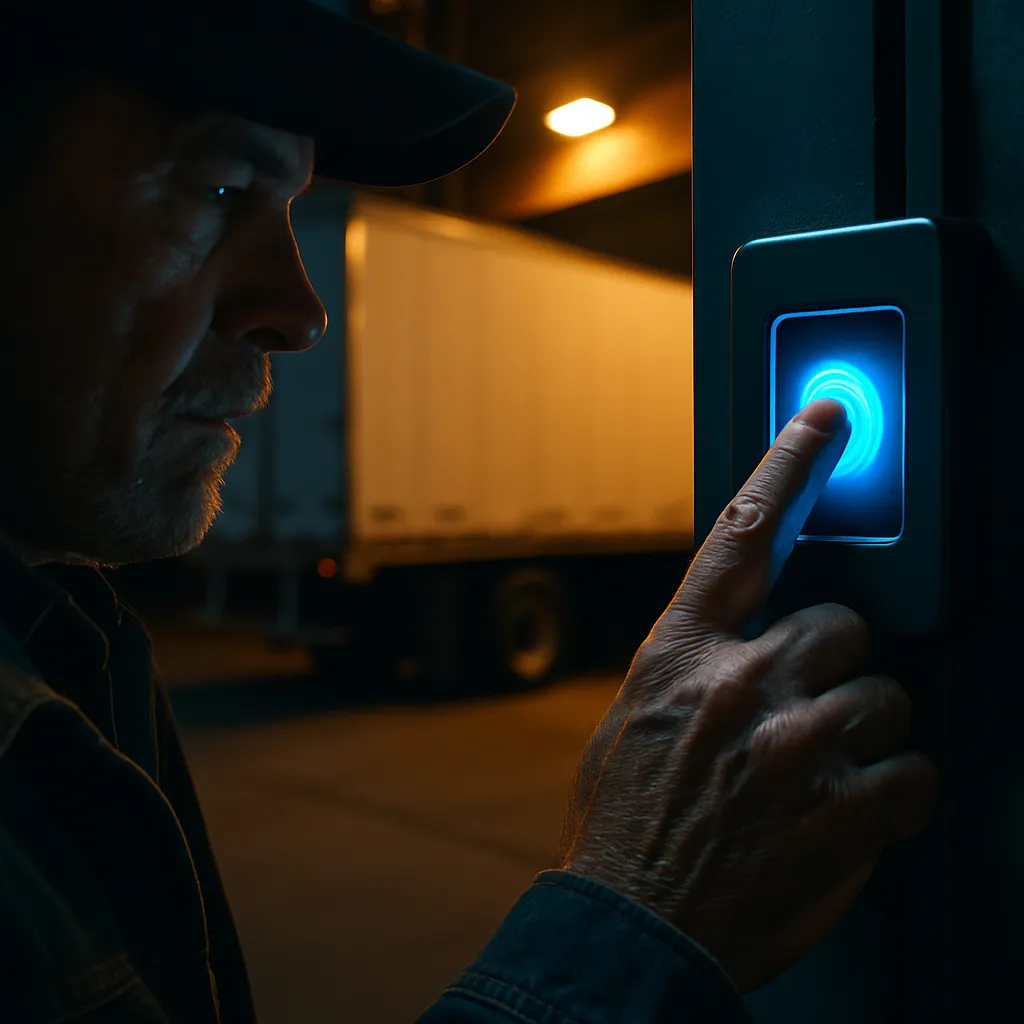
- Fingerprint scanners at dock doors ensure only authorized workers access high-value staging areas, eliminating the risk of lost, shared, or cloned access badges
- Facial recognition at facility entry points creates an auditable identity trail for every person who enters and exits, critical for pharmaceutical cold chain compliance and food safety documentation
- Iris scanning for restricted zones provides the highest accuracy for areas storing controlled substances, electronics, or defense-related cargo
The ROI case is straightforward: warehouses that have implemented biometric access report 40–60% reductions in internal shrinkage compared to traditional badge systems, because the fundamental weakness of badge-based security — that a badge proves possession, not identity — is eliminated.
Fleet Biometric Systems: Who's Behind the Wheel Matters
On the fleet side, biometric driver authentication is evolving from a niche safety feature to a mainstream operational requirement. Modern implementations include:
Biometric ignition locks prevent unauthorized vehicle operation by requiring fingerprint verification before engine start. If the authenticated driver doesn't match the assigned driver in the dispatch system, the vehicle won't move — and fleet managers receive an immediate alert.
Continuous facial recognition integrated with ELD and telematics platforms confirms that the driver who started the trip is the same driver behind the wheel at every checkpoint. This addresses a persistent compliance gap: under traditional ELD systems, a driver could log in and hand the keys to an unqualified operator.
Post-incident forensic identification provides legally defensible proof of who was driving at the exact moment of an accident or cargo loss event. As biometric solutions providers have documented, this capability allows fleets to cross-reference driver identity with telematics data, video footage, and GPS records to produce a forensically credible identity record for insurance, legal, or regulatory purposes.
The Privacy Equation: State Biometric Laws Create a Patchwork
The rapid adoption of biometric technology in logistics isn't without friction. Illinois' Biometric Information Privacy Act (BIPA) — the most aggressive biometric privacy law in the United States — requires informed written consent before collecting fingerprints, facial geometry, or iris scans, and allows private lawsuits with statutory damages of $1,000 to $5,000 per violation.
Texas, Washington, and several other states have enacted their own biometric privacy statutes, creating a compliance patchwork for national carriers and warehouse operators. A trucking company using fingerprint ignition locks across a 48-state fleet must navigate different consent and data retention requirements in every jurisdiction.
The practical impact is significant: logistics companies must implement state-specific consent workflows, data retention policies, and deletion schedules for biometric data. Carriers operating in Illinois face particular exposure — BIPA class action settlements have reached into the hundreds of millions of dollars in other industries, and logistics is increasingly in the crosshairs.
Chain-of-Custody Verification: The Biometric Handshake
One of the most promising applications of biometric technology is chain-of-custody verification — using identity authentication at every handoff point to create an unbreakable record of who handled freight and when.
In a traditional freight transaction, a load changes hands multiple times: shipper dock to driver, driver to cross-dock, cross-dock to final-mile driver, final-mile to consignee. At each handoff, the current verification method is a signature on a BOL — a process vulnerable to forgery and often illegible enough to be meaningless in a dispute.
Biometric chain-of-custody replaces the signature with an identity-verified handoff. The driver scans a fingerprint at pickup; the cross-dock operator authenticates via facial recognition at transfer; the consignee confirms delivery with their own biometric. Every link in the chain is cryptographically bound to a verified identity, creating a tamper-proof custody record that dramatically reduces claims disputes and accelerates insurance resolution.
ROI Analysis: Theft Reduction vs. Implementation Costs
For logistics operators evaluating biometric investment, the math increasingly favors deployment:
| Investment Area | Typical Cost | Expected Reduction |
|---|---|---|
| Warehouse fingerprint access (per door) | $2,000–$5,000 | 40–60% shrinkage reduction |
| Fleet biometric ignition (per vehicle) | $500–$1,500 | 85%+ unauthorized use prevention |
| Facility facial recognition (per site) | $15,000–$50,000 | 70% faster incident investigation |
| Chain-of-custody biometric system | $3–$8 per transaction | 50% reduction in claims disputes |
Against a backdrop of $35 billion in annual cargo theft losses and average stolen load values exceeding $330,000, even modest reductions in theft exposure deliver rapid payback periods — typically 6–12 months for warehouse deployments and 12–18 months for fleet-wide implementations.
How CXTMS Helps Logistics Operations Manage Identity-Secured Freight
As biometric authentication becomes standard across the logistics ecosystem, CXTMS provides the operational backbone to integrate identity verification into shipment management workflows. CXTMS carrier vetting tools allow shippers to verify that their carriers have completed FMCSA's biometric registration requirements before tendering loads, while real-time visibility dashboards surface authentication events across the chain of custody.
By connecting biometric identity verification with TMS-driven shipment planning, CXTMS helps logistics teams ensure that every carrier, driver, and facility handler in their network is verified — reducing fraud exposure and strengthening compliance documentation from pickup to final delivery.
Ready to integrate identity-verified carrier management into your logistics operations? Request a CXTMS demo today and see how biometric-ready TMS workflows can protect your freight.