Wireless Inductive Charging for Warehouse AMRs: How Contactless Power Eliminates Robot Downtime in 24/7 Fulfillment Operations

The autonomous mobile robot (AMR) market is projected to reach $3.4 billion in 2026 and surge to $17 billion by 2035, according to Global Market Insights — a compound annual growth rate of 19.5%. But behind those staggering growth numbers lies an uncomfortable operational reality: most AMR fleets still spend 30–35% of their time either charging or waiting to charge, a hidden bottleneck that undermines the very efficiency these robots are supposed to deliver.
Wireless inductive charging is emerging as the infrastructure breakthrough that finally closes this gap. At LogiMAT 2026 in Stuttgart, wireless power specialist Wiferion unveiled its next-generation product family designed to make contactless charging the default energy strategy for automated warehouses. The technology is moving from novelty to necessity — and it's reshaping how operations leaders think about robot fleet sizing, warehouse layout, and 24/7 fulfillment capacity.
The Hidden Bottleneck: Why Battery Charging Limits AMR Utilization
For every AMR navigating a warehouse floor, there's a simple constraint most ROI models underestimate: the robot needs to stop working to recharge. Traditional plug-in or docking-station charging creates a cascading set of operational problems.
A typical lithium-ion powered AMR requires 1–2 hours of dedicated charging for every 6–8 hours of operation. In a fleet of 50 robots, that means 12–15 units are offline at any given time, either traveling to charging stations, waiting in queue, or actively charging. The result is an effective utilization rate of just 65–70% — meaning facilities need to purchase 30–50% more robots than their throughput models theoretically require.
The problem compounds in 24/7 fulfillment operations where peak demand windows don't align with convenient charging schedules. During holiday surges or flash sale events, having a third of the fleet offline isn't an inconvenience — it's a throughput crisis.
How Inductive Charging Eliminates Manual Docking
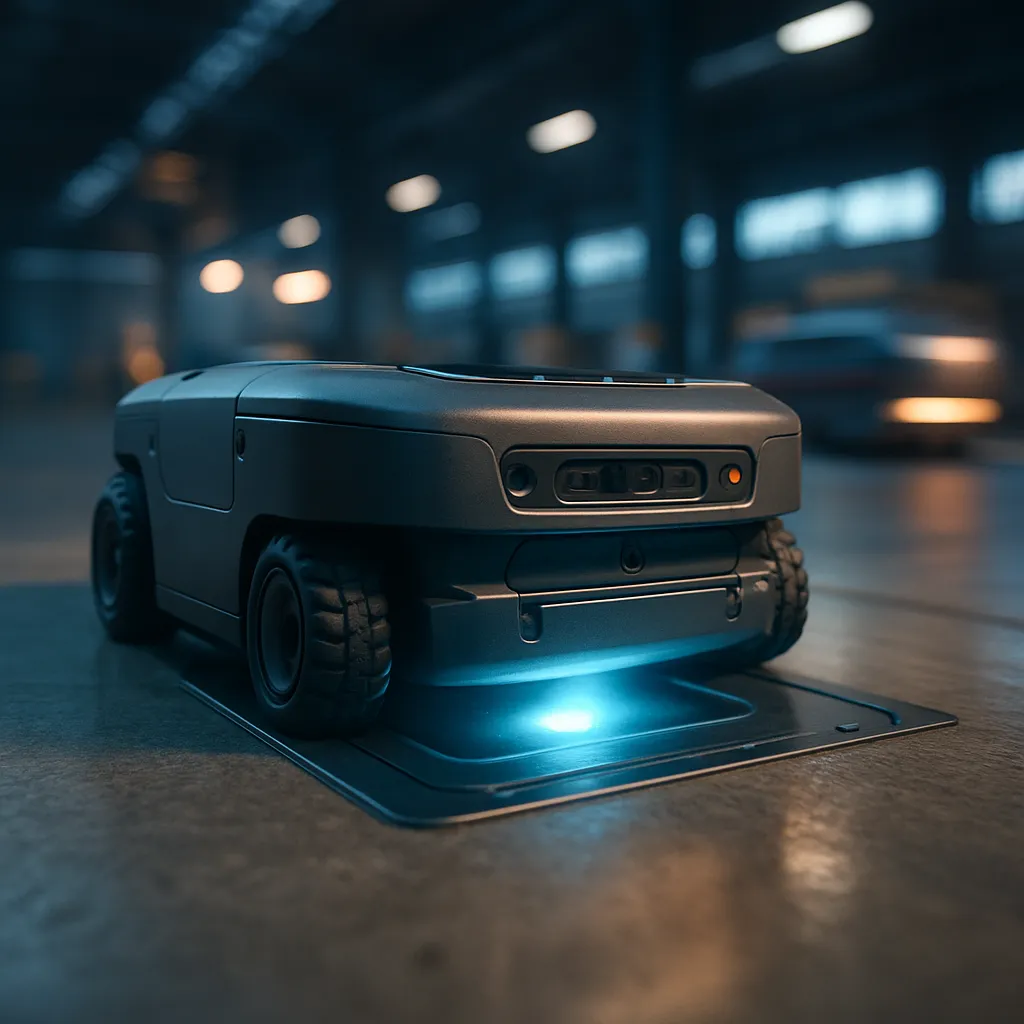
Wireless inductive charging works by transferring energy between a stationary transmitter pad embedded in the warehouse floor and a receiver coil integrated into the robot chassis. When an AMR pauses at a pickup point, workstation, or queue position — locations where it already stops during normal operations — it receives a charge without any physical connection, operator intervention, or deviation from its task path.
The technology delivers up to 3 kW of continuous charging power through systems like Wiferion's etaLINK 3000, with charging efficiency rates exceeding 93%. Because charging occurs in micro-bursts throughout the shift rather than in one long session, robots maintain optimal battery levels without ever leaving the operational floor.
KUKA, a global leader in industrial automation, has integrated inductive charging across its AMR product line, enabling what the company calls "99% availability" — a dramatic improvement over the 65–70% utilization rates typical of plug-in charging architectures. At MODEX 2026, KUKA showcased AMRs with built-in identification technology and adaptive navigation that autonomously optimize paths while charging inductively during natural pause points.
The Wireless Charging Product Landscape for Logistics
The wireless charging ecosystem for intralogistics is maturing rapidly. At LogiMAT 2026, Wiferion — now a PULS brand — revealed a strategic evolution from standalone products to a cohesive system-level platform. The company's new product family addresses three core challenges that have limited wireless charging adoption:
- Scalability — adaptable wireless power solutions that support diverse AGV and AMR fleet types from different manufacturers simultaneously
- Interoperability — future-proofed infrastructure compatible with multi-vendor automated warehouses and smart factory ecosystems
- Simplified deployment — plug-and-play integration that reduces installation complexity for system integrators
Wiferion's CW1000, designed specifically for smaller AMRs, features a mobile charging unit measuring just 160 mm — 36% smaller than the etaLINK 3000 — with fully internal electronics that eliminate external mounting requirements. This miniaturization is critical for the growing fleet of compact, goods-to-person robots operating in dense fulfillment environments.
Beyond Wiferion, the competitive landscape includes WiTricity (focused on higher-power industrial applications), Momentum Dynamics, and several Asian manufacturers targeting the booming APAC warehouse automation market — a region that accounted for 51.7% of global warehouse robotics market share in 2025, according to Fortune Business Insights.
ROI Analysis: Reduced Fleet Sizes, Eliminated Charging Stations, 24/7 Operation
The financial case for wireless inductive charging extends well beyond the technology itself. Consider a mid-sized e-commerce fulfillment center running 80 AMRs across three shifts:
Traditional Charging Model:
- 80 AMRs purchased at ~$25,000 each = $2M fleet investment
- Effective utilization: 65–70%, meaning ~24 robots offline at any time
- 16 dedicated charging stations consuming 400+ sq ft of floor space
- 2 maintenance technicians managing charging infrastructure
Wireless Inductive Charging Model:
- 60 AMRs achieving 95%+ utilization = $1.5M fleet investment (25% fewer robots needed)
- Charging pads embedded at existing workstations and queue points — zero dedicated charging floor space
- Maintenance-free contactless pads with no wear components
- Estimated annual savings: $500K+ in fleet reduction, floor space recovery, and maintenance labor
The Modern Materials Handling 2026 Outlook Survey found that 42% of respondents expect warehouse automation spending to increase over the next two to three years, with AMR fleets and robotics among the strongest adoption categories. As these fleets scale, the economics of charging infrastructure become increasingly decisive.
As one industry report noted, "the growth of electrified fleets, AMRs, and charging-dependent equipment increased electricity demand inside warehouses" — making power management strategy a first-class operational concern rather than an afterthought.
Integration Considerations for Automated Warehouses
Deploying wireless charging infrastructure requires coordinated planning across several domains:
Floor infrastructure: Charging pads must be flush-mounted in high-traffic areas where AMRs naturally pause — workstations, queue zones, staging areas, and loading docks. This requires planning during warehouse construction or retrofit projects.
Fleet management software: AMR fleet orchestration systems must incorporate battery state-of-charge data into task assignment algorithms. Daifuku's 2026 automation trends research highlights how AI-driven task assignment now factors in real-time congestion, battery status, and downstream capacity to optimize fleet-wide energy management.
Power distribution: A facility running 60+ wireless charging pads needs robust electrical infrastructure. Operations teams should model aggregate power draw and coordinate with utility providers, particularly in facilities also running AS/RS systems and conveyor networks.
Multi-vendor compatibility: As Wiferion's LogiMAT 2026 reveal emphasized, the industry is moving toward interoperable charging standards. Facilities deploying robots from multiple manufacturers should prioritize charging solutions with broad compatibility.
What This Means for CXTMS Customers
For shippers and 3PLs using CXTMS to manage transportation, the warehouse charging infrastructure evolution has direct implications for fulfillment velocity and order cycle times. Facilities achieving true 24/7 AMR operations can process orders faster and more predictably, reducing the gap between order placement and dock-ready shipment.
CXTMS integrates with warehouse management and execution systems to provide end-to-end visibility from pick confirmation through carrier dispatch. When AMR fleets operate at 95%+ utilization instead of 65–70%, the result is tighter fulfillment windows, more accurate carrier appointment scheduling, and fewer last-mile delays caused by upstream warehouse bottlenecks.
Ready to optimize the connection between your automated warehouse and transportation network? Request a CXTMS demo to see how real-time warehouse-to-carrier integration eliminates the gaps between fulfillment and shipping.