The Q2 2026 Multimodal Freight Divergence: Why Ocean, Trucking, and Air Are Moving in Opposite Directions

For most of the past decade, freight planning was relatively straightforward: watch the truckload rate, check the fuel surcharge, and extrapolate. Q2 2026 has blown that playbook apart.
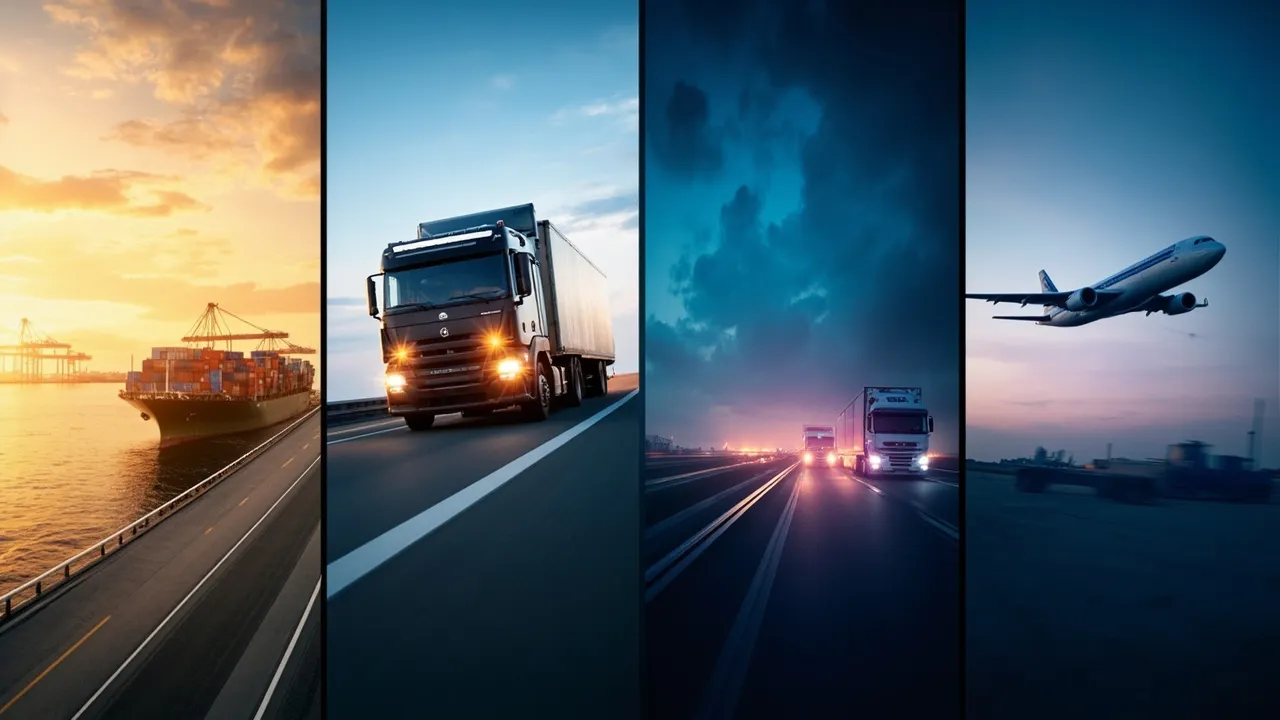
Ocean, trucking, and air cargo are not just fluctuating — they're diverging, each driven by distinct market forces operating on different timelines. Shippers who manage one mode in isolation are flying blind. Those who can read the divergence and shift tactically are capturing real savings. Here's what you need to know.
The Divergence in Numbers
The signals are clear for each mode:
Trucking is tightening fast. According to C.H. Robinson's April 2026 Edge Report, truckload costs are now projected up 16–17% year over year — not because of seasonal demand spikes, but because carrier attrition and rising operating costs are sustaining rate pressure well into what should be a softer period. Diesel prices climbed from $3.72 to over $5.40 per gallon between February and March 2026 — the sharpest single-month move since mid-2022. That's a direct margin hit to carriers, and they're passing it through.
Ocean is volatile but balanced. The Strait of Hormuz crisis, which escalated in early 2026 after Houthi forces resumed Red Sea attacks in late February, forced the Suez Canal effectively closed to commercial traffic. Carriers rerouted around Africa's Cape of Good Hope, adding weeks to transit times. Emergency surcharges of up to $3,000 per FEU have been applied across Gulf-linked corridors, and Transpacific spot rates to the U.S. West Coast are up approximately 40% from pre-crisis levels. But underlying demand remains soft, and with overcapacity in the system, the rate floor is more fragile than the surcharges suggest.
Air cargo is squeezed from both ends. Geopolitical disruptions have removed an estimated 15–18% of global air cargo capacity, while fuel constraints linked to Middle East tensions continue to drive up airline operating costs. For Asia-linked corridors, capacity has dropped 12–20%. Yet demand — particularly from e-commerce and AI-related semiconductor shipments — remains resilient. The result is a market where air rates are firming even as passenger belly capacity on key routes shrinks.
Why This Is Different From Past Cycles
In previous freight cycles, modes moved roughly in tandem. A strong economy pulled all modes up; a slowdown softened them together. Q2 2026 is structurally different because the drivers are geopolitical rather than cyclical.
The Red Sea and Persian Gulf disruptions are mode-specific in their impact. Ocean carriers face longer routes and higher fuel costs. Gulf-linked air corridors face airspace restrictions and reduced hub operations at Dubai and Doha. Trucking,domestically, faces its own pressure from the diesel shock — a direct consequence of the same Middle East tensions driving ocean rerouting.
The cross-modal effect is real but uneven. As C.H. Robinson noted in its March 2026 ocean update, "ocean routings are disrupted, creating a compounding, cross-modal constraint" as shippers shift to air, which further tightens air capacity. The modes are connected, but the pain isn't shared equally.
What Single-Mode Planning Costs You
Most freight procurement teams still negotiate ocean and trucking contracts with separate teams, different cycles, and incompatible data systems. That structure made sense when modes moved together. In Q2 2026, it's an expensive blind spot.
Consider a shipper with a standard ocean contract locked in Q4 2025 at pre-crisis rates. They're protected on base ocean costs — but they're absorbing emergency surcharges, extended transit buffer inventory, and rising inland drayage costs that their ocean budget never accounted for. Their trucking spend, negotiated separately, is already running 16–17% above prior year with no relief in sight.
Now add the shipper who needs to move time-sensitive components via air. They're paying a fuel surcharge叠加 on top of an already-elevated rate, because Gulf routing constraints have removed the most economical air corridors.
The gap between shippers who planned multimodally and those who didn't is now measurable in margin points.
A Framework for Multimodal Optimization in a Diverging Market
1. Separate your lanes by urgency tier. Not every shipment needs the same mode. Classify lanes into three tiers: mission-critical (air or expedited truck), standard service (ocean or intermodal), and flexible (rail or deferred truck). This determines where you absorb cost versus where you pay for speed.
2. Build transit buffer into ocean planning — budget for it too. With Cape of Good Hope routing adding 10–14 days to Asia–Europe lanes, safety stock levels need to reflect longer lead times. This isn't optional anymore; it's the cost of doing business in a disrupted ocean market. Plan inventory accordingly rather than chasing expedited ocean at a premium.
3. Watch intermodal as the offset to truckload. C.H. Robinson's April data shows intermodal costs remaining competitive versus truckload, and as truckload capacity tightens further, intermodal's cost advantage is expected to widen on key long-haul lanes. If you have rail-accessible facilities, this is the moment to shift more volume.
4. Lock air contracts selectively and early. Air capacity is tightest on Gulf and India corridors. If you have known air cargo needs for those lanes — pharmaceutical, semiconductor, high-value e-commerce components — don't wait. Fuel surcharges are escalating, and carrier network rationalization toward the latter half of 2026 will likely remove more capacity.
5. Stress-test your fuel surcharge exposure. Diesel at $5.40-plus per gallon is a new floor, not a spike. Build fuel surcharge review into your monthly cadence. Both ocean and trucking contracts with lag-language surcharge mechanisms can produce 60–90 day billing delays that don't reflect current market conditions fast enough.
The Bigger Picture
The freight market divergence of Q2 2026 is, at its root, a visibility and agility problem. Shippers with multimodal platforms and integrated planning processes can see the mode-level data in real time, shift routing decisions as conditions change, and optimize their total freight spend across modes rather than within them.
Those still running ocean procurement and truckload procurement in separate silos are making two sets of decisions with half the information.
The modes aren't broken — they're just moving in different directions. The question is whether your planning infrastructure can track all three at once.
Want to see how CXTMS gives logistics teams real-time visibility across ocean, trucking, and air — in a single platform? Schedule a demo to learn how our multimodal freight management tools help shippers optimize their total freight spend, not just one mode at a time.