Pallets and Unit Loads
Pallets are the standard unit of handling for bulk goods in warehousing and transportation. By consolidating individual cases or items onto a pallet, warehouses can move large quantities of product efficiently using forklifts and other material handling equipment. Understanding pallet standards, materials, and unit load configuration is essential for safe storage, accurate space planning, and seamless handoffs between supply chain partners.
What Is a Unit Load?
A unit load is a collection of individual items or cases assembled onto a pallet (or other load carrier) and secured as a single entity for handling, storage, and transport. The concept of unitization is fundamental to modern logistics:
- Efficiency — Moving 40 cases on a single pallet takes one forklift operation instead of 40 individual lifts.
- Protection — Goods secured on a pallet with stretch wrap or banding are less likely to be damaged during handling.
- Standardization — Consistent pallet sizes and configurations enable predictable space planning, racking design, and vehicle loading.
- Automation — Automated storage and retrieval systems (AS/RS), conveyors, and robotic palletizers all depend on standardized unit loads.
Unit loads are used throughout the supply chain—from manufacturing plants to distribution centers to retail stores. While pallets are the most common load carrier, other types include slip sheets, skids, and specialized containers for bulk or fragile goods.
The unit load principle states that goods should be combined into the largest practical unit that can be handled by available equipment, reducing the number of handling steps and associated labor and damage costs.
Standard Pallet Sizes
Pallet dimensions vary by region and industry, but several standards dominate global logistics:
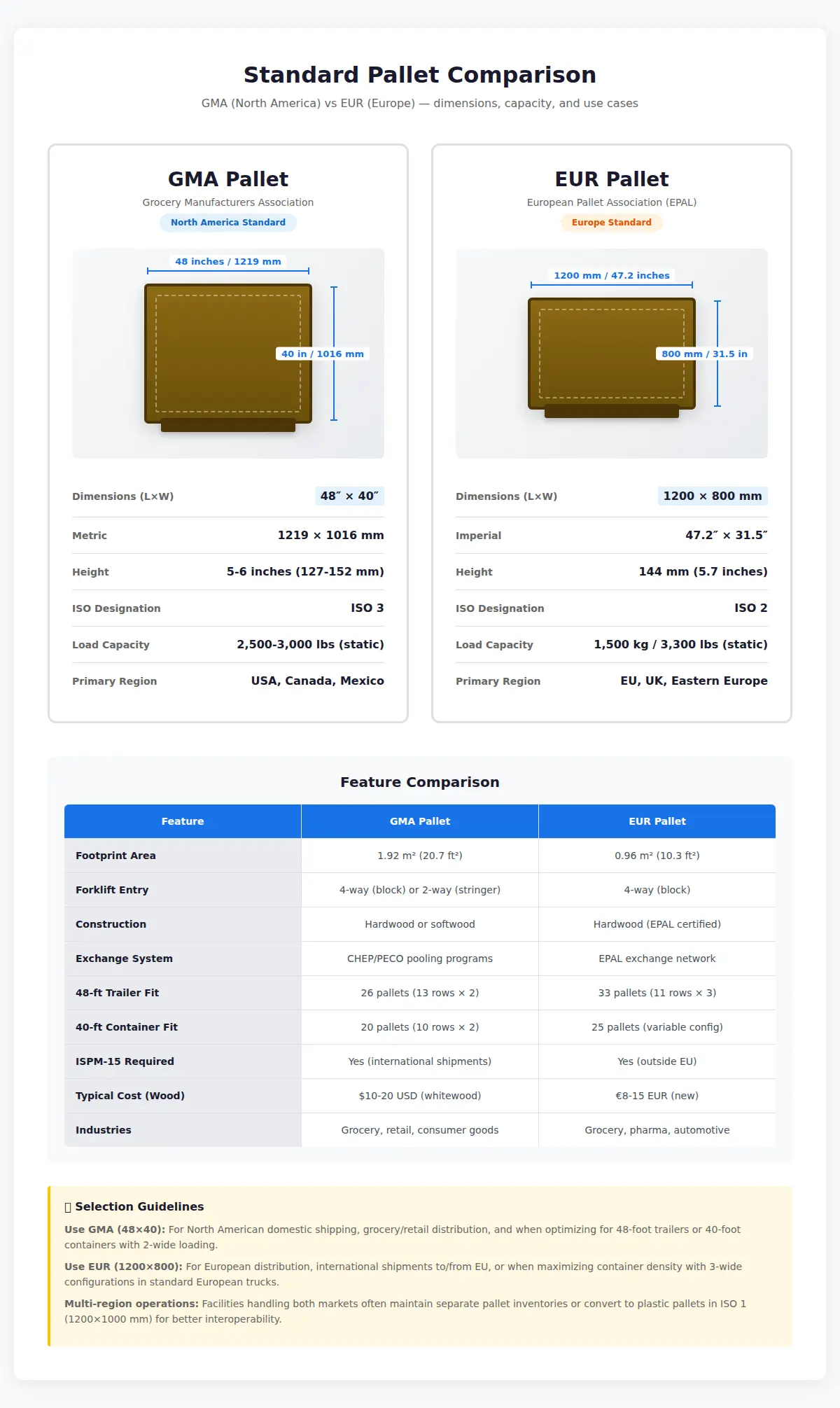
GMA Pallet (North America)
The GMA pallet (Grocery Manufacturers Association, now the Consumer Brands Association) is the most common pallet in North America. Its dimensions are:
- 48 inches × 40 inches (1219 mm × 1016 mm)
- Height: Typically 5-6 inches (127-152 mm)
The 48×40 size was selected because it fits efficiently into standard 48-foot trailers and intermodal containers, and matches common case dimensions used in the grocery and consumer goods industries. A 48-foot trailer can hold 26 pallets (13 rows of 2 pallets) when loaded lengthwise.
The 48×40 GMA pallet is so ubiquitous in North America that it's often referred to simply as a "standard pallet" or "warehouse pallet." Always confirm dimensions when coordinating with international partners, as "standard" varies by region.
EUR Pallet (Europe)
The EUR pallet (also called Euro pallet or EPAL pallet) is the European standard, regulated by the European Pallet Association. The most common variant is the EUR 1:
- 1200 mm × 800 mm (47.2 inches × 31.5 inches)
- Height: Approximately 144 mm (5.7 inches)
EUR pallets are designed to fit efficiently into European trucks and rail cars, and to align with metric-based case dimensions used in European manufacturing. The 1200 mm dimension matches the internal width of standard European truck beds.
EUR pallets are exchange pallets — shippers can exchange EUR pallets one-for-one at delivery points, creating a closed-loop pooling system without requiring pallet rental services.
ISO Standard Pallets
The International Organization for Standardization (ISO) defines six standard pallet sizes in ISO 6780:
| ISO Designation | Dimensions (mm) | Dimensions (inches) | Primary Region |
|---|---|---|---|
| ISO 1 | 1200 × 1000 | 47.2 × 39.4 | Europe, Asia |
| ISO 2 | 1200 × 800 | 47.2 × 31.5 | Europe (EUR pallet) |
| ISO 3 | 1219 × 1016 | 48 × 40 | North America (GMA pallet) |
| ISO 4 | 1140 × 1140 | 44.9 × 44.9 | Asia, Australia |
| ISO 5 | 1100 × 1100 | 43.3 × 43.3 | Asia, chemical/pharma |
| ISO 6 | 1067 × 1067 | 42 × 42 | North America, Asia |
While ISO standards provide a framework for interoperability, regional preferences still dominate in practice. Facilities engaged in international trade often maintain multi-sized pallet inventories to accommodate different markets.
Other Common Sizes
Several industry-specific and regional pallet sizes remain in use:
- 42 × 42 inches — Telecommunications and paint industries (North America)
- 48 × 48 inches — Drums and heavy industrial goods (North America)
- 1100 × 1100 mm — Chemical and pharmaceutical industries (Asia, Europe)
- 1165 × 1165 mm — Australian standard pallet
- 1200 × 1000 mm — General-purpose pallet (Europe, Asia)
Using non-standard pallet sizes can create inefficiencies in cross-docking, warehousing, and transportation. Always confirm pallet requirements with downstream partners before committing to a non-standard size.
Pallet Materials and Construction
Pallets are manufactured from several materials, each with distinct advantages and trade-offs:
Wood Pallets
Wood pallets are the most common globally due to their low cost, availability, and repairability. They are typically constructed from:
- Hardwood (oak, maple) — Higher strength and durability, preferred for heavy loads or multiple-trip use
- Softwood (pine, fir) — Lower cost, lighter weight, commonly used for single-trip or domestic shipping
Wood pallets come in two construction types:
- Stringer pallets — Use longitudinal boards (stringers) to support the deck, with notches for forklift entry on two sides (two-way entry)
- Block pallets — Use blocks of wood or composite material between deck boards, allowing forklift entry from all four sides (four-way entry)
ISPM-15 Compliance: International shipments require wood pallets to meet ISPM-15 standards (International Standards for Phytosanitary Measures No. 15), which mandate heat treatment or fumigation to prevent the spread of pests. Compliant pallets are stamped with an ISPM-15 mark.
ISPM-15 applies to all wood packaging materials (pallets, crates, dunnage) thicker than 6 mm used in international trade. The treatment kills wood-boring insects and prevents invasive species transfer.
Plastic Pallets
Plastic pallets (typically made from high-density polyethylene or polypropylene) offer several advantages:
- Hygiene — Non-porous surface is easy to clean, critical for food and pharmaceutical industries
- Durability — Resistant to moisture, chemicals, and pests; longer lifespan than wood
- Consistency — Uniform dimensions and weight, supporting automation
- Lightweight — Reduces shipping weight and handling strain
- ISPM-15 exempt — No phytosanitary treatment required for international shipping
However, plastic pallets are more expensive upfront (typically 3-5x the cost of wood) and less easily repaired. They are most cost-effective in closed-loop systems where pallets remain within a single company or pooling program.
Metal Pallets
Metal pallets (steel or aluminum) are used for heavy-duty applications requiring high load capacity or fire resistance:
- Load capacity — Can support 3,000+ pounds (1,360+ kg) static load
- Fire resistance — Used in facilities with strict fire codes or explosive materials
- Durability — Extremely long lifespan in harsh environments (foundries, automotive)
Metal pallets are expensive and heavy, limiting their use to specialized industries and closed-loop systems.
Composite and Engineered Pallets
Composite pallets are made from wood fiber, plastic, or other recycled materials bonded together. They combine some benefits of wood (cost) and plastic (consistency, hygiene) but are less common due to limited repairability and recycling challenges.
Unit Load Design and Configuration
Building a stable, safe unit load requires attention to several factors:
Stacking Patterns
The arrangement of cases or items on a pallet affects load stability and cube utilization:
- Column stacking — Cases aligned vertically, creating columns from bottom to top. Simple but less stable unless cases interlock.
- Interlocked (brick) stacking — Cases rotated 90° between layers, like bricks in a wall. More stable but uses space less efficiently.
- Pinwheel stacking — Cases rotated layer-by-layer in a circular pattern. Good for square cases but complex to automate.
The best pattern depends on case dimensions, weight distribution, and handling method. Automated palletizers use algorithms to optimize pattern selection based on these variables.
Use interlocked stacking for loads that will be transported over rough roads or handled multiple times. Use column stacking for loads moving directly from production to shipping with minimal handling.
Load Stability and Securing
Once stacked, unit loads are secured using:
- Stretch wrap — Plastic film wrapped tightly around the load, binding layers together and protecting from dust and moisture. Most common method.
- Shrink wrap — Plastic film applied loosely and then heat-shrunk to tighten. Provides better protection but requires heat equipment.
- Strapping (banding) — Plastic or metal straps cinched around the load. Used for heavy or irregularly shaped goods.
- Adhesives and slip sheets — Glue applied between layers or slip sheets inserted to increase friction and prevent shifting.
Overwrapping (wrapping down to the pallet deck) anchors the load to the pallet, preventing it from sliding off during handling.
Weight and Height Limits
Unit loads must respect several constraints:
- Pallet load capacity — Standard wood pallets typically support 2,500-3,000 pounds (1,134-1,361 kg) static load and 1,000-1,500 pounds (454-680 kg) dynamic load (in motion). Exceeding these limits risks pallet failure.
- Racking limits — Warehouse racking systems have maximum weight ratings per beam level, typically 2,500-4,000 pounds (1,134-1,814 kg) per pallet position.
- Floor stacking height — Loads stacked on the warehouse floor should not exceed 6-8 feet (1.8-2.4 meters) unless cases are specifically rated for high stacking.
- Trailer stacking — Over-the-road trailers typically accommodate loads up to 8.5 feet (2.6 meters) tall (floor to ceiling), accounting for pallet height.
Weight distribution is critical: heavier cases should be at the bottom, lighter at the top, with weight centered over the pallet to prevent tipping.
Exceeding pallet weight limits can cause catastrophic failure—pallet collapse, product damage, and worker injury. Always verify load capacity with your pallet supplier and ensure workers are trained on safe loading practices.
Pallet Pooling and Exchange Programs
Purchasing pallets outright can be capital-intensive, and managing returns (reverse logistics) adds operational complexity. Pallet pooling programs address these challenges by renting pallets on a per-use basis.
How Pallet Pooling Works
- Shipper rents pallets from a pooling provider (e.g., CHEP, PECO, iGPS)
- Goods are loaded onto pooled pallets and shipped to the receiver
- Receiver returns pallets to a designated depot or exchange point
- Pooling provider inspects, repairs, and redistributes pallets to new shippers
Shippers pay a rental fee (per pallet-day or per trip) plus a transfer fee when the pallet moves to a new party. The pooling provider owns and maintains the asset, eliminating the need for shipper-owned pallet inventory.
Major Pallet Pooling Providers
| Provider | Pallet Type | Coverage | Notes |
|---|---|---|---|
| CHEP | Blue wood, blue plastic | Global (50+ countries) | Largest pooling provider; iconic blue pallets |
| PECO | Red wood, red plastic | North America, Europe | Second-largest in North America; focuses on grocery/retail |
| iGPS | Green plastic | North America | All-plastic fleet; RFID-enabled tracking |
| Euro Pool System | EUR wood | Europe | Specializes in EUR pallets and pooling containers |
Pooled pallets are often color-coded (CHEP blue, PECO red, iGPS green) to simplify identification and prevent commingling with white-wood (one-way) pallets.
Pooled vs. Whitewood (One-Way) Pallets
| Factor | Pooled Pallets | Whitewood (One-Way) Pallets |
|---|---|---|
| Ownership | Rented from pooling company | Purchased by shipper, not returned |
| Cost | Rental fee per use (~$10-15/pallet/month) | Purchase price (~$10-20/pallet one-time) |
| Quality | Consistent, inspected, repaired | Variable quality, often lower-grade wood |
| Reverse logistics | Managed by pooling provider | Receiver must dispose or reuse |
| Tracking | Provider-managed, often RFID-enabled | Shipper must track manually |
| Compliance | ISPM-15 certified, labeled | Must arrange treatment/certification |
Whitewood pallets are common in one-way shipments where the receiver is not part of a pooling network or prefers to dispose of pallets locally. They are also used for export shipments where pallet return is impractical.
Unit Load Building Process
The following diagram illustrates the typical steps for building a unit load:
Best Practices:
- Minimize overhang — Cases should not extend more than 2 inches (50 mm) beyond the pallet edge to prevent snagging and damage.
- Square the load — Align corners and edges for stability and efficient cube utilization.
- Label visibly — Apply barcode labels or tags on multiple sides for easy scanning from any angle.
- Capture dimensions — Use dimensioning systems to record height, weight, and cube for accurate billing and space planning.
For high-volume operations, consider automated palletizing equipment (robotic or gantry palletizers) to improve consistency, speed, and worker safety. Manual palletizing is labor-intensive and prone to quality variation.
Pallet Specifications and Terminology
Understanding common pallet terminology helps when specifying requirements or troubleshooting issues:
- Deck boards — The top and bottom surfaces of the pallet where goods rest
- Stringers — Longitudinal boards that connect top and bottom decks (stringer pallets)
- Blocks — Vertical supports between decks (block pallets)
- Entry — The number of sides a forklift can enter (two-way or four-way)
- Static load — Maximum weight the pallet can support when stationary
- Dynamic load — Maximum weight the pallet can support while being moved
- Rackable load — Maximum weight the pallet can support when stored on racking (typically lower than static load)
When sourcing pallets, specify:
- Dimensions (length × width × height)
- Construction type (stringer or block)
- Material (wood species, plastic type, metal)
- Load capacity (static, dynamic, rackable)
- Compliance requirements (ISPM-15, FDA food-grade, etc.)
Cross-References and Related Topics
- Warehouse Zones — Understanding where pallets flow within warehouse functional areas
- Labels & Barcoding — Proper labeling of palletized loads for tracking and automation
- Receiving & Putaway — How unit loads are processed upon arrival
Resources
| Resource | Description | Link |
|---|---|---|
| National Wooden Pallet & Container Association (NWPCA) | Industry association for pallet manufacturers and users; pallet design guides and standards | palletcentral.com |
| ISPM-15 Standards (IPPC) | Official international phytosanitary standards for wood packaging materials | ippc.int |
| CHEP Pallet Specifications | Technical specifications for CHEP pooled pallets, including dimensions and load ratings | chep.com |
| European Pallet Association (EPAL) | Standards and certification for EUR pallets | epal-pallets.org |
| ISO 6780:2003 | International standard defining pallet dimensions and tolerances | iso.org |
Pallets and unit loads are the foundation of efficient warehouse and transportation operations. Standardized dimensions, proper load configuration, and strategic use of pooling programs reduce costs, improve safety, and enable seamless collaboration across the supply chain.