GNC’s Drone Cycle Counts Show the Real Warehouse Drone Use Case Isn’t Delivery


Warehouse drones have had a branding problem for years.
The public version of the story has been dramatic, suburban, and a little silly: flying machines dropping off toothpaste and burritos on front lawns. The warehouse version is much less flashy, which is exactly why it matters more. Inside distribution centers, drones are not trying to replace the delivery van. They are trying to replace the clipboard, the ladder, and the overnight inventory scramble.
That is the real use case, and GNC is a good example of why.
A recent Supply Chain Dive report on Kroger’s cold-chain deployment noted that Corvus Robotics also lists brands such as Asics, ArmorAll, and GNC among users of its warehouse drone systems. That matters because it reinforces where the technology is actually finding traction: not in headline-grabbing last-mile experiments, but in day-to-day inventory execution.
In GNC’s case, the topic is especially relevant because the company’s distribution footprint is large enough that manual cycle counts are expensive in every sense of the word. In a roughly 450,000-square-foot distribution center, the cost of poor inventory visibility is not abstract. It shows up as labor hours, slotting errors, replenishment noise, and customer service headaches when the system says stock is available but the rack tells a different story.
The warehouse drone job is brutally simple
Count what is there, count it accurately, and do it without disrupting operations.
That sounds modest, but it solves a very real warehouse problem. Traditional cycle counting is slow, labor-intensive, and often scheduled around operational inconvenience rather than business need. Someone has to stop, travel, scan, verify, reconcile, and then repeat that process across aisles and levels. The larger and taller the building, the uglier that math gets.
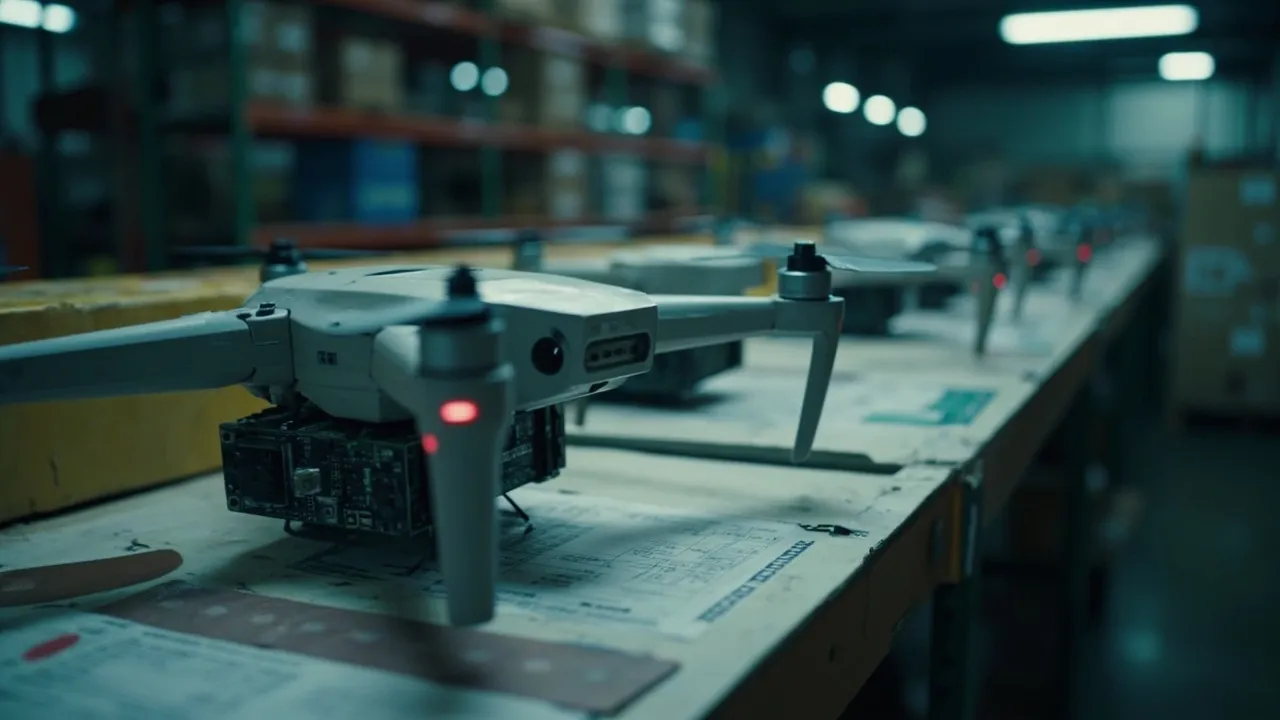
By contrast, the warehouse-drone model is built around persistence. In the Kroger deployment, Supply Chain Dive reported that autonomous drones can scan pallet locations across ambient and freezer zones and deliver weekly, facility-wide inventory visibility instead of forcing sites to rely on full physical counts. Corvus also says the system can operate in temperatures as low as minus 20 degrees Fahrenheit, which matters in cold-chain environments where manual counting is not just slow, but miserable.
Even if GNC is operating in a more conventional dry warehouse environment, the operational logic is the same. Drones turn inventory checks from a periodic event into a repeatable workflow. That is a much better fit for modern warehousing, where planners need cleaner inventory signals more often, not one heroic count at month-end.
Why this beats the delivery-drone narrative
Delivery drones make for better TV. Inventory drones make for better operations.
That distinction has been obvious for a while, even if the market took its time admitting it. In an earlier Supply Chain Dive analysis, Gartner projected that drone delivery would account for less than 1% of the commercial drone market by 2020. The date is old now, but the point aged well: the economics, regulation, and customer-acceptance hurdles around delivery drones were always much tougher than the warehouse pitch.
Inside four walls, the value proposition is cleaner. You control the environment. You already have barcodes, rack locations, WMS logic, and labor constraints. You are not asking a drone to solve airspace regulation or neighborhood drop-off behavior. You are asking it to fly a repeatable path and collect data.
Frankly, that is the smarter bet.
The business case is not “cool tech.” It is labor quality.
Inventory drones are often described as labor-saving tools. That is true, but incomplete. The better way to think about them is that they upgrade labor quality.
Manual counting eats time from supervisors, lift operators, and inventory-control staff who should be working exceptions, root causes, and slotting discipline, not hunting for confirmation that pallet A is still in location B. If a drone can handle the repetitive scan-and-verify work, the human team can focus on the decisions that actually improve throughput.
There is also a safety and uptime angle. Counting high rack inventory manually is annoying on a good day and risky on a bad one. Every avoided lift movement for a simple visual verification is a small operational win. Multiply that over weeks and months, and the return looks a lot less theoretical.
This is also why warehouse drones fit neatly beside WMS and labor-planning tools instead of competing with them. They are not a standalone miracle. They are a data-capture layer. A good WMS still matters. Slotting discipline still matters. Replenishment logic still matters. The drone just improves the quality and frequency of the signals those systems depend on.
The broader market is finally aligned for this
The timing is not accidental. Warehouses are more willing to fund practical automation than they were a few years ago.
According to Logistics Management’s coverage of the 2026 MHI and Deloitte industry report, 48% of surveyed supply chain leaders now rate AI’s disruptive impact as significant or greater, and 39% say the same about robotics and automation. That is not just hype capital. It signals that operators increasingly see automation as core infrastructure, not experimental garnish.
The idea has been building for years. Supply Chain Dive reported back in 2018 that a Tractica forecast expected warehouse robot deployments to grow from 40,000 in 2016 to 620,000 by 2021, while providers like Eyesee and DroneScan were already positioning drones as tools for automated inventory processes. The exact vendor list has changed, but the direction of travel has not. Warehouses want automation that plugs into ugly, repetitive, expensive workflows. Inventory counting is all three.
That is why the GNC example matters. It shows the market where drones belong in logistics: above the rack, inside the building, feeding better inventory data into execution systems.
What logistics teams should do with this
If you run warehouse operations, do not ask whether drones are futuristic. Ask whether your current cycle-count process is still defensible.
A few blunt questions usually expose the answer:
- how many labor hours are spent each month on manual counts and recounts?
- how often do pick, replenishment, or allocation issues trace back to bad location-level accuracy?
- how much of your inventory-control work is true exception management versus basic verification?
- how much operational pain do you tolerate just because counting has always been manual?
If those answers are ugly, drones are not a gimmick. They are a pretty rational next step.
The real warehouse drone use case is not delivery. It is inventory truth at scale. GNC’s example makes that painfully clear.
If your team wants tighter inventory visibility, stronger execution data, and warehouse workflows that do not depend on manual guesswork, book a CXTMS demo and see how better transportation and warehouse orchestration fit together.