Supply Chain Network Design Software in 2026: How Scenario Modeling Is Replacing Gut-Feel Distribution Strategy


For decades, deciding where to place distribution centers, which trade lanes to prioritize, and how to structure a logistics network came down to experience, instinct, and oversized spreadsheets. In 2026, that era is ending. Supply chain network design software is giving logistics leaders the power to model hundreds of scenarios in hours — not months — and the companies adopting these tools are finding savings that gut-feel planning never could.
The 80% Problem: Why Network Design Is the Highest-Leverage Decision in Logistics
Here's a statistic that should change how every supply chain leader allocates their time: according to Gartner research, approximately 80% of a supply chain's total costs are effectively locked in by the location of its facilities. That means optimizing last-mile routes, negotiating carrier rates, and fine-tuning warehouse operations — while valuable — are fighting over the remaining 20%.
The implication is stark. If your distribution centers are in the wrong places, if your trade lanes don't match current demand patterns, or if your network was designed for a pre-tariff, pre-pandemic world, no amount of operational optimization will close the gap.
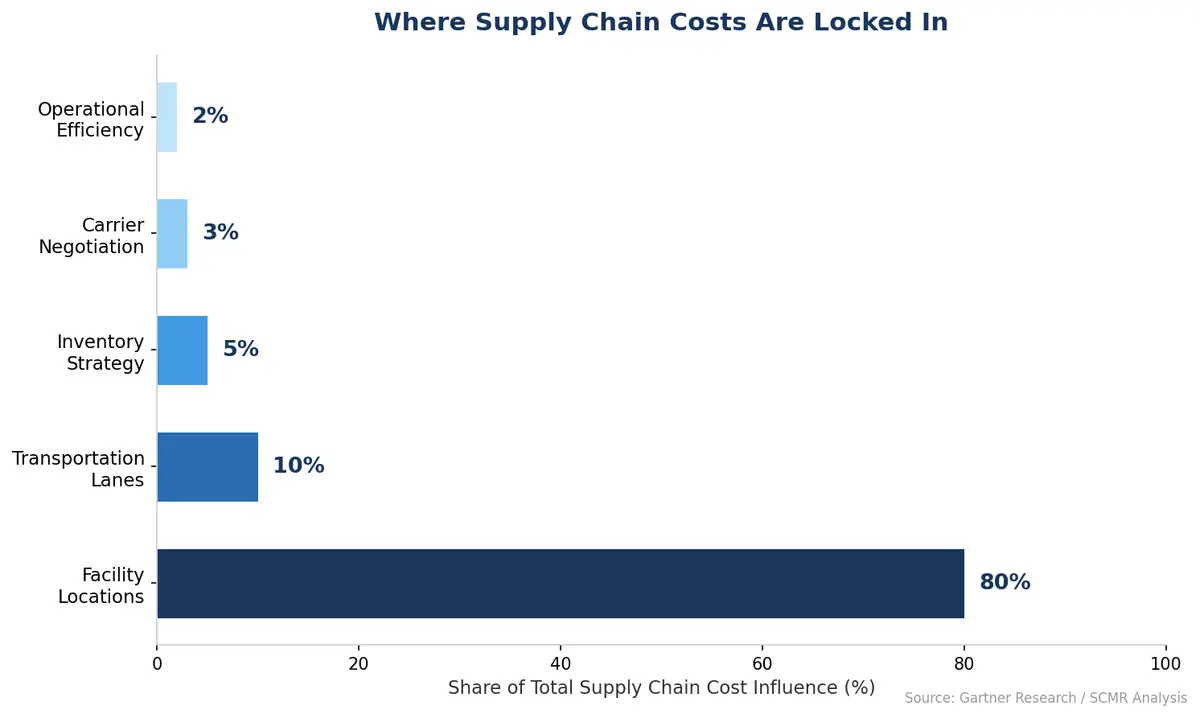
Supply chain consultancies consistently report identifying between 5% and 15% in annual cost avoidance through network design projects, according to analysis published in Supply Chain Management Review. For a mid-size shipper spending $50 million annually on logistics, that's $2.5 million to $7.5 million left on the table — every year — because no one modeled whether the current network still makes sense.
From Spreadsheets to Scenario Engines
Traditional network design was a periodic exercise. Companies would hire a consulting firm every three to five years to build a massive Excel model, run a handful of scenarios, and produce a recommendation. By the time the analysis was complete and approved, market conditions had often shifted.
Modern network design platforms — tools like AIMMS SC Navigator, Coupa, o9 Solutions, and Kinaxis — have fundamentally changed this dynamic. These platforms enable continuous network evaluation with capabilities that spreadsheets simply cannot match:
- Multi-echelon optimization that simultaneously evaluates supplier locations, manufacturing plants, distribution centers, and last-mile hubs as an interconnected system
- What-if scenario modeling that can test hundreds of variables — facility closures, new market entry, demand shifts, carrier rate changes — in minutes rather than weeks
- Constraint-based modeling that accounts for real-world limitations like labor availability, zoning restrictions, lease terms, and environmental regulations
- Total landed cost analysis that incorporates transportation, warehousing, inventory carrying costs, duties, and tariffs into a single optimization framework
Gartner's Market Guide for Supply Chain Network Design Tools has tracked this category's rapid maturation, noting that vendors are increasingly embedding AI-enhanced forecasting and autonomous scenario generation directly into their platforms.
Geopolitical Scenario Planning: The 2026 Imperative
If there's one factor accelerating adoption of network design software in 2026, it's geopolitical volatility. Tariff uncertainty, trade policy shifts, and regional realignment are forcing companies to model scenarios they never previously considered.
According to a January 2026 McKinsey analysis, companies are no longer simply hedging risk — they're fundamentally rethinking where and how they manufacture and source goods in response to tariffs, trade policies, and industrial incentives. This isn't a temporary reaction; it's a structural shift in how global supply chains are designed.
Network design software makes this tractable. Instead of debating whether to nearshore production based on hunches about future tariff policy, companies can model specific scenarios:
- What happens to total landed cost if China tariffs increase to 60%? The software can instantly recalculate optimal sourcing and routing across the entire network.
- Should we add a regional DC in Mexico to serve the Southwest? Model the trade-off between closer proximity, USMCA benefits, and cross-border complexity.
- How does a Red Sea disruption affect our European distribution? Simulate rerouting through the Cape of Good Hope and quantify the inventory buffer needed.
Leading organizations are treating tariffs and costs as dynamic strategic variables rather than static constraints, investing in total landed cost modeling and scenario analysis that can be refreshed quarterly — or even monthly — as conditions evolve.
Integration With TMS: Where Strategy Meets Execution
The most sophisticated approach to network design doesn't treat it as a standalone strategic exercise. Instead, it connects network-level decisions directly to transportation execution through TMS integration.
This execution-aware network optimization closes a critical gap. Historical shipment data from TMS platforms feeds network models with actual lane costs, transit times, and service performance — not theoretical estimates. In return, network design recommendations flow back into TMS routing logic, ensuring that day-to-day execution reflects strategic intent.
Graph-based reasoning is emerging as a key technology enabler here. As logistics technology analysts have noted, graph frameworks integrated into control towers and network design tools allow planners to visualize and optimize complex multi-node relationships that traditional tabular analysis struggles to represent.
The Greenfield vs. Brownfield Reality
Not every network design project starts from scratch. In practice, most companies face brownfield constraints — existing leases, sunk infrastructure costs, labor agreements, and customer commitments that limit the feasible solution space.
Modern network design software handles this gracefully by supporting phased optimization. Rather than recommending an idealized network that would require $200 million in capital investment, these tools can identify the highest-impact incremental changes:
- Which single facility relocation would yield the greatest cost reduction?
- Can adding a cross-dock in a specific region eliminate an entire echelon of inventory?
- What's the optimal sequence of lease expirations to exploit for network restructuring?
This pragmatic approach — optimizing within real constraints while identifying the long-term ideal state — is what separates modern network design from academic exercises.
How CXTMS Supports Data-Driven Network Strategy
CXTMS approaches network design from the execution side. By capturing granular shipment data across every lane, mode, and carrier, CXTMS provides the real-world cost and performance data that network design models need to produce accurate results. Lane-level analytics, carrier performance scoring, and total cost visibility give logistics teams the foundation to evaluate whether their current network structure still serves their business — or whether it's time to model a better one.
Rather than guessing at transportation costs in a network model, CXTMS users can export actual rate performance, transit time distributions, and service metrics directly into their planning tools — ensuring that strategic network decisions are grounded in operational reality.
Ready to build a data foundation for smarter network decisions? Contact CXTMS for a demo and see how execution-level visibility powers strategic supply chain design.