Samsung's AI Factory Blueprint: Why Data-Layer Orchestration Is the Next Frontier for Supply Chain Automation

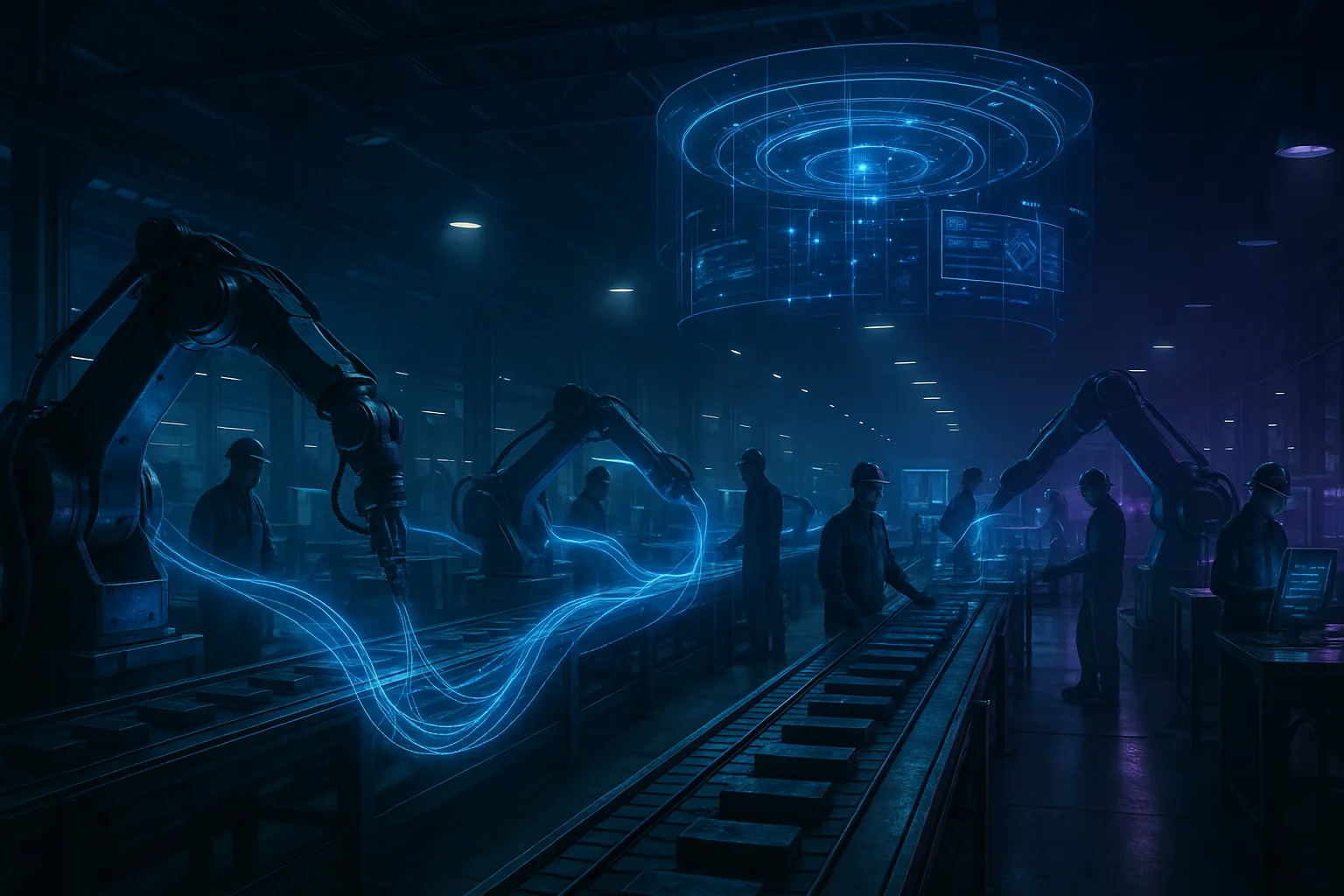
Samsung Electronics announced on March 1, 2026 that it will transition every manufacturing operation worldwide into an "AI-Driven Factory" by 2030. The strategy integrates artificial intelligence across the entire manufacturing value chain — from inbound material logistics and production to quality inspection and final shipment.
This isn't just a Samsung story. It's a signal that the center of gravity in supply chain automation is shifting from physical hardware deployment to data-layer orchestration — and every shipper, carrier, and logistics operator needs to pay attention.
The Paradigm Shift: From Hardware to Data Coordination
For decades, warehouse and manufacturing automation followed a straightforward playbook: install robotic arms, deploy autonomous forklifts, add conveyor systems, and reduce labor costs. The metric that mattered was throughput per square foot.
That model is hitting its ceiling. According to McKinsey's 2025 State of AI survey, 88% of organizations now use AI in at least one business function, but only about 6% are capturing meaningful enterprise-wide value from it. The gap isn't a hardware problem — it's a data orchestration problem.
Samsung's AI factory initiative represents the next evolution. Instead of asking "how many robots can we deploy," the question becomes "how intelligently can our systems coordinate machines, workers, and logistics flows in real time?"
"The next phase of manufacturing innovation lies in building autonomous environments where AI truly understands operational contexts in real time and independently executes optimal decisions," said YoungSoo Lee, Executive Vice President and Head of Global Technology Research at Samsung Electronics.
Samsung's AI Factory Model: Digital Twins, Agentic AI, and Autonomous Coordination
At the core of Samsung's strategy are three interconnected technology layers:
Digital twin simulations create virtual replicas of entire manufacturing facilities, enabling real-time monitoring and scenario planning before changes hit the physical floor. The global digital twin market is projected to grow from $21.14 billion in 2025 to $149.81 billion by 2030 — a 47.9% CAGR — with manufacturing and logistics driving a significant share of adoption.
Specialized AI agents handle quality control, production optimization, logistics coordination, and predictive maintenance autonomously. Samsung is extending the same "Agentic AI" technology first introduced in its Galaxy S26 smartphone series to the factory floor, creating purpose-built agents that plan, execute, and optimize decisions independently.
Robotics integration spans operating robots for line management, logistics robots for autonomous material handling, and assembly robots for precision manufacturing. But crucially, these robots operate under AI coordination rather than following pre-programmed routines.
The result is a facility where sensors, machines, enterprise systems, and human workers all feed into a unified AI-driven data layer that responds dynamically to operational changes and market demand.
Why Data-Layer Orchestration Outperforms Siloed Automation
Traditional automation investments often create islands of efficiency. A warehouse might have world-class robotic picking systems but still rely on manual coordination between receiving, storage, and outbound shipping. Each automated silo operates well in isolation but breaks down at the seams.
Data-layer orchestration solves this by treating the entire supply chain as a connected system. Consider what this means in practice:
- Demand shifts detected by AI forecasting agents automatically adjust production schedules, which trigger logistics coordination agents to rebook carrier capacity — all before a human planner reviews the change.
- Equipment anomalies identified through predictive maintenance algorithms reroute tasks to alternative production lines while simultaneously notifying downstream logistics of potential timing changes.
- Supply disruptions trigger automated recalculation of inventory allocations across distribution centers, with AI agents sourcing alternative suppliers and adjusting transportation plans in parallel.
The AI in supply chain market reflects this momentum. Mordor Intelligence estimates the sector will grow from $7.67 billion in 2025 to $35.28 billion by 2030 at a 35.67% CAGR, driven largely by organizations moving beyond point solutions to enterprise-wide AI orchestration.
Implications for Warehouse and Distribution Center Design
Samsung's blueprint has ripple effects far beyond electronics manufacturing. The principles of data-layer orchestration are already reshaping how logistics leaders think about facility design:
Software-defined operations mean warehouse layouts become more fluid. Instead of permanent conveyor systems dictating workflow, AI-coordinated mobile robots and human workers adapt configurations based on real-time demand patterns.
Predictive rather than reactive maintenance reduces unplanned downtime. Sensors embedded across infrastructure generate continuous performance data that AI systems analyze to forecast failures days or weeks before they occur.
Environmental safety automation extends beyond production. Samsung is deploying digital twin-integrated environmental safety robots to monitor hazardous conditions, identify risks, and proactively mitigate on-site hazards — a capability that translates directly to temperature-controlled warehousing, chemical logistics, and cold chain operations.
As Supply Chain Dive reported, continued investments in AI and automation are creating a fundamental divergence in labor availability, costs, and productivity across supply chains in 2026. Companies that architect their facilities around data-layer coordination will capture these gains; those still investing in isolated automation projects risk falling further behind.
How CXTMS Integrates With AI Orchestration Layers for End-to-End Visibility
The shift toward data-layer orchestration demands that transportation management systems evolve from transactional tools into intelligent integration hubs. CXTMS is built for exactly this architecture.
By connecting with AI-driven warehouse systems, IoT sensor networks, and predictive analytics platforms, CXTMS provides the transportation intelligence layer that completes the orchestration loop. When an AI-coordinated warehouse adjusts outbound schedules based on real-time production data, CXTMS automatically optimizes carrier selection, consolidation opportunities, and routing — ensuring the logistics response matches the speed of upstream intelligence.
Whether you're managing LTL consolidation, multi-modal routing, or cross-border freight, CXTMS gives you the real-time visibility and automated decision-making that data-layer orchestration demands.
Ready to connect your transportation management to the AI orchestration layer? Request a CXTMS demo today and see how intelligent freight management closes the gap between warehouse intelligence and logistics execution.