Rail Freight Digitization in North America: How Real-Time APIs Are Modernizing the $80 Billion Rail Cargo Market

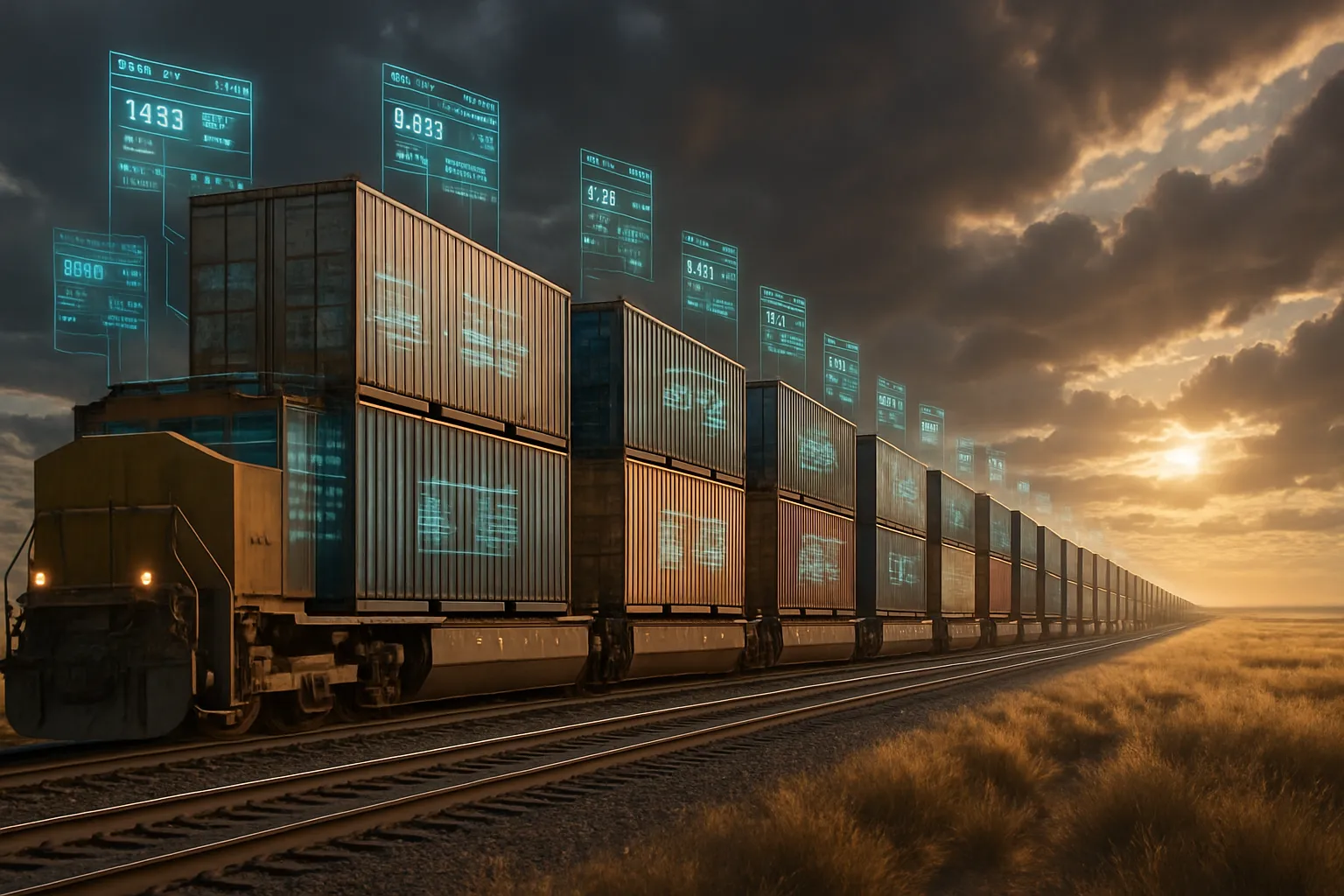
If you've ever tried to get a real-time ETA on a rail shipment, you understand the problem. While a truckload carrier can ping you GPS coordinates every 15 minutes, a rail shipment can disappear into a black hole somewhere between the origin yard and destination terminal—surfacing only when a customer service rep manually checks the system 48 hours later.
That gap is closing fast. North American Class I railroads are pouring investment into digital infrastructure, and the numbers tell the story: according to ABI Research, railcar IoT digitization revenues will surpass $20 billion globally by 2032, with North America leading the charge. Meanwhile, intermodal traffic hit 14.06 million containers and trailers in 2025—the second-highest volume ever recorded, per the Association of American Railroads—signaling that shippers are increasingly willing to trust rail when the digital experience improves.
The 10-Year Technology Gap
For most of the last two decades, rail freight technology lagged trucking by a full generation. While over-the-road carriers adopted GPS tracking, electronic logging devices, digital freight matching, and real-time capacity platforms, railroads operated on legacy mainframe systems designed in the 1980s and 1990s.
The reasons were structural. Class I railroads—BNSF, Union Pacific, Norfolk Southern, CSX, CPKC, and Canadian National—operated as near-monopolies on their respective corridors. Without competitive pressure to improve shipper experience, technology investment focused on internal operational efficiency rather than customer-facing digital tools.
That calculus has changed. Trucking's technology advantage became a competitive weapon, pulling freight that could move intermodal back to the highway. The AAR reports that total U.S. carloads rose 4.4% in January 2026 versus January 2025, but railroads know that sustaining growth requires matching the digital experience shippers now expect from every other mode.
The API Revolution: From EDI to Real-Time Integration
The most consequential shift in rail freight technology isn't happening on the tracks—it's happening in the data layer. Railinc, the AAR subsidiary that serves as the freight rail industry's digital backbone, now manages critical data and software systems powering real-time equipment tracking, proactive maintenance, and financial transactions across every Class I network in North America.
BNSF has launched its own API Center, offering shippers and logistics providers programmatic access to shipment tracking, equipment availability, pricing, and service scheduling. This isn't the EDI transactions of the past—these are modern RESTful APIs that integrate directly into a shipper's TMS, providing the same real-time data flow that trucking platforms have offered for years.
The impact is measurable. Shippers integrating railroad APIs into their transportation management systems report 30-40% reductions in manual status check calls and a 25% improvement in rail shipment planning accuracy. When you can query a railroad's system the same way you query a truckload carrier's API, rail becomes a genuine option for freight that previously defaulted to over-the-road simply because visibility was better.
IoT and the Sensor-Equipped Railcar
Beyond APIs, the physical railcar fleet is getting smarter. The freight rail industry's push toward IoT-equipped rolling stock represents one of the largest industrial IoT deployments in history. Sensors mounted on railcars now monitor location, speed, temperature, humidity, vibration, and mechanical health—transmitting data continuously rather than only at interchange points.
For temperature-sensitive freight, this is transformative. A refrigerated intermodal container crossing from Los Angeles to Chicago previously had temperature data only at origin, destination, and maybe one intermediate check. Today's IoT-equipped reefer containers stream temperature readings every few minutes, enabling automated alerts when cold chain integrity is at risk—before the freight is compromised, not after.
The data volumes are staggering. A single Class I railroad operates roughly 200,000 to 400,000 railcars at any given time. Equipping even half of that fleet with multi-sensor IoT packages generates billions of data points per month, feeding machine learning models that predict maintenance failures, optimize train consists, and improve network throughput.
BNSF's Digital Playbook: AI Meets Iron Horse
BNSF Railway, which operates 32,500 miles of track across the western two-thirds of the United States, has emerged as the technology leader among North American Class I railroads. The railroad's dedicated technology division, bnsf|tech, is developing proprietary AI solutions including:
- RailPASS: An AI-powered system for predictive train scheduling and network optimization
- Automated Yard Check: Computer vision systems that identify railcar positions and conditions without manual inspection
- Load Plan Optimization: Machine learning algorithms that determine optimal intermodal container placement on trains
- Customer Support Agent Assist: AI tools that help customer service teams resolve shipper inquiries faster
These aren't pilot programs. BNSF uses AI algorithms trained on historic data to optimize switching operations across its yard network, reducing dwell time and improving asset velocity. The railroad has raised its efficiency targets to a cumulative goal of $600 million in savings by 2026 through disciplined asset utilization and technology-driven process improvements.
Precision Scheduled Railroading 2.0: From Cost-Cutting to Digital Service
The original Precision Scheduled Railroading (PSR) revolution—pioneered by the late Hunter Harrison—focused on operational efficiency: running longer trains, closing underperforming yards, and reducing headcount. It worked financially but often damaged service quality, as shippers experienced longer transit times and less reliable delivery windows.
PSR 2.0 is a different animal. Today's version layers digital intelligence on top of the lean operating model. Fixed departure schedules mean rail operates more like a commercial airline—trains leave at set times regardless of whether they're completely full. But now those schedules are dynamically optimized using real-time demand data, weather forecasts, and network congestion models.
The result is rail service that's increasingly competitive with truckload for lanes over 500 miles. Norfolk Southern and CMA CGM recently launched a new door-to-door intermodal service that combines rail's reach with truckload simplicity, reflecting how digital tools are enabling railroads to offer the kind of seamless, visibility-rich experience that was once exclusive to highway carriers.
What This Means for Shippers
The practical implications for freight shippers are significant:
Intermodal becomes viable for more freight types. As rail visibility approaches trucking standards, commodities that previously required over-the-road transport for tracking reasons—electronics, pharmaceuticals, high-value consumer goods—can shift to intermodal, saving 15-30% on linehaul costs.
Planning accuracy improves dramatically. API-connected rail data flowing into TMS platforms means shippers can build rail into their routing guides with confidence, knowing that ETA predictions are based on real-time network conditions rather than historical averages.
Sustainability reporting gets easier. Rail produces roughly 75% fewer carbon emissions per ton-mile than trucking. With digital tracking proving that freight moved by rail and arrived on time, sustainability teams can quantify emissions reductions with actual shipment data.
Multi-modal optimization becomes possible. When rail data speaks the same API language as trucking, ocean, and air freight systems, true multi-modal optimization—dynamically selecting the best mode for each shipment based on cost, time, emissions, and service requirements—moves from theoretical to operational.
How CXTMS Powers Rail-Inclusive Freight Management
CXTMS integrates directly with Class I railroad APIs and intermodal marketing companies, bringing rail shipment data into the same unified platform where you manage truckload, LTL, ocean, and air freight. Real-time rail ETAs, automated status updates, and intermodal rate comparisons sit alongside your highway freight—eliminating the visibility gap that has kept shippers from leveraging rail's cost and sustainability advantages.
Our multi-modal optimization engine evaluates rail-truck combinations automatically, identifying lanes where intermodal saves money without sacrificing service. When a 750-mile truckload lane can move intermodal at 20% lower cost with comparable transit time, CXTMS flags it—and handles the booking, tracking, and exception management through a single interface.
Ready to bring rail into your digital freight strategy? Request a CXTMS demo and see how unified multi-modal visibility transforms your transportation network.