Lithium Battery Shipping Compliance in 2026: How the New IATA State-of-Charge Mandate Is Reshaping Air Cargo Operations

Lithium batteries are the lifeblood of the modern economy — powering everything from smartphones and laptops to electric vehicles and grid-scale energy storage. But as of January 1, 2026, shipping them by air just got significantly more regulated. The IATA Dangerous Goods Regulations (DGR) 67th Edition introduces mandatory state-of-charge (SoC) limits that transform what were previously recommendations into enforceable compliance requirements, reshaping how shippers, freight forwarders, and airlines handle battery cargo worldwide.
The 2026 IATA Mandate: State of Charge Capped at 30%
The headline change in the DGR 67th Edition is straightforward but far-reaching: lithium-ion batteries packed with equipment (UN 3481) with cells exceeding 2.7 Wh, and lithium-ion battery-powered vehicles (UN 3556) with batteries exceeding 100 Wh, must now be offered for air transport at a state of charge not exceeding 30% of their rated design capacity — or an indicated battery capacity not exceeding 25%.
This isn't a new concept. IATA had already mandated SoC limits for lithium batteries shipped alone (UN 3480) and introduced the packed-with and in-equipment limits as recommendations in 2025. What changed on January 1, 2026 is that those recommendations became mandatory requirements, with non-compliance now grounds for cargo rejection, fines, or carrier bans.
The rationale is simple: a lithium battery at 30% SoC contains roughly 70% less stored energy than a fully charged one. In the event of thermal runaway — the cascading overheating reaction responsible for battery fires — a lower charge state significantly reduces the intensity and duration of the resulting fire, buying critical minutes for containment aboard an aircraft.
Why This Matters Now: A Market Growing 29% Year-Over-Year
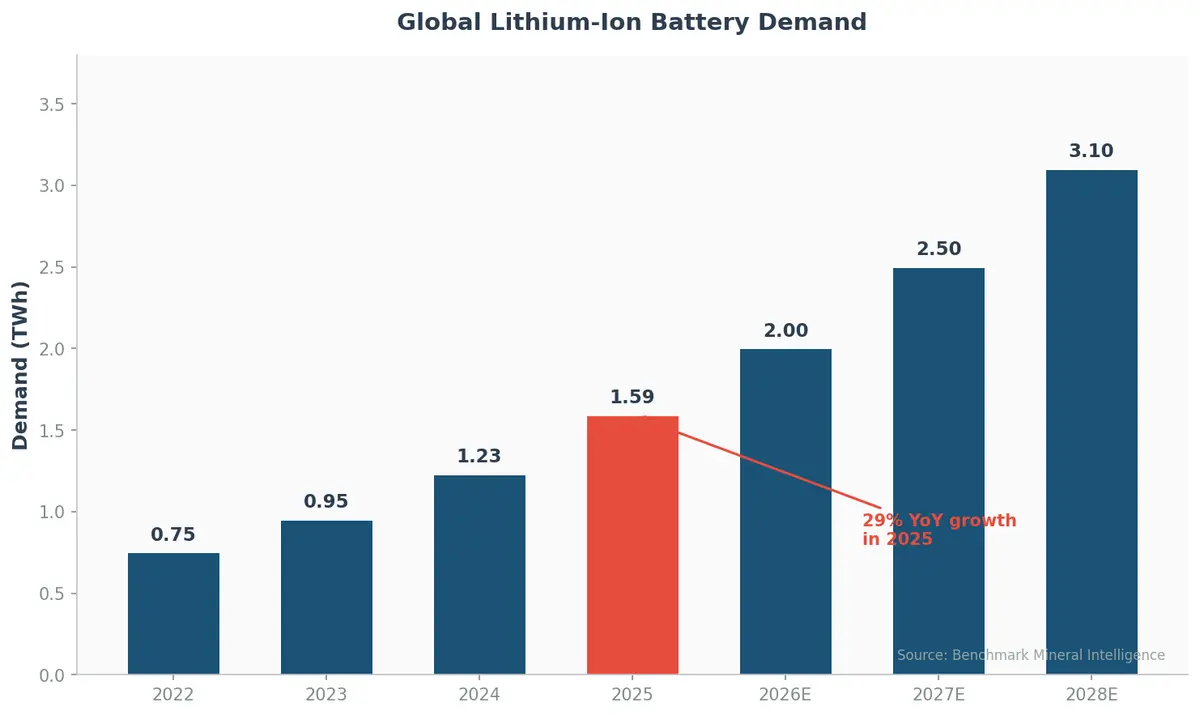
The timing of this mandate isn't accidental. Global lithium-ion battery demand surged 29% in 2025 to reach 1.59 TWh, driven by electric vehicle adoption and energy storage deployments. The lithium-ion battery market, valued at $68.66 billion in 2025, is projected to reach $306.24 billion by 2033 at a compound annual growth rate of 21.1%.
More batteries mean more shipments — and more risk. The FAA documented 89 lithium battery incidents aboard aircraft in 2024, a 16% increase over the prior year. These incidents involved batteries smoking, igniting, or producing extreme heat, and the trend shows no sign of slowing as battery volumes continue to climb.
For air cargo operators, the math is clear: every additional percentage point of state of charge translates to measurable thermal risk at altitude. The 30% mandate is IATA's attempt to keep regulatory pace with an industry that's doubling in size every three to four years.
Classification Pathways: Section I vs. Section II
One of the most common compliance errors shippers make is misclassifying their lithium battery shipments. The DGR divides lithium batteries into two categories based on energy capacity:
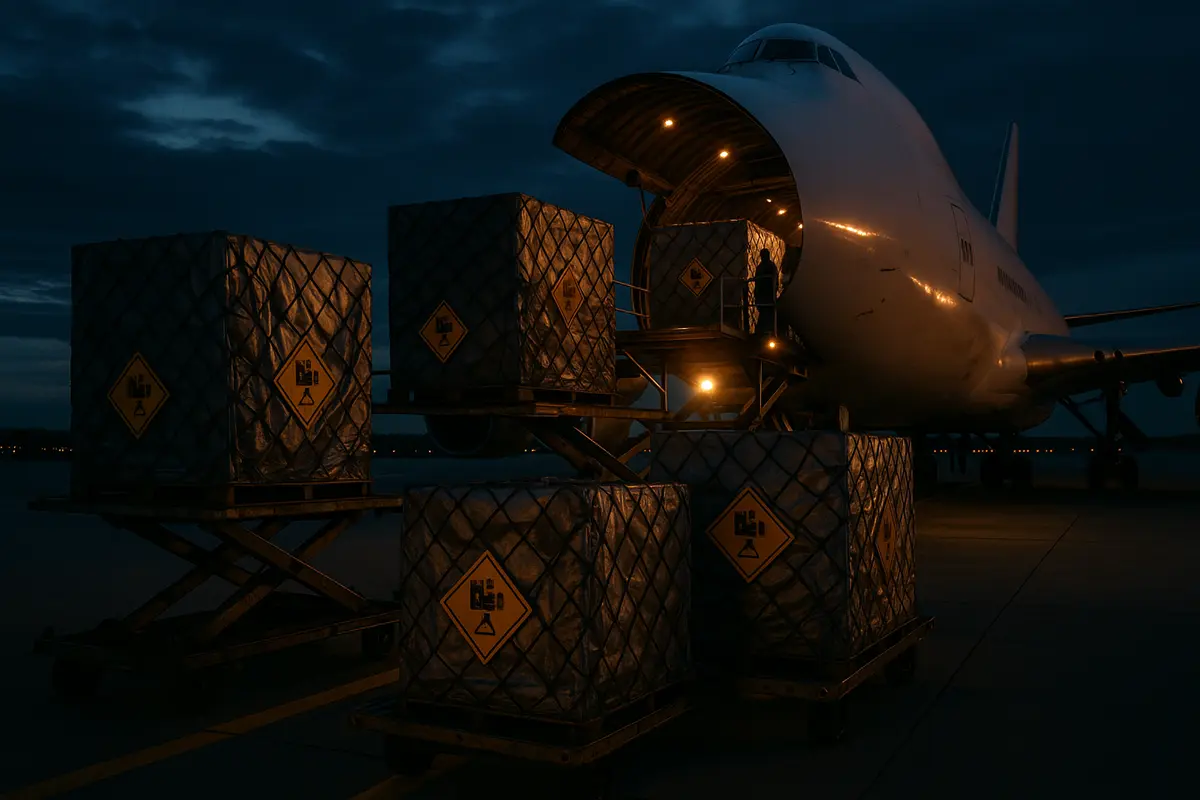
Section I batteries are larger cells and batteries that exceed specific watt-hour thresholds (over 20 Wh per cell or 100 Wh per battery for lithium-ion). These require full dangerous goods documentation, Class 9 hazard labeling, and must be shipped on cargo-only aircraft in most cases. The new SoC limits apply most strictly here.
Section II batteries are smaller — under the watt-hour thresholds — and can ship under less restrictive provisions, including on passenger aircraft. However, they still require specific packaging, marking with the lithium battery handling label, and compliance with quantity limits per package.
The critical distinction: shippers who routinely classified batteries as Section II to avoid full DG documentation need to verify their cell-level watt-hour ratings. With battery energy density increasing each generation, what qualified as Section II two years ago may now exceed the threshold.
Packaging, Marking, and Labeling Updates
Beyond the SoC mandate, the DGR 67th Edition refines several packaging and documentation requirements:
-
Standardized operator variations: IATA has harmonized the language that individual airlines use when restricting or prohibiting certain dangerous goods categories, making it easier for shippers to understand carrier-specific requirements without parsing dozens of differently worded policies.
-
Vehicle classification updates: Proper shipping names for UN 3166 (vehicles) have been revised to better distinguish between different powertrain types, reducing misclassification errors for hybrid and electric vehicle shipments.
-
State variations: Updated requirements for shipments to Thailand, France, and the UK add country-specific conditions that shippers must check before booking air cargo to these destinations.
Sodium-Ion Batteries: New Classification Rules
The 2026 DGR also addresses the emerging sodium-ion battery market. Sodium-ion cells and batteries with organic electrolyte are now classified under new UN numbers — UN 3551 and UN 3552 — with their own set of packing instructions and transport conditions.
While sodium-ion batteries are generally considered less prone to thermal runaway than their lithium-ion counterparts, IATA has proactively established classification pathways before the technology scales. For shippers evaluating sodium-ion as an alternative chemistry, this regulatory clarity is a green light for commercial air transport planning.
How TMS Platforms Automate Dangerous Goods Compliance
Manual compliance with these evolving regulations is increasingly untenable. A single lithium battery shipment by air now requires verification of cell chemistry, watt-hour ratings, SoC levels, classification pathway, packaging standards, carrier-specific operator variations, and destination country state variations — all before a booking confirmation can be issued.
Modern transportation management systems address this complexity through:
-
Automated DG classification engines that evaluate battery specifications against current IATA thresholds and assign the correct UN number, packing instruction, and documentation requirements.
-
SoC verification workflows that flag shipments lacking manufacturer certificates of charge state compliance before they reach the airline.
-
Carrier compliance matching that cross-references shipment DG profiles against operator variations to identify which airlines will accept the cargo — and which won't.
-
Dynamic regulatory updates that push DGR edition changes into classification logic without requiring manual rule reconfiguration.
For organizations shipping lithium batteries at volume, the cost of a single rejected or non-compliant shipment — including rebooking fees, storage charges, and potential regulatory penalties — typically exceeds the annual cost of automated compliance tooling.
Preparing for What's Next
IATA's Appendix H in the 67th Edition already signals further changes for the 2027 DGR, suggesting the regulatory trajectory will continue tightening. Shippers who treat the 2026 SoC mandate as a one-time adjustment rather than part of an ongoing compliance evolution risk falling behind.
The organizations best positioned are those building systematic compliance capabilities — automated classification, digital documentation, and real-time regulatory monitoring — rather than relying on manual processes that break every time the rules change.
Navigating lithium battery compliance shouldn't require a regulatory PhD. Contact CXTMS for a demo of how our platform automates dangerous goods documentation and keeps your air cargo operations compliant.