Double Brokering Fraud Hits Record Levels: How NMFTA's Identity Verification Is Fighting Back in 2026


Freight fraud is no longer a nuisance—it's a full-blown crisis. Cargo theft losses surged 60% to an estimated $725 million in 2025, according to Verisk CargoNet analysis, with organized criminal groups targeting increasingly high-value shipments. And double brokering—where a broker illegally re-brokers a load to an unvetted carrier without the shipper's knowledge—sits at the heart of the epidemic.
The Double Brokering Epidemic: Scale of the Problem
Double brokering has evolved from an occasional bad actor problem into a sophisticated, industrialized fraud operation. The NMFTA's 2026 Transportation Industry Cybersecurity Trends Report reveals that crime syndicates are now leveraging both traditional deception and cyber techniques in coordinated campaigns targeting brokers, carriers, and shippers.
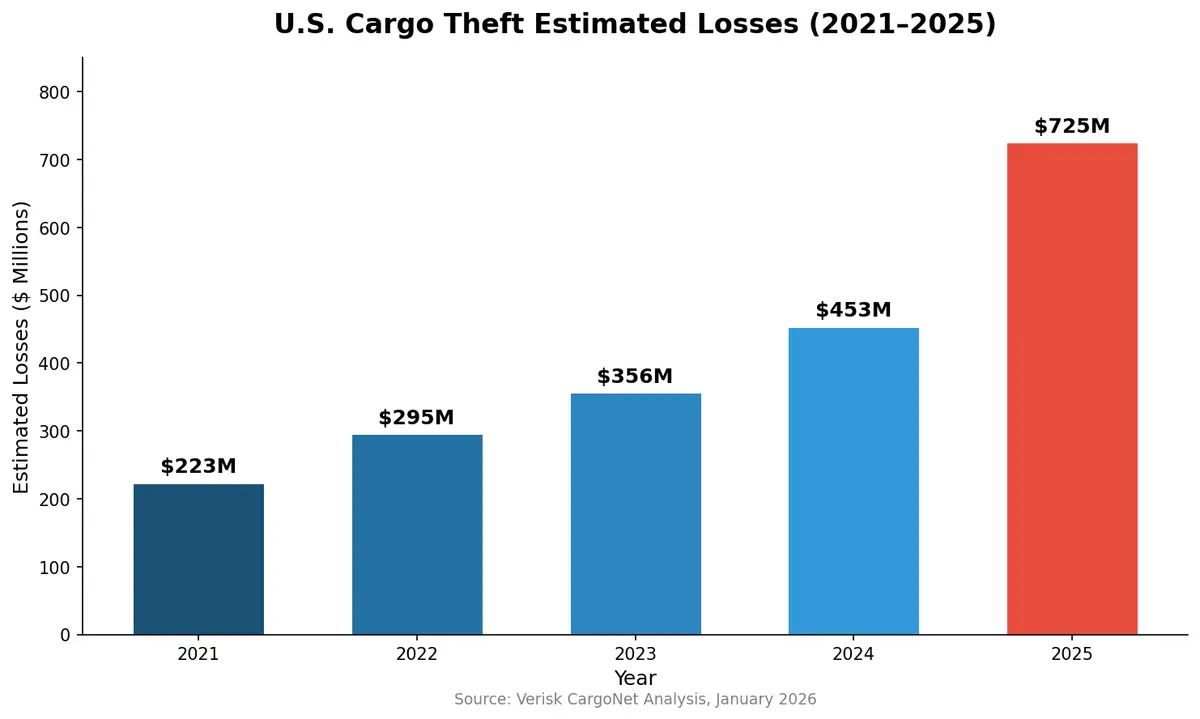
The mechanics are deceptively simple: a fraudulent entity poses as a legitimate carrier, accepts a load from a broker, then re-brokers it to an actual carrier at a lower rate—pocketing the difference. In worst-case scenarios, the freight simply disappears. The annualized cost of cargo theft to the U.S. freight transportation industry reaches up to $6.6 billion, according to NMFTA estimates, with double brokering and identity fraud representing a rapidly growing share.
What makes modern double brokering particularly dangerous is the sophistication of carrier impersonation. Fraudsters replicate company credentials, insurance certificates, and operating authorities with alarming accuracy. They create convincing clone websites, spoof FMCSA authority numbers, and exploit the fragmented verification systems that the freight industry has relied on for decades.
NMFTA's SCAC Verified: A Game-Changing Response
On February 26, 2026, the National Motor Freight Traffic Association (NMFTA) launched SCAC Verified—a landmark initiative that ties every Standard Carrier Alpha Code to a verified individual through identity verification technology powered by Persona.
For decades, the SCAC has served as the universal identifier for carriers moving goods across North America. It's required at ports, border crossings, and in millions of transactions between shippers, brokers, and carriers every year. But until now, the system never verified the person behind the code.
SCAC Verified changes that equation fundamentally:
- Identity-assured credentials: Every SCAC is now linked to a verified, real person—transforming it from a static code into a trust signal
- Fraud prevention at registration: Identity verification happens at the point of SCAC application and renewal for non-Class 8 carriers
- Universal trust signal: Shippers, brokers, and 3PLs get a checkable verification that works across every system and transaction
As NMFTA stated in their announcement: "We must shift our focus from a reactionary to a proactive approach. Until we confront the tangled, overlapping systems that allow freight fraud to thrive, we'll continue to chase solutions that merely sound the alarm."
Technology Solutions: Two-Step Verification and AI Fraud Detection
NMFTA's SCAC Verified is part of a broader technology wave transforming freight fraud prevention. The FreightWaves 2025 Fraud Fighters Awards recognized ten companies building innovative solutions that combat double brokering, identity theft, and cargo theft using AI, real-time monitoring, and advanced verification.
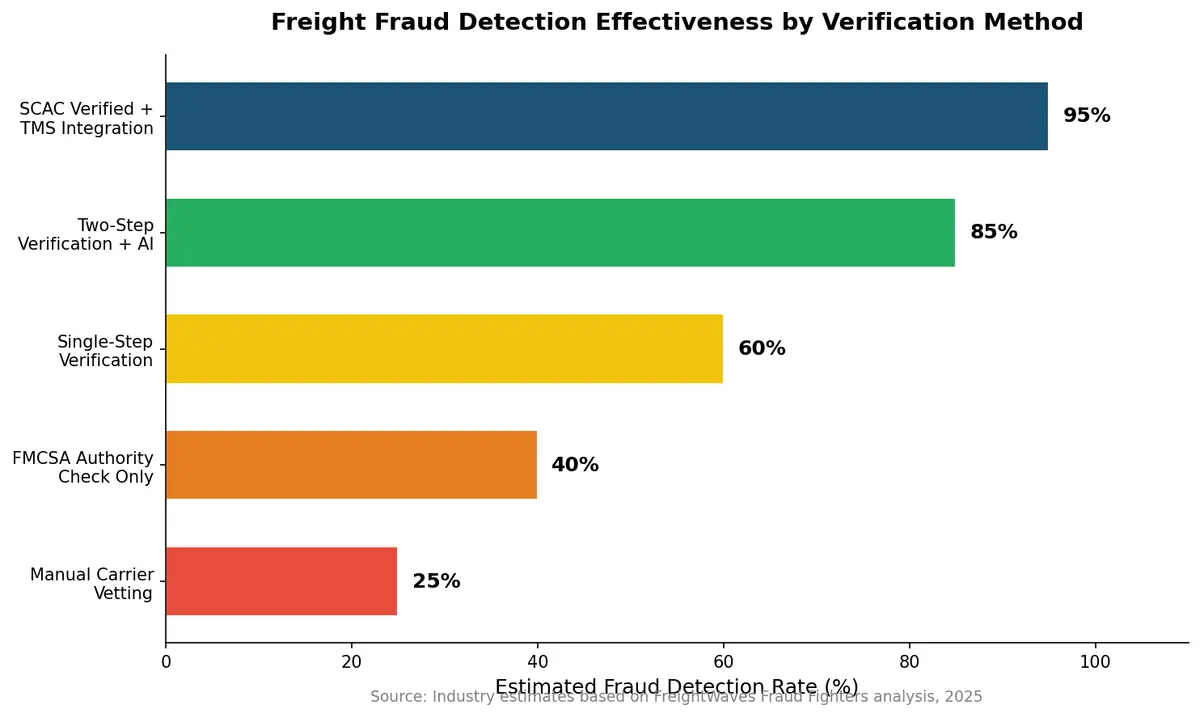
The most effective approaches now employ two-step carrier verification:
- At carrier assignment: Verify the carrier's identity, FMCSA authority, insurance status, and safety record before tendering a load
- At pickup: Confirm the driver and equipment match the assigned carrier—catching identity swaps that happen between tender and pickup
AI-powered fraud detection adds another layer by analyzing behavioral patterns across millions of transactions. These systems flag anomalies like newly activated authorities immediately booking high-value loads, carriers operating far outside their normal lanes, or sudden spikes in capacity from single-truck operations.
Real-time monitoring platforms now cross-reference data from FMCSA, insurance databases, GPS tracking, and historical transaction patterns to generate carrier risk scores that update continuously—not just at onboarding.
How TMS Platforms Integrate Carrier Vetting Into Load Assignment
The most critical shift in freight fraud prevention is moving verification from a standalone compliance activity into the core workflow of load assignment. Modern Transportation Management Systems are embedding carrier vetting directly into the tendering process, creating an automated safety net that catches fraud before loads move.
Key integration points include:
- Automated authority checks: Real-time FMCSA authority validation at the moment of carrier selection, not days before
- Insurance monitoring: Continuous certificate tracking with instant alerts when coverage lapses or changes
- Identity verification APIs: Direct integration with SCAC Verified and similar identity platforms
- Risk scoring dashboards: Carrier trust scores visible to dispatchers and brokers at the point of decision
- Geofencing and GPS matching: Confirming that the carrier's actual location and equipment align with the tendered load
This workflow-embedded approach means that even if a fraudulent carrier passes initial vetting, subsequent verification steps at tender, dispatch, and pickup create multiple failure points for fraud schemes.
Best Practices for Shippers and Brokers
Protecting against double brokering in 2026 requires a layered defense strategy:
Verify at every touchpoint. Don't rely on a single check at onboarding. Verify carrier identity at assignment, confirm driver credentials at pickup, and monitor in-transit tracking for route anomalies.
Leverage SCAC Verified. Require identity-verified SCAC codes from all carrier partners. This single step eliminates the easiest impersonation vectors.
Monitor for red flags. Watch for carriers with brand-new authority immediately booking loads, contact information that doesn't match FMCSA records, or repeated requests to change payment details.
Invest in technology. Manual verification doesn't scale. Integrate automated carrier vetting into your TMS workflow so that every load is protected—not just the ones your team has time to check.
Report fraud immediately. Notify FMCSA, your insurance provider, and industry databases like CargoNet when you encounter suspected fraud. Every report helps protect the broader network.
Building a Fraud-Resistant Freight Network
The freight industry's fraud problem didn't develop overnight, and it won't be solved by any single initiative. But NMFTA's SCAC Verified represents a fundamental shift—from reactive incident response to proactive identity assurance. Combined with AI-powered fraud detection, two-step carrier verification, and TMS-integrated vetting workflows, the industry finally has the tools to make fraud unprofitable.
The shippers and brokers who move fastest to adopt these technologies won't just protect their freight—they'll build the trusted carrier networks that become a competitive advantage in an industry where trust is the scarcest commodity.
Need to embed carrier verification and fraud prevention directly into your logistics workflows? Contact CXTMS for a demo of our integrated carrier management platform.