Digital Product Passports Meet Supply Chain: How W3C Verifiable Credentials Are Fighting the $4.2 Trillion Counterfeiting Problem

Counterfeiting isn't just a luxury brand problem anymore—it's a supply chain crisis that touches every industry from pharmaceuticals to industrial components. The global trade in counterfeit and pirated goods has ballooned to an estimated $4.2 trillion annually, with counterfeit products representing roughly 3.3% of world trade according to the OECD's ongoing research into illicit trade. Small parcels shipped through e-commerce channels have become the fastest-growing conduit for fake goods, making traditional border enforcement increasingly inadequate.
In 2026, two converging forces are finally giving supply chain professionals the tools to fight back: the EU's mandatory Digital Product Passport (DPP) framework and the W3C's newly standardized Verifiable Credentials 2.0. Together, they're building an authentication layer that could fundamentally change how goods are verified as they move through global logistics networks.
The EU Digital Product Passport Mandate: 30 Categories and Counting
The European Union's Ecodesign for Sustainable Products Regulation (ESPR), which entered into force in July 2024, is now the most ambitious product transparency initiative ever attempted. Under ESPR, roughly 30 product categories will be required to carry a Digital Product Passport between 2026 and 2030, starting with high-impact goods like batteries, textiles, and electronics.
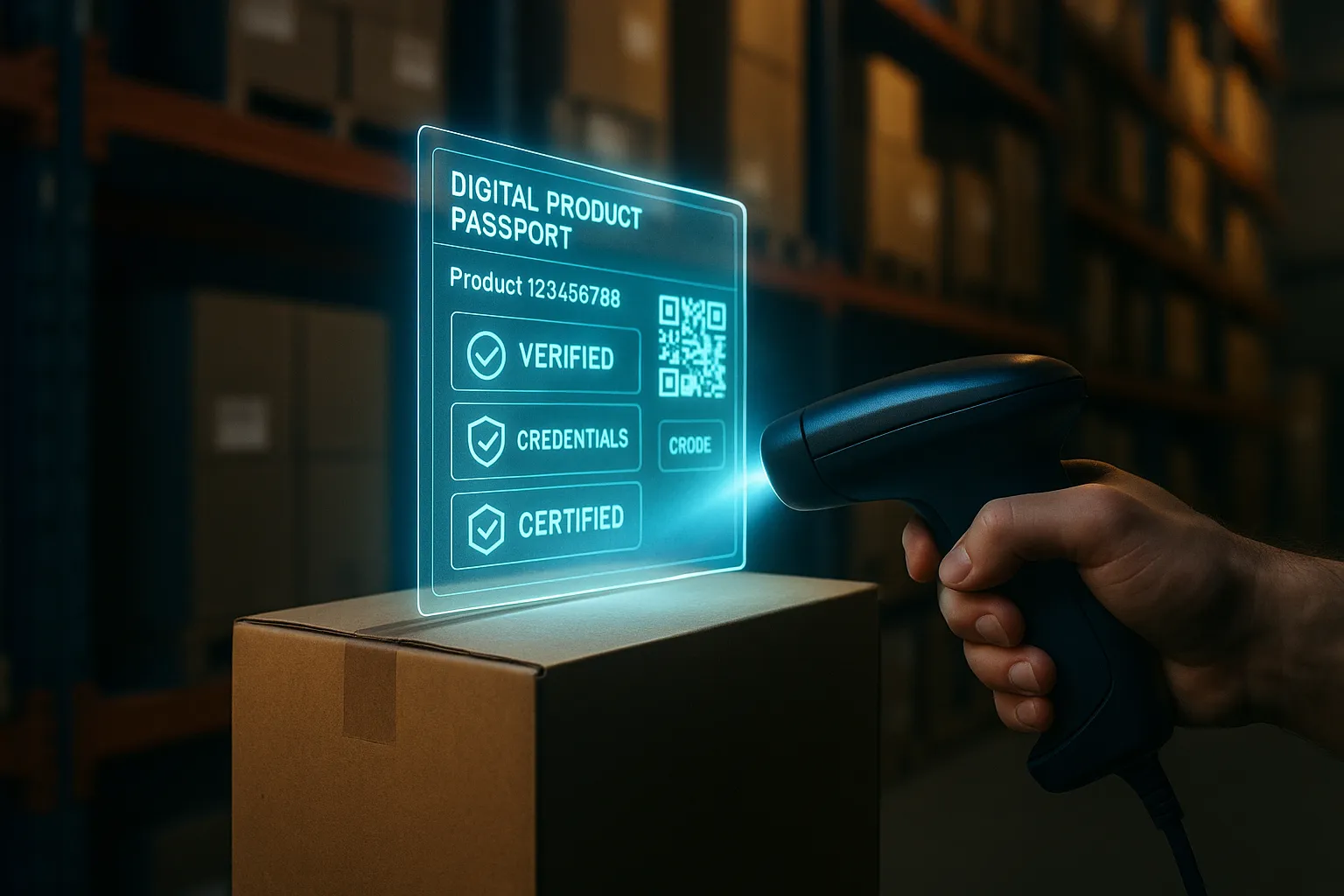
A Digital Product Passport is essentially a standardized digital record that travels with a product throughout its lifecycle. It contains verified data about a product's origin, materials, manufacturing processes, carbon footprint, repairability, and recycled content. The DPP is accessible via a QR code, RFID tag, or NFC chip embedded in the product or its packaging—creating a bridge between the physical item and its digital identity.
The market is responding aggressively to this mandate. The global digital product passport market was valued at $213.9 million in 2024 and is projected to reach $1.23 billion by 2030, growing at a staggering 34.9% CAGR according to Grand View Research. Other analysts project even faster growth, with The Business Research Company forecasting the market could hit $5.64 billion by 2030 when including the broader ecosystem of compliance platforms, blockchain infrastructure, and integration services.
For logistics providers and shippers, this isn't optional. Any product entering the EU market will need a compliant DPP, which means supply chain systems must be capable of generating, transmitting, and verifying passport data at every handoff point.
W3C Verifiable Credentials 2.0: The Trust Infrastructure for Supply Chains
While the EU provides the regulatory mandate, the W3C is providing the technical standard to make it work at scale. In 2025, the W3C published Verifiable Credentials 2.0 as a full web standard, establishing the credential format that enables cryptographically secure, machine-verifiable claims about any entity—including products moving through a supply chain.
Then in February 2026, the W3C formally launched the Verifiable Supply Chain Community Group, specifically focused on applying the VC ecosystem to supply chain provenance and authentication. The group's mission is to produce toolkits and specifications that bridge verifiable credential systems with existing supply chain infrastructure, enabling cryptographically secure proofs of origin, custody, compliance, and sustainability with interoperability as a core focus.
This is a significant departure from earlier blockchain-based traceability approaches. Where blockchain solutions often required all participants to join a specific platform or consortium, Verifiable Credentials are designed to be decentralized and interoperable by default. A manufacturer in Vietnam can issue a credential about a product's origin that a customs inspector in Rotterdam can verify without either party needing to be on the same system. The verification is cryptographic—tamper-proof and mathematically provable—not dependent on trust in a central authority.
Companies like Tradeverifyd are already integrating verifiable credentials at the core of their platforms, embedding data lineage and trust into every supply chain document. This means bills of lading, certificates of origin, quality inspections, and customs declarations can all carry cryptographic proof of authenticity.
The Physical-Digital Verification Stack: RFID Meets Cryptography
The real power of digital product passports emerges when you combine the digital credential layer with physical authentication technologies. The RFID anti-counterfeiting packaging market alone is projected to reach $110.1 billion by 2030, according to MarketsandMarkets, reflecting massive investment in the physical side of the authentication equation.
Modern anti-counterfeiting systems layer multiple technologies into what industry experts call the "physical-digital verification stack":
- RFID and NFC tags embedded in products or packaging provide unique identifiers that can be scanned at every supply chain touchpoint
- Cryptographic authentication ensures that tag data hasn't been cloned or tampered with—RFID systems can now reduce losses from product tampering fraud by over 70% while increasing authentication efficiency by 20x
- Digital product passports link each physical tag to a comprehensive digital record containing verifiable credentials about the product's journey
- Mobile verification apps enable warehouse workers, customs agents, and even end consumers to authenticate products with a simple scan
This multi-layered approach addresses a critical weakness in traditional supply chain traceability: it's no longer enough to track where a product has been. You need to prove that the product at each checkpoint is genuinely the product it claims to be—and that every credential attached to it is authentic.
What This Means for Shippers and Logistics Providers
The convergence of digital product passports, verifiable credentials, and RFID authentication creates both challenges and opportunities for supply chain professionals in 2026:
Compliance readiness is urgent. With DPP requirements phasing in now through 2030, shippers serving EU markets need to start building data collection and transmission capabilities into their logistics workflows today. Waiting until enforcement begins means scrambling to retrofit systems under deadline pressure.
Data infrastructure matters more than ever. Digital product passports require granular, verified data from every stage of the supply chain. Your TMS, WMS, and carrier management systems need to capture, store, and transmit authentication data alongside traditional shipment information. Siloed systems that can't share verified data will become a bottleneck.
Authentication becomes a competitive advantage. As consumers and B2B buyers become more aware of counterfeiting risks, the ability to provide cryptographically verified product provenance becomes a differentiator. Shippers who can prove their goods are authentic—and that their supply chain partners are verified—will command premium positioning.
Integration complexity is real but manageable. The W3C's emphasis on interoperability means that verifiable credential systems are designed to work with existing infrastructure. You don't need to rip and replace your TMS—you need a platform that can integrate with credential issuance and verification APIs alongside your existing carrier and customs workflows.
Building Authentication Into Your Supply Chain Operations
The shift toward verifiable supply chains isn't a future trend—it's happening now, driven by regulation, technology standards, and the sheer economic cost of counterfeiting. The organizations that move first to integrate digital product passports and verifiable credentials into their logistics operations will be best positioned as these requirements expand from the EU to other markets.
The key is choosing supply chain technology that's built for this level of data integration. Your TMS needs to do more than optimize rates and track shipments—it needs to serve as a hub for verified, authenticated data that flows seamlessly between trading partners.
Ready to build authentication and traceability into your supply chain operations? CXTMS provides the integrated platform shippers need to manage verified data across carriers, customs, and trading partners—all from a single dashboard. Request a demo today and see how CXTMS can help you stay ahead of digital product passport requirements while optimizing your entire logistics operation.