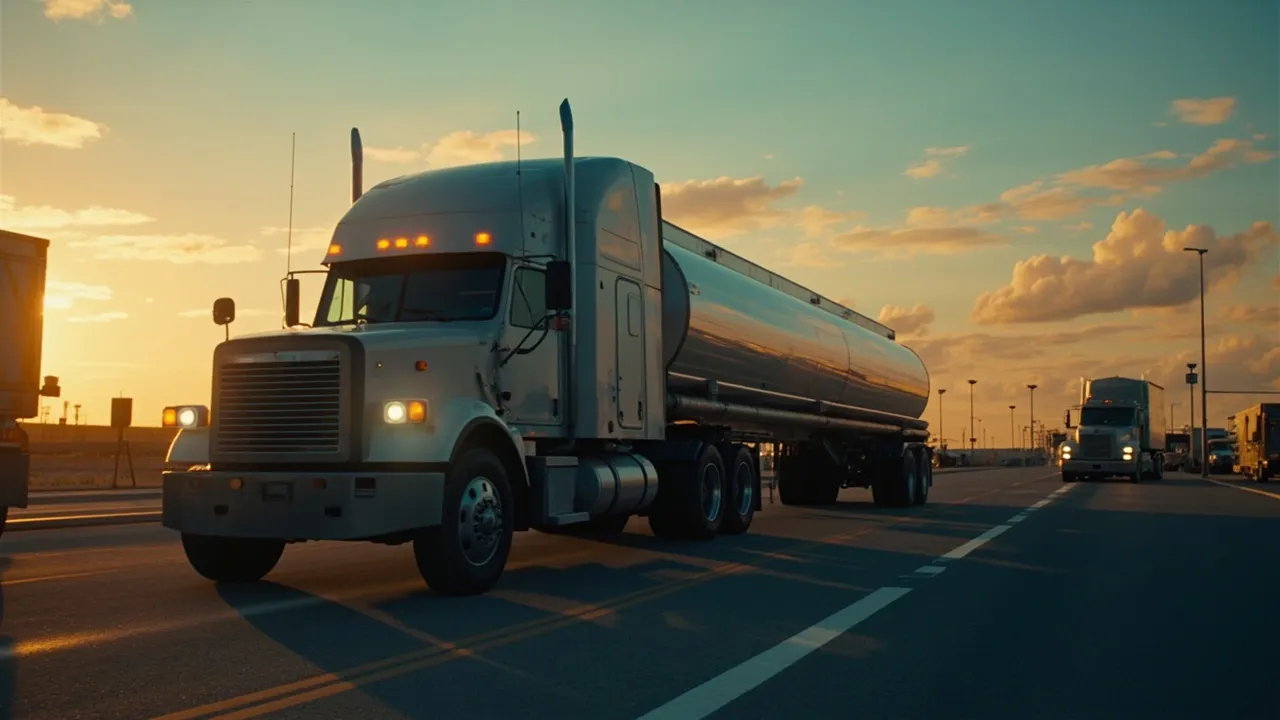
Class 8 Safety Sensors Are Becoming a Freight Procurement Signal


Class 8 safety technology is moving from a fleet maintenance conversation to a freight procurement signal.
That shift became clearer when FreightWaves reported that Bendix selected Aeva 4D LiDAR for next-generation collision mitigation systems on Class 8 mass-production vehicles. Bendix's Fusion advanced driver assistance platform already operates across most major Class 8 OEMs, and the Aeva program targets one of the first LiDAR-based L2+ driver assistance solutions for commercial vehicles at scale.
The numbers matter. FreightWaves noted that roughly 300,000 new Class 8 trucks enter the North American market annually. If advanced perception systems become common on new tractors, shippers will increasingly face two carrier classes: fleets that can prove modern collision-mitigation coverage, and fleets that cannot. Safety equipment can no longer sit outside the carrier qualification file.
Safety Technology Is Becoming Operational Evidence
Carrier safety has traditionally been scored through authority checks, insurance certificates, DOT history, crash indicators, service performance, and relationship trust. Those inputs still matter. But they often describe what happened in the past.
Advanced driver assistance systems add a different kind of evidence: what the carrier is doing now to reduce preventable crashes.
The Bendix-Aeva program is important because it points to safety technology being embedded into production equipment rather than bolted on as a premium option for a few showcase fleets. Aeva's 4D LiDAR combines distance and velocity sensing, while Bendix brings the commercial vehicle safety platform, OEM footprint, and braking-system expertise needed to turn sensor data into interventions.
For shippers, the procurement question is practical: if two carriers quote a lane at similar rates, but one can document active collision mitigation across most assigned tractors and the other cannot identify equipment coverage, are they really offering the same risk profile?
They are not. The cheaper rate may simply be hiding risk somewhere else.
Nuclear Verdicts Make Safety Proof Harder to Ignore
The financial backdrop is brutal. In a separate report, FreightWaves covered a California case where a jury awarded $52.1 million after one crash involving three trucking firms. The case centered on vicarious responsibility and subcontracted transportation work. FreightWaves reported that the load had been subcontracted twice and that an alleged hours-of-service violation became an issue at trial.
That case is not just legal trivia. It is a warning about weak chain-of-custody in carrier management. If freight moves through subcontracted parties, independent contractors, or layered motor-carrier relationships, shippers and brokers need stronger evidence that the operating carrier is qualified, insured, maintained, and safe.
Safety technology does not eliminate liability. It will not rescue a bad carrier from poor hiring, weak maintenance, fake compliance, or reckless dispatching. But documented collision-mitigation capability can become one more proof point in a broader due-diligence package.
Insurance markets are likely to care, too. When crash costs are severe and legal theories can pull multiple companies into a claim, underwriters and risk teams will look for measurable controls. Procurement teams should care because insurance pressure eventually becomes rate pressure, capacity pressure, or both.
Rate Inflation Raises the Stakes
Safety requirements are arriving just as truckload economics are tightening. FreightWaves recently reported that truckload carriers are eyeing a multiyear rate upcycle, with J.B. Hunt's Spencer Frazier saying truckload operating expense lines are up roughly 30% to 50% over the past five years while rates declined. The same report noted that J.B. Hunt management has flagged the possibility of a cumulative 20% rate hike over the next two years, while some bid expectations have moved from low- to mid-single-digit increases toward mid- to high-single-digit increases.
That environment tempts shippers to chase the lowest truck. Bad instinct.
When capacity tightens, routing guides get stressed. Mini-bids increase. Backup carriers receive more freight. Procurement teams may onboard capacity quickly to avoid service failures. That is exactly when safety standards can slip unless they are built into the workflow.
A modern carrier scorecard should make unsafe shortcuts harder. If a carrier cannot provide equipment-generation data, collision-mitigation coverage, current insurance, maintenance proof, and subcontracting controls, that carrier should not be treated as interchangeable capacity just because the rate is attractive.
Freight procurement is not only buying a truck. It is buying the risk profile of the truck, the driver, the carrier, the maintenance program, the insurer, and every handoff behind the tender.
What to Add to the Carrier Scorecard
Shippers do not need a 90-field questionnaire that nobody maintains. They need a small set of safety fields that can be verified and refreshed.
Start with equipment generation. Capture the tractor model years normally assigned to the lane or region, not just the newest units in the fleet.
Next, record safety technology coverage. Does the assigned fleet include automatic emergency braking, forward collision warning, lane departure alerts, stability control, camera systems, telematics, or LiDAR-enabled systems as they enter production? What percentage of the fleet has those systems? Are they active, maintained, and monitored?
Then require maintenance proof. Sensors are only useful if they work. Procurement should ask how the carrier verifies calibration, fault alerts, repairs, and preventive maintenance. A broken camera or disabled warning system is not a safety program.
Add claims and incident history. Do not rely on vague assurances. Track preventable crashes, cargo claims, service failures tied to safety events, insurance changes, and corrective actions. If a carrier has a bad incident but can show disciplined remediation, that is different from a carrier that cannot explain the pattern.
Finally, document subcontracting rules. The California verdict coverage shows why this matters. If freight can be passed to another motor carrier, owner-operator, or related entity, the shipper needs approval rights, visibility, and the same safety standards applied downstream.
Route-Level Risk Scoring Comes Next
The smartest procurement teams will not stop at carrier-level scoring. They will connect safety data to lane risk.
A dense urban final-mile route, a winter mountain corridor, a night run through congested interstates, and a low-complexity dedicated shuttle do not carry the same risk. The TMS should help procurement and operations apply different qualification thresholds by lane, commodity, customer, and delivery window.
That is where Class 8 safety sensors become more than hardware. They become routing intelligence. A high-risk lane may require carriers with verified collision mitigation, strong claims history, specific insurance layers, and tighter escalation rules. A lower-risk lane may allow a broader carrier pool while still enforcing baseline compliance.
The goal is not to punish smaller carriers. Many strong regional fleets run excellent safety programs. The goal is to replace assumptions with evidence.
CXTMS helps logistics teams bring that discipline into daily execution: carrier profiles, tender controls, compliance records, lane rules, exception workflows, and auditable decisions in one operating layer. When market pressure rises, those controls keep procurement from trading safety for short-term capacity.
If your team is updating carrier scorecards, tightening safety requirements, or preparing for a harder truckload market, schedule a CXTMS demo and see how better transportation controls turn risk management into repeatable execution.