B2B Logistics Trends Defining 2026: IoT Detects 60% of Disruptions Earlier and the Rise of Proactive Supply Chains


For decades, the default mode of supply chain management was reactive. Something broke, someone noticed, and then the scramble began — phone calls, emails, spreadsheets, and damage control. In 2026, that model is finally dying. Industry research cited by FedEx shows that IoT-enabled sensors can now detect more than 60% of potential supply chain disruptions earlier, shifting organizations from reactive firefighting to proactive prevention.
The implications are massive. Proactive logistics isn't just a technology upgrade — it's a fundamental rethinking of how B2B supply chains operate, compete, and deliver value.
The End of Reactive Logistics
The traditional supply chain playbook relied on a simple loop: ship, wait, react. A delayed container? You found out when the customer called. A temperature excursion? You discovered it at the dock. A carrier no-show? You scrambled for a backup with hours to spare.
IoT has inverted that equation. Connected sensors on containers, pallets, trucks, and warehouse assets now stream real-time data on location, temperature, humidity, shock, and light exposure. When combined with AI-powered analytics, this data creates an early warning system that flags disruptions before they cascade through the network.
According to FedEx's 2026 B2B Trends report, supply chain visibility and automation have moved from competitive advantages to core operational requirements. Businesses that lack real-time monitoring capabilities are now at a measurable disadvantage in cost control, service reliability, and customer confidence.
How Leading Retailers Are Building Proactive Supply Chains
At Manifest 2026 in Las Vegas, executives from American Eagle Outfitters and Dollar General shared how they're operationalizing proactive logistics through layered AI deployment. As reported by Supply Chain Dive, American Eagle has built a four-layer intelligence approach spanning forecasting, inventory, logistics, and orchestration.
The results speak volumes. American Eagle's AI systems forecast demand down to the ZIP code level, reposition inventory while purchase orders are still en route, and optimize carrier selection based on real-time capacity and cost. When tariff disruptions hit in April 2025, the company ran network simulations to evaluate mitigation strategies — and expected to reduce tariff impact by more than 60% by early 2026 through proactive sourcing and transportation adjustments.
"It allowed us to make decisions that were millions of dollars in impact," said Brandon Friez, SVP of Global Logistics and Supply Chain Intelligence at American Eagle. "It allowed us to stop, think, simulate and then execute."
Dollar General, meanwhile, is using automated storage retrieval systems in its distribution centers to increase storage density and picking efficiency, while AI-driven order segmentation ensures each store receives an optimized product mix. Both retailers demonstrate that proactive supply chain management isn't theoretical — it's generating measurable ROI today.
AI Agents: From Visibility to Autonomous Action
The next evolution beyond IoT visibility is autonomous action. AI agents — software systems that can execute multi-step workflows without human intervention — are now handling operational tasks that previously required entire teams.
At US Cold Storage, AI agents managing customer and vendor scheduling have reduced team workload by 50%. At Coca-Cola, AI-powered shipment monitoring cut response times for "where's my truck" queries from 90 minutes to seconds. These aren't pilot programs or proof-of-concept demos. They're production systems handling thousands of transactions per week.
The shift represents what industry analysts are calling the "proactive supply chain maturity model":
- Visibility — Knowing where things are in real time
- Prediction — Anticipating what's likely to go wrong
- Prevention — Automatically adjusting before disruptions hit
- Autonomy — AI agents executing corrective actions without human approval
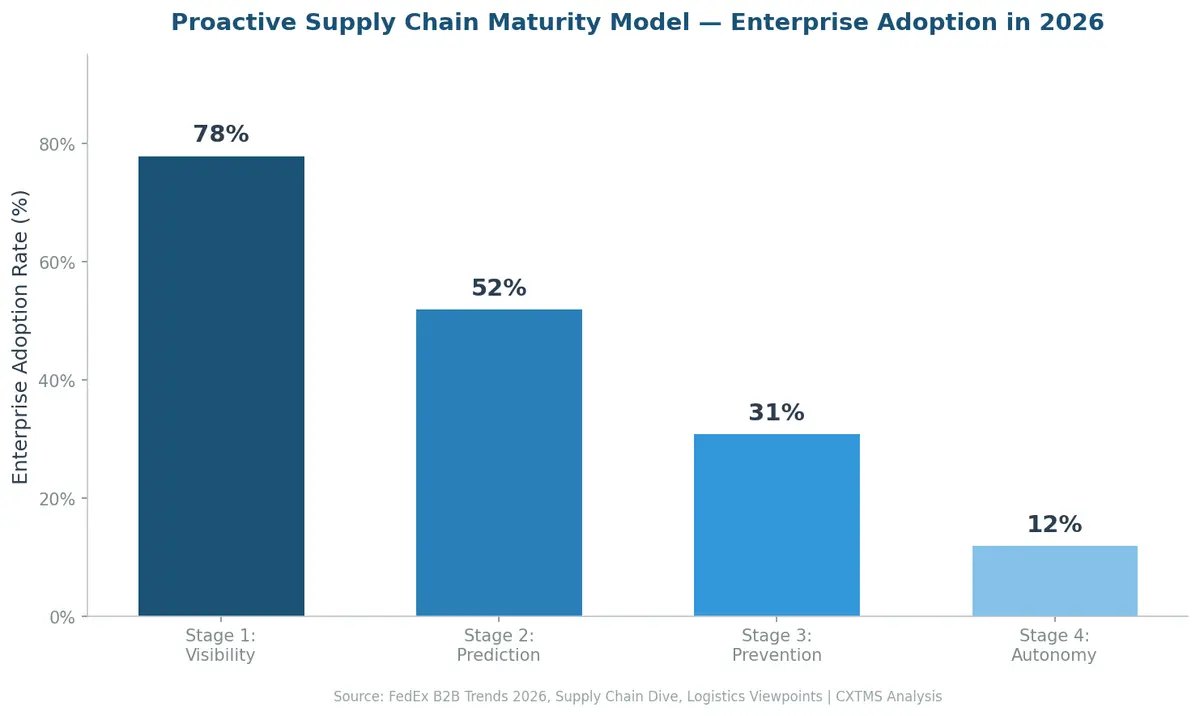
Most enterprises in 2026 are somewhere between stages two and three. The leaders — companies like American Eagle, Coca-Cola, and US Cold Storage — are already operating at stage four for specific workflows.
B2B Expectations Now Mirror B2C
The proactive supply chain shift is also being driven by changing B2B buyer behavior. FedEx's research found that 75% of B2B buyers would switch suppliers for a better experience. Business customers now expect the same real-time tracking, transparent delivery timelines, and digital self-service options they get as consumers.
This means supply chain performance has become a direct driver of customer retention. A shipment delay that goes undetected until the customer calls isn't just an operational failure — it's a customer experience failure that threatens the relationship. Proactive disruption detection and automated customer notification have become table stakes for B2B logistics providers.
AI Adoption Is No Longer Optional
Perhaps the most striking data point from FedEx's 2026 trends report is this: eight in ten small business owners now credit AI and technology with helping them navigate inflation, supply chain challenges, and access to capital. AI adoption has moved from experimental to essential across businesses of all sizes.
For logistics operations specifically, this means AI-powered demand forecasting, automated carrier selection, predictive maintenance, and intelligent exception management are baseline capabilities — not differentiators. Companies that haven't embedded AI into their logistics workflows aren't just missing opportunities. They're falling behind competitors who can detect disruptions earlier, respond faster, and serve customers more reliably.
Building a Proactive Logistics Strategy
Transitioning from reactive to proactive logistics requires three foundational investments:
Connected infrastructure. IoT sensors across your supply chain — on assets, in warehouses, on vehicles — create the data foundation that makes proactive detection possible. Without real-time data, AI has nothing to work with.
Integrated analytics. Raw sensor data is noise. AI and machine learning transform that data into actionable intelligence — predicting delays, identifying patterns, and flagging anomalies before they become crises.
Automated response. The final step is closing the loop. When the system detects a potential disruption, it should be able to trigger corrective actions automatically — rerouting shipments, adjusting schedules, notifying stakeholders, and updating downstream systems.
The Bottom Line
The 60% early detection statistic isn't just a number. It represents a paradigm shift in how supply chains create and protect value. Companies that embrace proactive logistics will spend less time fighting fires and more time optimizing performance. Those that don't will keep wondering why their competitors seem to always be one step ahead.
The shift from reactive to proactive isn't coming. It's here.
Ready to build a proactive supply chain? Contact CXTMS for a demo and see how integrated IoT monitoring, AI-powered analytics, and automated workflows can transform your logistics operations.