FMCSA's New Broker Financial Responsibility Rules: What January 2026 Changes Mean for Freight Brokers and Shippers


The era of lax enforcement is over. On January 16, 2026, FMCSA's updated broker and freight forwarder financial responsibility rules went into full effect — and they're already reshaping the freight brokerage landscape. For an industry still recovering from a prolonged rate trough, these changes couldn't have come at a more consequential time.
What Changed on January 16, 2026
The updated financial responsibility rules — originally finalized in late 2023 and delayed a year due to registration system issues — close loopholes that allowed some brokers to operate with depleted or questionable financial security for years.
The core changes are straightforward but far-reaching:
- Immediate suspension trigger: If a broker's available bond or trust fund dips below the $75,000 minimum, they have just seven business days to replenish it before operating authority is automatically suspended.
- Real-time notification: Surety providers and trustees must now electronically notify FMCSA of any drawdowns or signs of insolvency — practically in real time.
- Penalties with teeth: Each violation carries a monetary penalty of $12,882, plus potential three-year suspension from having financial responsibility instruments filed.
- BMC-85 trust fund overhaul: Trust funds must now consist solely of cash or cash-equivalent assets liquidatable within seven days, and only federally regulated financial institutions can serve as trustees.
That last point is particularly disruptive. According to industry analysis, up to 90% of existing BMC-85 trustees may no longer qualify under the new requirements, forcing thousands of brokers to find new providers or switch to costlier BMC-84 surety bonds.
The Financial Impact on Brokers
The numbers tell the story of how these rules hit broker bottom lines:
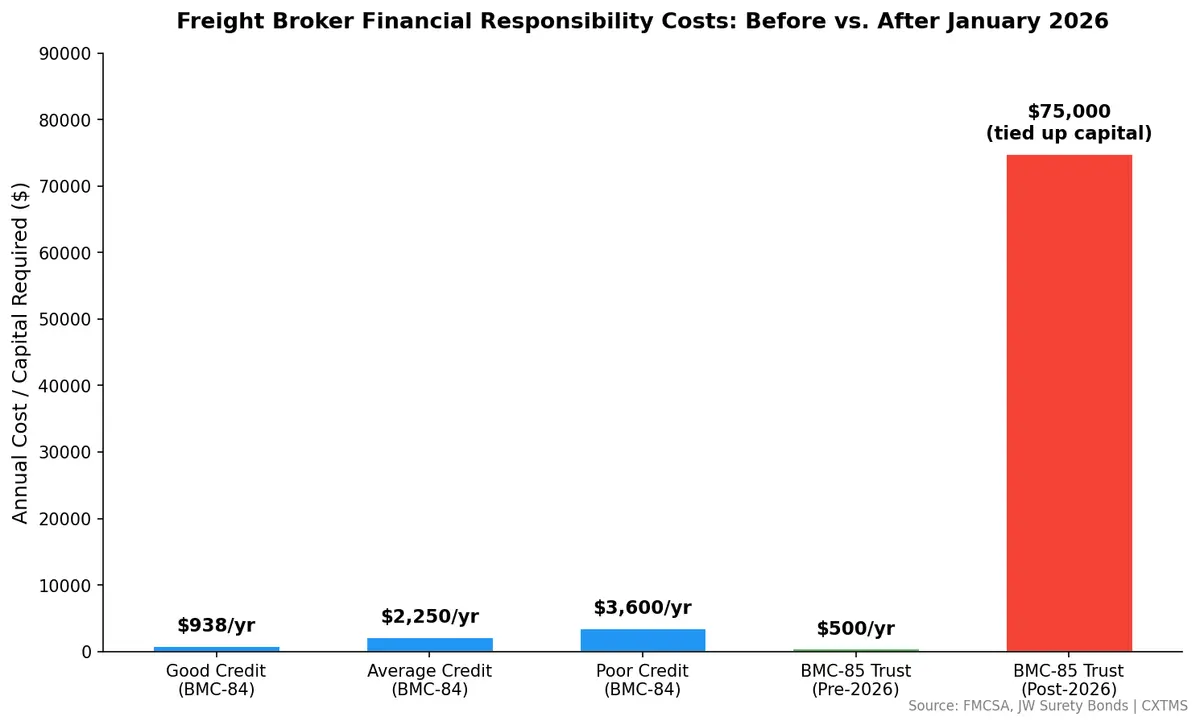
Surety bond costs for a standard BMC-84 $75,000 bond start at approximately $938 per year for brokers with strong credit. But for brokers with credit challenges or claims history, annual premiums can reach $3,000 to $3,600 — and that's before the new enforcement environment potentially drives premiums higher as surety providers reassess their risk exposure.
For the BMC-85 trust fund route, brokers previously enjoyed lower costs through creative asset arrangements with non-bank trustees. That door is now closed. Brokers using trust funds must deposit the full $75,000 in cash equivalents with a federally regulated institution, tying up working capital that many small and mid-market brokers simply don't have.
The timing is brutal. The freight market spent much of 2024 and 2025 in a protracted trough, with contract rates from shippers remaining stubbornly low while spot rates paid to carriers have begun climbing. Many brokers entered this period with contract books locked at rates that no longer cover escalating spot payouts. Gross margins at some publicly traded brokerages have fallen to the low-to-mid teens — down sharply from healthier levels in prior cycles.
Why Shippers Should Pay Attention
If you're a shipper, you might think broker compliance is someone else's problem. It's not. Here's why these changes directly affect your supply chain:
Routing guide disruption. As non-compliant brokers lose operating authority, shippers relying on those intermediaries will face sudden gaps in their routing guides. The seven-day suspension timeline means a broker you used last week could be shut down next week.
Market consolidation. Industry observers expect thousands of intermediaries to exit the brokerage space in 2026 as compliance costs combine with margin compression. Larger, better-capitalized 3PLs will absorb market share, but the transition period will create transactional friction and potentially higher costs as competition thins.
Due diligence is no longer optional. Shippers must actively verify that their broker partners maintain compliant financial responsibility status. A single shipment arranged through a suspended broker leaves the shipper exposed if cargo is damaged, lost, or a carrier goes unpaid.
How to Verify Broker Financial Compliance
FMCSA provides tools for shippers to check broker status, but manual verification across dozens of broker relationships is time-consuming and error-prone. Here's a practical compliance verification framework:
- Check FMCSA's SAFER system for each broker's operating authority status and financial responsibility filings.
- Request proof of current BMC-84 or BMC-85 filing directly from brokers — not just certificates of insurance, but evidence of the surety bond or trust fund specifically.
- Monitor for lapses. Under the new rules, suspension can happen within days. Quarterly checks are no longer sufficient; monthly or real-time monitoring is the new standard.
- Ask about contingent cargo liability coverage. Beyond the $75,000 bond, responsible brokers carry contingent liability policies typically ranging from $100,000 to $1 million.
- Diversify your broker panel. Don't over-concentrate volume with any single intermediary, especially smaller operators who may be most vulnerable to the new requirements.
The Technology Angle: Automated Compliance Monitoring
Modern TMS platforms are rapidly adding broker compliance verification as a core feature. The most effective systems provide:
- Automated FMCSA authority checks before load tender, flagging brokers with pending or suspended status
- Real-time alerts when a broker's financial responsibility filing changes
- Centralized broker scorecards combining compliance status, claims history, and performance metrics
- Integration with surety databases to verify bond amounts and expiration dates without manual lookups
This level of automated oversight transforms broker vetting from a periodic administrative task into a continuous, real-time compliance layer embedded in every transaction.
What Comes Next
The January 2026 enforcement date has passed, but the market impact is still unfolding. Expect broker failures to accelerate through Q1 and Q2 as non-compliant operators lose authority and overleveraged brokers breach their covenants. For shippers, the message is clear: know your brokers, verify their compliance, and have contingency plans ready.
The brokers who thrive in this new environment will be those with strong balance sheets, transparent financial practices, and technology platforms that make compliance verification seamless for their shipper customers.
Need automated broker compliance monitoring built into your TMS? Contact CXTMS for a demo of our broker management and financial responsibility verification tools.